UCA Denounces Newsweek Smear of Chinese-American Community

UCA Denounces Newsweek Smear of Chinese-American Community as Tool of Beijing

United Chinese Americans (UCA), a national coalition of Chinese-American organizations, denounces in the strongest possible terms the October 26 Newsweek cover story that accuses more than 600 Chinese-American organizations of being “linked to [the] Chinese Communist Party influence effort” abroad and that suggests that they are agents of “Xi’s secret plan to subvert America” and constitute “600 reasons to worry about China.”

美国华人联合会(UCA)强烈谴责10月26日《新闻周刊》的封面文章,该文诬陷600多个美国华人组织“与中共在海外施加影响力的努力有关联”,暗示这些组织是中共“颠覆美国的秘密计划”的代理人,因此成为美国“担心中国的600个理由”。

In an article long on innuendo and prejudice but short on facts, Newsweek has gone beyond even the sensational language of cold warriors determined to further undermine already worsening U.S.-China relations. It has ignored the important and crucial difference between Chinese citizens and Americans of Chinese descent and lumped all together as agents of the Chinese Communist Party’s “United Front,” an entity charged with advancing the Party’s interests at home and abroad. It alleges the existence of hundreds of such organizations, but names only a handful of them.

《新闻周刊》的这篇文章充满影射和偏见,但缺乏事实依据,所使用的措辞耸人听闻,比那些一心想恶化中美关系的冷战分子还要过分。文章对中国公民与华裔美国人之间至关重要的区别视而不见,把华裔统统视作中共“统一战线”的、维护其政党在海内外利益的代理人。《新闻周刊》的文章声称存在数百个这样的组织,但仅仅列出了几个组织的名称。

We haven’t seen such a wholesale, indiscriminate smear of an ethnic minority community since the McCarthy days of the 1950s.

Even those named are tarred with the flimsiest of evidence. It is wrongheaded to lump reputable groups like the Committee of 100, a civic association of prominent Chinese-Americans in business, government, academia and the arts that has served our community since 1988, or the China Institute, founded in 1926 to advance a deeper understanding of China through programs in education, culture, art, and business, with campus associations or other groups in which participants are mostly Chinese citizens.

即便对这几个指名道姓的组织而言,文章也是十分缺乏证据的。比如,对于信誉良好的“百人会”的指责就十分错误。“百人会“(Committee of 100)是由商界、政界、学术界和艺术界的华裔美国人杰出人士组成的民间协会,自1988年以来一直为社区服务;而早在1926年就成立的“华美协进社”(China Institute)旨在通过教育、文化、艺术和商业的渠道加深对中国的了解。该文章将这些卓有成效的组织 与以中国公民为主的校园协会或其它团体混为一谈。

Many Chinese American civic organizations have established and maintain relationships with mainland Chinese organizations, which naturally include branches of the Chinese government at various levels as well as individuals like Chinese diplomats posted in the United States. Such relationships and activities, which include heritage- or education-related, cultural and scientific exchange programs as well as business relationships, are generally innocent, social or professional in nature. There is nothing wrong, nor should there be anything suspect, about organizations working to promote closer ties and understanding between China and the United States. This is worlds apart from acting as agents of the Chinese government, and suggesting otherwise, and assuming guilt by association on such a community-wide scale, is reckless and unjustified.

许多华裔美国民间组织都与中国大陆组织建立并保持着联系,这些中国大陆组织自然包括了中国各级政府的分支机构,以及派驻美国的中国外交人员。这种关系和活动,涉及到文化遗产、教育、科学的交流项目,以及商业往来,通常都是单纯的社会或专业活动性质。这些组织致力于促进中美之间的紧密联系,以及彼此的相互了解,这并没有错,也不应该遭受无端猜疑,与充当中国政府的代理人有天囊之别。仅仅因为组织间的自然交往和联系就一股脑子地给整个华人社区定罪,这既鲁莽又不公。

It should surprise no one that there may be individuals or groups that have veered outside of established norms and conducted inappropriate or even illegal activities. As American citizens we denounce such activities, and in such cases we trust our legal system to prosecute the perpetrators according to appropriate laws. But the existence of a small number of lawbreakers is no excuse for Newsweek or any other publication to tar everyone of Chinese ancestry with the same brush. Indeed, it’s repugnant to our democratic values to cast a dark cloud of suspicion over an entire race or class of people for the actions of individuals. Our history has been stained too often by incidents of injustice inflicted upon minority groups that is motivated by deep-seated prejudice. 

可能有些个人或团体偏离了既定准则,从事了不当甚至是非法的活动,这并不令人惊讶。作为美国公民,我们谴责这类活动。对于这类情形,我们相信美国的法律制度会根据相关法律起诉违法者。但是,少数违法者的存在,不能成为《新闻周刊》或任何其它出版物讨伐每个具有华裔血统的人的借口。的确,因为某些个人行为而让整个族裔或群体被笼罩在怀疑的乌云下,与我们的民主价值格格不入;由根深蒂固的偏见而导致对少数族裔造成的不公对待,已经太经常地成为我们的历史的污点。

UCA demands that Newsweek withdraw the article and apologize to five million Americans of Chinese descent for its reckless allegations.

Newsweek has reached a new low. We haven’t seen such a wholesale, indiscriminate smear of an ethnic minority community since the McCarthy days of the 1950s,” asserted UCA President Haipei Shue. “Newsweek seems intent on painting our whole community as suspect and untrustworthy. This reminds me of the 1940s, when more than 120,000 members of the Japanese American community were forced into internment camps. We will not allow history to repeat itself.”

“《新闻周刊》如此做法,是创了新低。自五十年代麦卡锡主义以来,从未见过如此大规模地随意污抹少数族裔社区的情形”,UCA会长薛海培说,“《新闻周刊》似乎有意将我们的整个社区描绘成动机可疑、不可信任的群体。这使我想起了上个世纪四十年代,当时十二万日裔美国人被强迫送进拘留营。我们绝不允许历史重演。”

UCA demands that Newsweek withdraw the article and apologize to five million Americans of Chinese descent for its reckless allegations. We stand ready to meet with its editors for a full and frank discussion of the damage their publication has done to the image and reputation of our community. We call on Americans of all backgrounds to join us in denouncing this outrageous piece of sham journalism. 

UCA要求《新闻周刊》撤回此文,并向被其粗暴指控的五百万华裔美国人道歉。我们随时准备与其编辑们见面,就其出版物对我们社区的形象和声誉造成的损害进行全面而坦率的讨论。我们呼吁所有不同背景的美国人和我们一起谴责这一令人毛骨悚然的假新闻。

UCA WeChat Use Survey Report

Survey Gauges Impact of WeChat Ban on Chinese American Community

October 22, 2020 

United Chinese Americans (UCA) has just concluded a nationwide survey (click to see the form) among the Chinese American community regarding the impact of a potential WeChat ban by the Trump administration.

WeChat Survey Introduction 

About UCA 

Founded in September 2016 at the inaugural Chinese American Convention, UCA was formally incorporated and received IRS 501(c)(3) nonprofit status in 2017. UCA has since grown into a national federation with 12 chapters and over 30 community partners. 

Survey Purpose 

After the Trump Administration issued the Executive Order to ban WeChat on August 6, 2020, UCA conducted an online survey (see attached WeChat survey email) to measure the potential impact to the Chinese American community among its followers between October 14 to October 21. 

Sampling Method 

An on-line survey questionnaire was sent via email to 7447 UCA followers and promoted through UCA social media channels. Everyone is invited to respond to the survey within a 7-day window. Survey response is voluntary with anonymity. The invitation message also assures respondent privacy. (Link to survey invitation message) 

Wie Trustly laut CasinosSofort das Online-Casino-Banking verändert hat

Die Art und Weise, wie Spieler Einzahlungen und Auszahlungen in Online-Casinos abwickeln, hat sich in den vergangenen zwei Jahrzehnten grundlegend gewandelt. Während zu Beginn der 2000er Jahre noch Kreditkarten und Banküberweisungen dominierten, etablierte sich mit dem Aufstieg des Open-Banking-Prinzips eine neue Generation von Zahlungsdienstleistern, die den Prozess schneller, sicherer und transparenter gestalten sollten. Trustly gehört zu jenen Unternehmen, die diesen Wandel nicht nur begleitet, sondern aktiv mitgestaltet haben. Gegründet im Jahr 2008 in Stockholm, entwickelte sich der schwedische Zahlungsdienstleister zu einem der einflussreichsten Akteure im europäischen Online-Glücksspielmarkt – mit spürbaren Konsequenzen für Betreiber und Spieler gleichermaßen.

Von der klassischen Banküberweisung zum Echtzeit-Transfer: Die technische Grundlage von Trustly

Um zu verstehen, warum Trustly das Online-Casino-Banking so nachhaltig verändert hat, muss man zunächst die technischen Schwächen des traditionellen Zahlungsverkehrs betrachten. Klassische SEPA-Überweisungen benötigten in der Regel ein bis drei Werktage, bis Gelder tatsächlich verfügbar waren. Für Online-Casino-Spieler bedeutete das: Einzahlungen waren nicht sofort nutzbar, und Auszahlungen konnten sich über mehrere Tage hinziehen. Kreditkarten boten zwar schnellere Einzahlungen, brachten aber eigene Probleme mit sich – darunter hohe Gebühren, Rückbuchungsrisiken für Betreiber und zunehmende regulatorische Einschränkungen in mehreren europäischen Ländern.

Trustly löste dieses Problem, indem es direkt auf die Infrastruktur der Banken zugreift, ohne dass der Spieler eine zusätzliche Wallet anlegen oder Kartendaten hinterlegen muss. Das Prinzip funktioniert über eine sichere API-Verbindung zur jeweiligen Hausbank des Nutzers. Der Spieler wählt seine Bank aus, authentifiziert sich über das bekannte Online-Banking-Interface, und die Transaktion wird unmittelbar ausgelöst. Für den Betreiber bedeutet das eine garantierte, nicht rückbuchbare Zahlung – ein entscheidender Vorteil gegenüber Kreditkartenzahlungen, bei denen Chargebacks ein erhebliches Risiko darstellen.

Die technische Umsetzung basiert auf dem Open-Banking-Framework, das durch die europäische Zahlungsdiensterichtlinie PSD2 aus dem Jahr 2015 – in Kraft getreten 2018 – regulatorisch abgesichert wurde. PSD2 verpflichtete Banken dazu, Drittanbietern wie Trustly unter definierten Sicherheitsbedingungen Zugang zu Kontoinformationen und Zahlungsauslösediensten zu gewähren. Trustly hatte dieses Modell technisch bereits Jahre vor der regulatorischen Verpflichtung entwickelt, was dem Unternehmen einen erheblichen Wettbewerbsvorsprung verschaffte. Durch die Einführung von Pay N Play im Jahr 2018 ging Trustly noch einen Schritt weiter: Spieler konnten sich bei teilnehmenden Casinos registrieren und einzahlen, ohne ein Konto anlegen zu müssen – die Identitätsverifizierung erfolgte direkt über die Bankdaten.

Pay N Play und die Neugestaltung des Onboarding-Prozesses

Das Pay N Play-Konzept ist vielleicht der bedeutendste Einzelbeitrag, den Trustly zur Transformation des Online-Casino-Bankings geleistet hat. Traditionell mussten neue Spieler bei der Registrierung zahlreiche Formulare ausfüllen, Ausweisdokumente hochladen und auf eine manuelle Überprüfung warten, bevor sie spielen konnten. Dieser Prozess konnte in regulierten Märkten wie Deutschland, Schweden oder Finnland mehrere Stunden oder sogar Tage in Anspruch nehmen. Die Abbruchquoten während der Registrierung waren entsprechend hoch – Branchenschätzungen zufolge verlassen bis zu 70 Prozent der potenziellen Neukunden einen Registrierungsprozess, der länger als fünf Minuten dauert.

Pay N Play beseitigt diesen Engpass, indem es die Bankidentifikation als Grundlage für die KYC-Verifizierung (Know Your Customer) nutzt. Da Banken in der Europäischen Union bereits umfangreiche Identitätsprüfungen ihrer Kunden durchführen müssen, können diese verifizierten Daten – mit Zustimmung des Nutzers – an den Casino-Betreiber weitergegeben werden. Das Ergebnis: Registrierung, Verifizierung und erste Einzahlung lassen sich in einem einzigen Schritt innerhalb weniger Minuten abschließen. Für regulierte Märkte, in denen strenge AML- (Anti-Geldwäsche) und Verantwortungsstandards gelten, ist das ein erheblicher Fortschritt, weil die Identität des Spielers von Anfang an zweifelsfrei festgestellt ist.

Plattformen wie http://casinos-sofort.com dokumentieren, wie sich dieser Wandel auf das Angebot deutschsprachiger Online-Casinos ausgewirkt hat und welche Betreiber entsprechende Zahlungsmethoden inzwischen unterstützen. Die Verbreitung von Pay N Play war dabei nicht gleichmäßig: In Skandinavien, insbesondere in Finnland und Schweden, adaptierten Betreiber das Modell sehr schnell, während in Deutschland die regulatorische Fragmentierung durch den Glücksspielstaatsvertrag die Einführung verzögerte. Erst mit dem neuen Glücksspielstaatsvertrag 2021, der eine bundesweit einheitliche Lizenzierung einführte, schufen sich klarere Bedingungen für Anbieter, die moderne Zahlungsmethoden integrieren wollten.

Aus Sicht der Betreiber brachte Pay N Play nicht nur kürzere Onboarding-Zeiten, sondern auch eine messbar höhere Conversion-Rate. Casinos, die das System einführten, berichteten von einer Verdoppelung der abgeschlossenen Registrierungen im Vergleich zu traditionellen Formularprozessen. Gleichzeitig sank der Aufwand für manuelle Überprüfungen erheblich, da die Bankverifikation einen Großteil der Compliance-Arbeit automatisiert übernahm. Diese Effizienzgewinne schlugen sich in niedrigeren Betriebskosten nieder, die in einigen Fällen in Form von verbesserten Bonusbedingungen oder niedrigeren Einzahlungsmindestbeträgen an die Spieler weitergegeben wurden.

Regulatorische Entwicklungen und Trustlys Rolle im europäischen Glücksspielmarkt

Die Expansion von Trustly im Online-Glücksspielsektor verlief nicht ohne regulatorische Herausforderungen. In Großbritannien, einem der größten regulierten Glücksspielmärkte Europas, führte die UK Gambling Commission im April 2020 ein Verbot von Kreditkartenzahlungen für Glücksspiele ein. Diese Entscheidung, die auf Bedenken hinsichtlich der Verschuldung von Spielern zurückging, schuf unmittelbar einen größeren Markt für alternative Zahlungsmethoden wie Trustly. Innerhalb von zwölf Monaten nach dem Verbot verzeichnete Trustly nach eigenen Angaben einen Anstieg der Transaktionsvolumina im britischen Glücksspielmarkt um mehr als 40 Prozent.

In Deutschland stellte der Glücksspielstaatsvertrag 2021 eine Zäsur dar. Erstmals wurden Online-Casinospiele bundesweit legalisiert, allerdings unter strengen Auflagen: Einsatzlimits von einem Euro pro Spin, Einzahlungslimits von 1.000 Euro pro Monat und verpflichtende Spielersperrsysteme wie OASIS. Für Zahlungsdienstleister wie Trustly bedeutete das eine notwendige technische Anpassung: Die Integration in das OASIS-System musste sichergestellt werden, damit gesperrte Spieler keine Einzahlungen vornehmen konnten. Trustly reagierte auf diese Anforderungen mit angepassten API-Schnittstellen, die eine Echtzeit-Überprüfung gegen die Sperrdatei ermöglichen.

Parallel dazu entwickelte sich die regulatorische Landschaft in anderen europäischen Märkten weiter. In den Niederlanden trat im Oktober 2021 das Gesetz über Fernglücksspiele (KOA) in Kraft, das einen neuen lizenzierten Online-Markt schuf. Auch hier war Trustly frühzeitig präsent und konnte Partnerschaften mit lizenzierten Betreibern schließen. Die schwedische Regulierung durch die Spelinspektionen, die seit 2019 gilt, hatte Trustly bereits früher zur Anpassung seiner Dienste veranlasst – insbesondere hinsichtlich der Anforderungen an verantwortungsvolles Spielen und der verpflichtenden Spielzeitlimits, die direkt in den Zahlungsprozess integriert werden mussten.

Ein weiterer regulatorischer Aspekt betrifft die Datenschutzgrundverordnung (DSGVO), die seit Mai 2018 gilt. Da Trustly im Rahmen von Pay N Play Kontoinformationen der Nutzer verarbeitet, unterliegt das Unternehmen strengen Anforderungen an die Datenspeicherung, die Einwilligung und die Datenminimierung. Die schwedische Datenschutzbehörde Integritetsskyddsmyndigheten (IMY) hat in der Vergangenheit Untersuchungen zu Open-Banking-Diensten durchgeführt, was Trustly zur kontinuierlichen Überprüfung seiner Datenschutzpraktiken veranlasste. Diese regulatorische Aufmerksamkeit hat letztlich dazu beigetragen, das Vertrauen der Nutzer in den Dienst zu stärken, da Transparenz und Datenschutz als Kernmerkmale kommuniziert werden.

Auswirkungen auf Auszahlungsgeschwindigkeit, Sicherheit und das Spielererlebnis

Neben der Vereinfachung des Einzahlungsprozesses hat Trustly auch die Erwartungen der Spieler an Auszahlungsgeschwindigkeiten grundlegend verändert. Vor der Einführung moderner Open-Banking-Lösungen galten Auszahlungszeiten von drei bis fünf Werktagen als branchenüblich. Trustly ermöglicht in vielen Märkten Auszahlungen innerhalb von Minuten bis wenigen Stunden, sofern der Betreiber diese Funktion aktiviert hat und die empfangende Bank Echtzeitüberweisungen unterstützt. In Ländern, die am SEPA Instant Credit Transfer (SCT Inst) teilnehmen, sind Überweisungen bis zu einem Betrag von 100.000 Euro innerhalb von zehn Sekunden möglich.

Diese Beschleunigung hat die Erwartungshaltung der Spieler dauerhaft verändert. Betreiber, die weiterhin auf langsame Auszahlungsmethoden setzen, geraten zunehmend unter Wettbewerbsdruck. CasinosSofort und ähnliche Informationsplattformen haben diesen Trend aufgegriffen und bieten Spielern systematische Vergleiche der Auszahlungszeiten verschiedener Anbieter an, was den Druck auf Betreiber weiter erhöht, schnellere Optionen zu implementieren.

Aus Sicherheitsperspektive bietet das Trustly-Modell mehrere strukturelle Vorteile gegenüber traditionellen Zahlungsmethoden. Da der Spieler niemals Kreditkartennummern oder Bankdaten direkt an den Casino-Betreiber übermittelt, entfällt das Risiko, dass diese Daten bei einem Datenleck des Betreibers kompromittiert werden. Die Authentifizierung erfolgt ausschließlich über die gesicherte Infrastruktur der jeweiligen Bank, die in der Regel mehrstufige Sicherheitsverfahren wie TAN-Generatoren, biometrische Authentifizierung oder Push-Benachrichtigungen einsetzt. Für Betreiber wiederum eliminiert das Modell das Rückbuchungsrisiko nahezu vollständig, da Banküberweisungen im Gegensatz zu Kreditkartenzahlungen nicht einfach storniert werden können.

Ein weiterer Aspekt, der das Spielererlebnis beeinflusst hat, ist die Transparenz der Transaktionen. Da alle Zahlungen direkt über das Bankkonto des Spielers abgewickelt werden, erscheinen sie im normalen Kontoauszug und sind damit leichter nachvollziehbar. Dies hat auch Auswirkungen auf das verantwortungsvolle Spielen: Spieler können ihre Ausgaben direkt in ihrem Banking-Interface verfolgen, ohne eine separate Wallet-App oder einen Extrakt von einem Zahlungsdienstleister abrufen zu müssen. Einige Banken haben diesen Umstand genutzt und bieten ihren Kunden inzwischen integrierte Ausgabenanalysen an, die Glücksspielausgaben als eigene Kategorie ausweisen – eine Entwicklung, die indirekt durch die Transparenz des Open-Banking-Modells ermöglicht wurde.

Zusammenfassend lässt sich festhalten, dass Trustly das Online-Casino-Banking nicht durch eine einzige Innovation, sondern durch eine Kombination aus technischer Infrastruktur, regulatorischer Anpassungsfähigkeit und einem tiefen Verständnis der Bedürfnisse sowohl von Betreibern als auch von Spielern verändert hat. Die Beschleunigung von Transaktionen, die Vereinfachung des Registrierungsprozesses, die Erhöhung der Sicherheit und die Anpassung an unterschiedliche nationale Regulierungsrahmen haben gemeinsam dazu beigetragen, dass sich das Unternehmen als Referenzpunkt für modernes Casino-Banking in Europa etabliert hat. Für Betreiber und Spieler gleichermaßen hat diese Entwicklung die Messlatte für das gesetzt, was ein zeitgemäßes Zahlungserlebnis im Online-Glücksspiel bedeutet – und der Wettbewerb unter Zahlungsdienstleistern, der dadurch ausgelöst wurde, dürfte die Branche weiter vorantreiben.

Questionnaire Design 

I receive daily updates of my mother’s health status from her doctors in China when she underwent surgery.

User Y.

The questionnaire consists of questions. Most questions are close-end (Yes/No or Multiple choices) except two open-ended items related to personal reasons and specific example of using WeChat. (Link to survey questionnaire) Every effort was made to assure neutrality and avoid leading respondent one way or the other. 

Results 

Between October 14 and October 21, 2020, 45% of the 7447 UCA email recipients opened the email, 17% attempted the survey, 8.5% (625 people) completed survey. Of 625 respondents, 70% are U.S. Citizen, 23% are permanent resident, the remaining are international students, H1B/H4 holders or visitors. Of all respondents, 97% are identified as ethnic Chinese. 

For more details, please see the attachments: 

  • Attachments 1. Survey Summary 
  • Attachments 2. Why WeChat 
  • Attachments 3. Personal Stories 

Among the more than 600 individuals who participated in the survey, 97% are ethnic Chinese who are either citizens or permanent residents of the United States; 83% have lived in the United State for more than 10 years.

As an “all-in-one” social media platform combining messaging, video, phone, payment, and other features, WeChat has attracted a large following among the Chinese speaking population since its inception just 10 years ago. Among the survey participants, 90% have used it for at least 5 years. Among all the users, 92% use Chinese as the primary language, and 95% use WeChat on a daily basis. The most popular reasons to use WeChat are its ease of use for users of all ages, its Chinese language features, and the extensive communications between friends and family members already on the network in China and US.

The survey has revealed an interesting finding that 1 in 3 users learned about the COVID-19 through WeChat as early as December 2019 as it was emerging in Wuhan, China. 58% of them continue to reply on WeChat for infection prevention and treatment information on an ongoing basis.

The survey also included questions on sensitive issues such as censorship, propaganda, and national security. 8% of the users have experienced censorship enforced by the platform owner Tencent in China; 6% have received or consumed some Chinese government contents; but 93% don’t think their use threatens US national security.

I am an adoptive parent who is using WeChat to not only try and find my daughter’s Chinese birth parents, but also to help other Chinese adoptees spread their search information. We keep in touch with friends and volunteers via WeChat, and without it, we wouldn’t have been able to help reunite all of the families we have thus far.

User G.

If the WeChat ban is implemented, 82% of the users think they cannot find a reasonable alternative or replacement.

The survey also encouraged users to share their personal stories. Some of these stories are highlighted in this article.

For details of the survey and its results, please click on the following links.


All my family members (close to 100 people ) use WeChat Group feature to share our life.

User L.

Top reasons why people use WeChat:

· Availability and smooth usage in both US and China.

· Keep in touch with relatives and friends.

· Connection with business partners.

· Group chat capability.

· Convenient and important for everyday life.


Featurette: User Stories

“Before I had WeChat, it was so inconvenient to call my family and get information on timely manner. In December 2008 just several days before Christmas, my father was in a car accident and admitted into the hospital. My family attempted to call me but could not get through. They sent me email, but I was busy working and doing Christmas stuff, didn’t check emails for several days. By the time when I checked email and found out what had happened, my father already passed away. I didn’t have chance to go home to be at his side when he died. That was the one thing I could never make up for.

“Two weeks ago, my sister called me and told me that my mom felt and broke her hip. Initially I was trying to go home, but found out I couldn’t due to COVID and the tension between the two countries. Thanks to WeChat! I was able to consult the doctors in China, contacted my friends in China (they are all healthcare professionals), arranged her hospitalization and her surgery. Now she had her hip replaced and went back home walking again. I would not be able to do all these things without WeChat! With WeChat, I feel no distance with my family and friends in China. I video chat with my mom everyday when she was in the hospital, talked with the doctors via WeChat. I am so thankful we have WeChat! My mom is 86 this year. I don’t want to lose her without being at her side! WeChat means so much to me and my family!” — User-submitted personal experience.

There are countless stories like this, some are warm and sweet, some are heart-wrenching, while some others are inspiring. Please see the PDF link above.

Everyday I use WeChat to connect my parents in China, my father had kidney failure and do hemodialysis every other day, it is very hard for him, so I call to courage him and help to release his lots of pain.

Video chatting with my patents and grand mother during quarantine.

I call my parents, relatives and friends almost every day. All these calls are free. I love it so much.

[I use WeChat to] help a family in china to look for their missing son who studied in our area.

I did video-calls with elders in my family in China who are in their 70s and 80s . It is remarkable because they are not technology-savy by any stretch.

I found many of my old friends and classmates who I grew up with, attended elementary and high school together, through WeChat.

I introduced WeChat to my boss who went to China for a business trip he could keep close contact with his family while he was there, after that he introduced WeChat to our department head when he needed travel to China.

I organized Kenya trip using WeChat group with my friends in China and Kenya.

I use WeChat with my parents in China. They are old and WeChat is the only app they know how to use.


Breaking Silences in the Model Minority

Breaking Silences in the Model Minority

A national intervention to increase mental health awareness and decrease stigma in Asian immigrant families

For the past four years, UCA has worked with Chinese American community with thousands of community members. One of the most urgent issues expressed by parents and community members is youth mental health. This concern is validated by observed students experiences and behaviors.

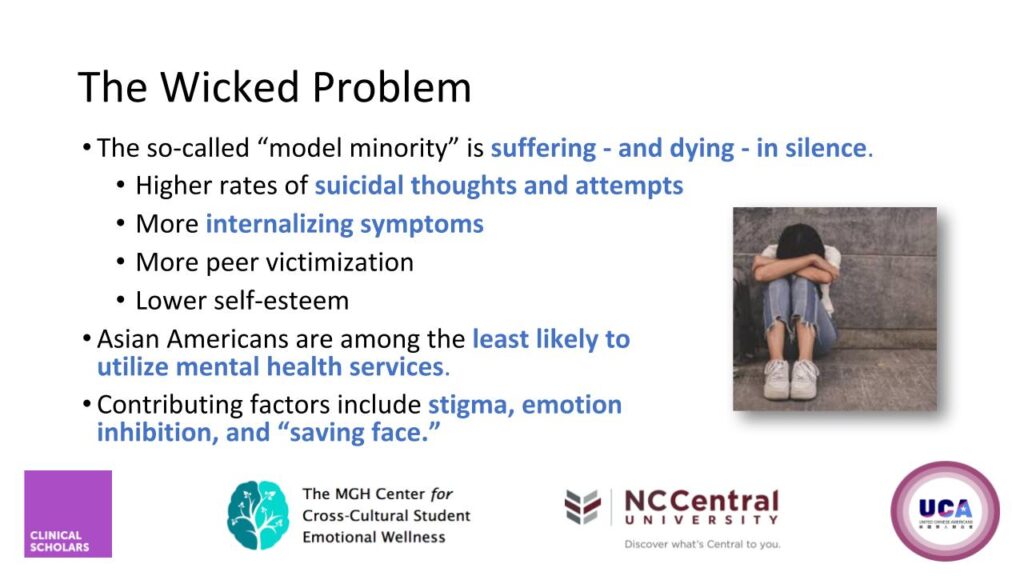
Due to cultural expectations, identity issues, low health literacy about mental health, stigma against mental health, and social isolation, Chinese/Asian American youth are suffering “silently” with mental illness and emotional stress. Insufficient support from families and their community, as well as lack of available Chinese speaking mental health professionals, further contributes to the problem According to the Centers for Disease Control (CDC) & Prevention (2016), in general, Asian Americans report fewer mental health concerns compared to White Americans

  • 18.9 percent of Asian American high school students report considering suicide, versus 15.5 percent of white high school students.
  • 10.8 percent of Asian American high school students report having attempted suicide, versus 6.2 percent of white high school students.
  • Asian American high school females are twice as likely (15 percent) to have attempted suicide than their male peers (7 percent)
  • Suicide death rates are 30 percent higher for 15-24 year old Asian American females than they are for white females (5.3 versus 4.0)

In order to meet the urgent needs of our community, United Chinese Americans (UCA), a national coalition of Chinese Americans dedicated to civic engagement, youth development, and heritage-sharing (www.ucsusa.org), has worked with its chapters to address mental health issues facing the community. UCA has taken a leap of faith to tackle this issue with very limited resources and funding, collaborating with its Illinois chapter (il.ucausa.org) and community partners to organize 12 youth mental conferences in Chicago (2), Minnesota (1), Wisconsin (2), Ohio (3), Nevada(1), San Francisco (1), and at the 2016 and 2018 Chinese American Conventions (2) in Washington, DC.

This past summer, UCA organized three very impactful mental health webinars, and co-organized the most recent one in September.


We also are building a Chinese American mental health network with other organizations and individuals including Massachusetts General Hospital’s (MGH) Center for Cross-Cultural Student Emotional Wellness, also affiliated with Harvard Medical School’s Department of Psychiatry; the Pacific, Education, Advocacy, Research, Learning (PEARL) Institute of New York, affiliated with New York University’s (NYU) Silver School of Social Work; National Alliance of Mental Illness NAMI North Carolina Chapter; and mental health discussion groups with on social media, including WeChat, an app-based platform popular among Chinese Americans. We also support many community organizations in their efforts to educate our community about youth mental health.

In November, 2019, UCA started to lead the process for the Clinical Scholar Leadership Development Program from Robert Woods Johnson Foundation RWJF. UCA is proud to announce that our Clinical Scholar team was chosen as one of the eight teams nationwide as the 2020 Clinical Scholar Cohort.

RWJF is the nation’s  largest healthcare  philanthropy with the commitment to continue working passionately toward improved health and health care for everyone in America. Clinical Scholars is a national leadership program for experienced health care providers advancing health equity supported by the Robert Wood Johnson Foundation.

OUR GUIDING PRINCIPLES:“The inspired vision of our founder, General Robert Wood Johnson II, was to improve health and healthcare in America, especially for those most in need. Energized by our legacy of taking on challenging issues, we are dedicated to building a Culture of Health that provides everyone in America a fair and just opportunity for health and well-being.

We take seriously our responsibilities, and we pledge to work in ways that reflect our values:

  • We seek bold and lasting change rooted in the best available evidence, analysis, and science, openly debated.
  • We treat everyone with fairness and respect.
  • We act as good stewards of private resources, using them to advance the public’s interest with a focus on helping the most vulnerable.
  • We cultivate diversity, inclusion, and collaboration.
  • We speak out as leaders for what we believe.

We are privileged to do this work. We are proud of our successes and accomplishments, and we believe our best achievements lie ahead.”

UCA MHI to Participate in RWJF Clinical Scholars Program

Click to Read news release

Short Project Summary

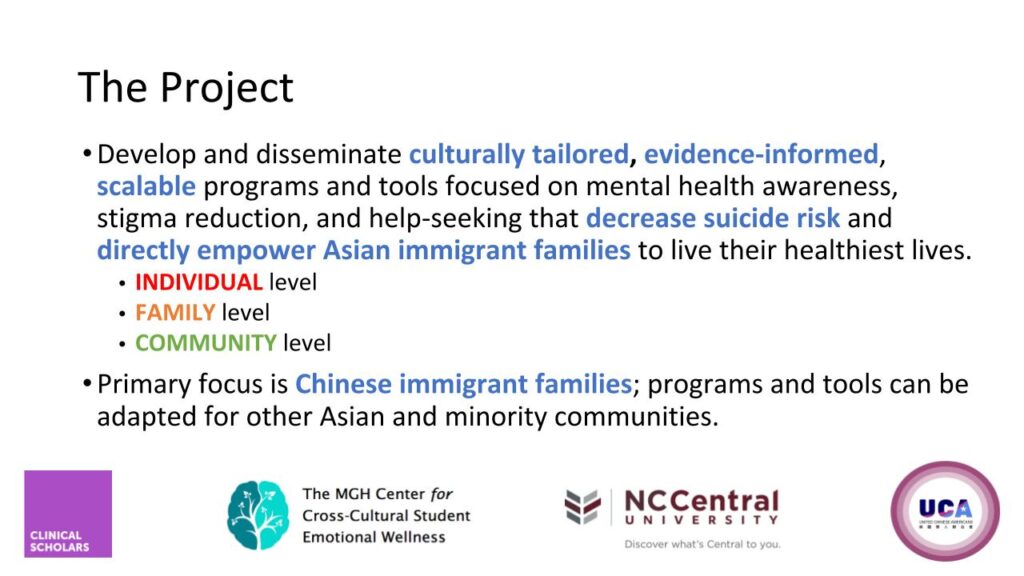
Our project, “A national intervention to increase mental health awareness and decrease stigma in Asian immigrant families” tackles the problem of mental health and suicide in Chinese immigrant families. Although Asian American youth are often stereotyped as a uniformly well-educated and successful “model minority,” they are at high risk of depression and suicide. Parents often want to help, but face barriers including communication and language challenges, lack of awareness, and stigma of mental health issues and treatment. Our team will develop and disseminate culturally tailored, evidence-informed, and scalable programs and tools focused on mental health awareness, stigma reduction, and help-seeking that decrease suicide risk and directly empower Asian immigrant families to live their healthiest lives. Strategies at the individual level will focus on stigmatization and education. Strategies at the family level will focus on improving parenting skills and practices, including parent-child communication. Community-level strategies will focus on building national networks and resources, including a national provider directory, in partnership with school districts and community organizations throughout the country. While the primary focus of the current project is Chinese immigrant families, we anticipate that the programs, tools, and models developed can be adapted for other Asian and minority communities.

Team Members

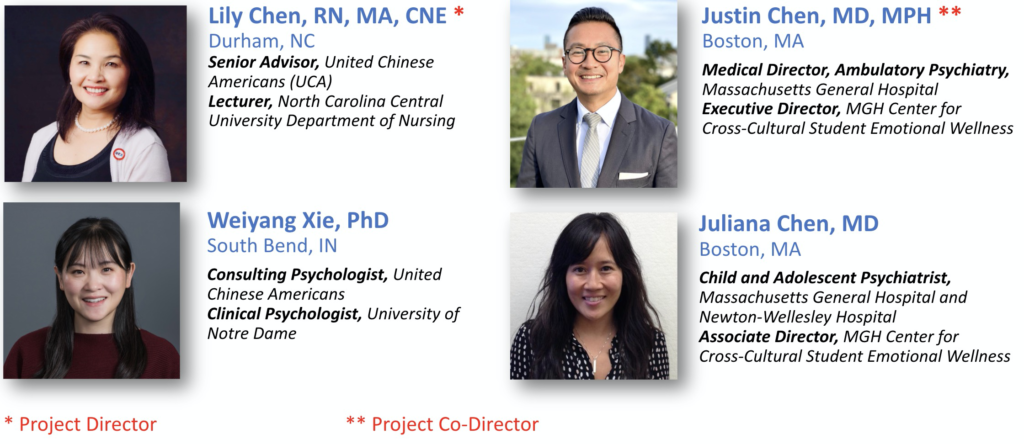
  • Lily Chen, Nurse, Project Director, United Chinese Americans UCA & North Carolina Central University 
  • Weiyang Xie, Psychologist, United Chinese Americans UCA & University of Notre Dame 
  • Justin Chen, Physician, Project co-director, Massachusetts General Hospital  
  • Juliana Chen, Physician, Massachusetts General Hospital 

More information on the foundation websites https://clinicalscholarsnli.org/

Contact Person Information

Name: (Lily) Jian Chen, RN, MA, CNE
Title: Senior Advisor
Organization: United Chinese Americans (UCA)
Email: lily.chen@ucausa.org

UCA wins the Prestigious Robert Wood Johnson Foundation Grant

Press Release:

UCA wins the Prestigious Robert Wood Johnson Foundation Grant

A National Intervention is Needed to Increase Youth Mental Health Awareness and Tackle Mental Health Stigma in Asian Immigrant Families

Contact: Lily Chen (lily.chen@ucausa.org)

Washington, DC (October 5, 2020) – UCA is proud to announce members of its Youth Mental Health Initiative have been selected to participate in the 2020-2023 cohort of Clinical Scholar Fellows, part of the Robert Wood Johnson Foundation Leadership Program. As a team, the Fellows will tackle youth suicide among Chinese American immigrant families by developing culturally-tailored and evidence-informed programs and tools to increase mental health awareness, reduce stigma, and to empower Asian immigrant families to live their healthiest lives.

“The need to address Asian American mental health conditions, especially those affecting our youths, is widely known and long overdue and I am so pleased the Robert Wood Johnson Foundation has taken a major step to help our community,” said Haipei Shue, President of UCA. “Immigrant communities face hardships adjusting to a new language, new culture, lack of social and professional access, as well as the resulting mental stress. Thank you, Robert Wood Johnson Foundation Clinical Scholars Program, on behalf of our community!”

“UCA has accepted the challenge and responsibility to destigmatize and highlight an issue that impacts children and families who are Asian American immigrants,” noted Dr. John K. Holton, Board member of UCA Illinois Chapter and Director of Strategic Initiatives at the Jane Addams College of Social Work, University of Illinois at Chicago. “Helping young people’s mental health concerns is important to every community. The programs and toolkits to be developed by the Clinical Scholars team working with UCA will be important not only to Asian Americans, but also to every racial group. This is a national and international issue.”

Suicide is the leading cause of death among Asian American youths, and experts have been alarmed by the rising suicide rates. Cultural stigma and lack of understanding about mental health in Asian families and the community often prevent adolescents from seeking help, as Asian Americans are among the least likely to utilize mental health services. Furthermore, the COVID-19 pandemic has compounded strain on youth mental health due to social isolation and, in the case of Asia-immigrant families, an increase in racially motivated bullying and crimes. 

The Robert Wood Johnson Foundation Clinical Scholars Program is a highly competitive program aimed to develop effective health care leaders to enable everyone in America to live longer, healthier lives. Fellows will collaborate on a three-year community project aimed to address the root causes of inequality in health.

The UCA team project, aptly titled Breaking Silences in the “Model Minority”: A National Intervention to Increase Mental Health Awareness and Decrease Stigma in Asian Immigrant Families, will be led by Lily Chen, UCA Senior Advisor and Lecturer at the Department of Nursing, North Carolina Central University, and co-led by Justin Chen, Medical Director of the Ambulatory Psychiatry Services at the Massachusetts General Hospital (MGH). Team members include Weiyang Xie, Clinical Psychologist at the University of Notre Dame, and Juliana Chen, Child and Adolescent Psychiatrist at MGH and Newton-Wellesley Hospital. Partnering organizations include North Carolina Central University as well as the MGH Center for Cross-Cultural Student Emotional Wellness.

UCA is committed to educating the Chinese American community about youth suicide prevention and overcoming a reluctance to seek help. UCA has organized a series of webinars and forums to address mental health needs that can be viewed on the UCA YouTube page HERE.


About the Clinical Scholars Program

Clinical Scholars is a national leadership program supported by the Robert Wood Johnson Foundation. It invests in innovative health care professionals who are passionate about collaborating across disciplines to tackle complex health problems in their communities.

Website: https://clinical-scholars.org/

About UCA

Founded in 2016, UCA is dedicated to enriching and empowering Chinese American communities through civic participation, political engagement, and youth education. Its various programs aim to develop and preserve heritage and culture and to promote a better understanding between the United States and China for the well-being of our community, our country, and our world.

1050 Connecticut Ave. NW, Suite 500, Washington, DC 20036

Website: https://ucausa.org/

Twitter: https://twitter.com/ucasocial

The opinions expressed here are the author’s own and do not represent the opinions of the program or the Robert Wood Johnson Foundation.

Webinar Series: The “China Initiative”

Inaugural Webinar: The Human and Scientific Costs of the China Initiative

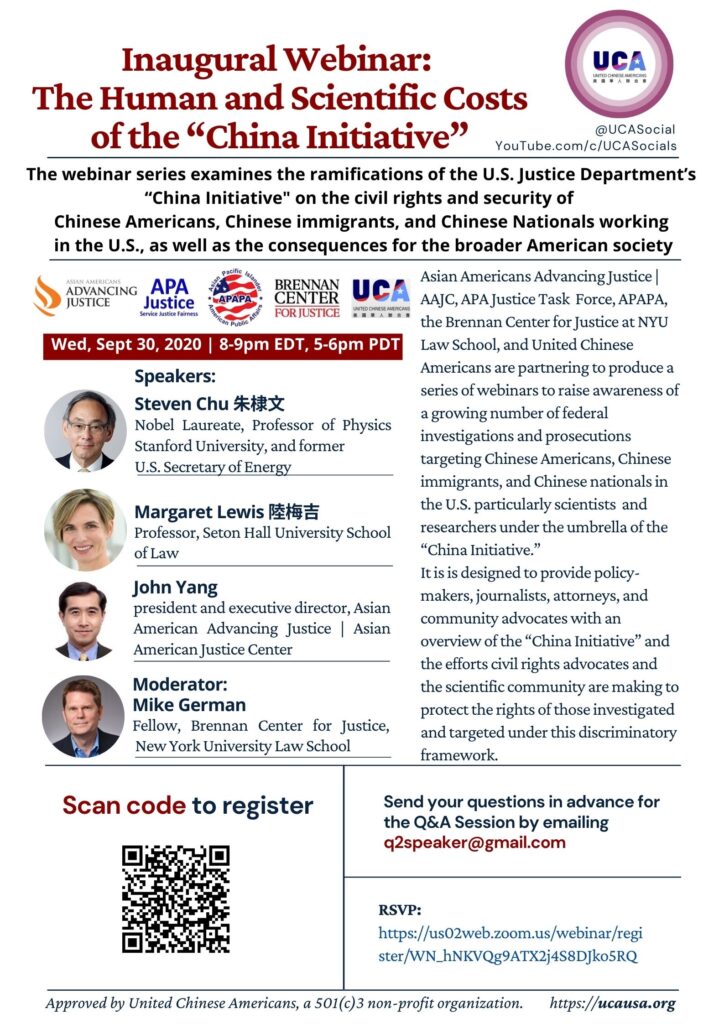
The webinar series examines the ramifications of the U.S. Justice Department’s “China Initiative      on the civil rights and security of Chinese Americans, Chinese immigrants, and Chinese Nationals working in the U.S., as well as the consequences for the broader American society.

Webinar banner

Media Contacts

Asian Americans Advancing Justice | AAJC: Michelle Boykins, Mboykins@advancingjustice-aajc.org, 202-296-2300, ext. 0144

Brennan Center: Mireya Navarro, mireya.navarro@nyu.edu, 646-925-8760

APA Justice Task Force: Jeremy Wu, Jeremy.S.Wu@gmail.com 

Details:

Asian Americans Advancing Justice | AAJC, APA Justice Task Force, and the Brennan Center for Justice at NYU Law School are partnering to produce a series of webinars to raise awareness of a growing number of federal investigations and prosecutions targeting Chinese Americans, Chinese immigrants, and Chinese nationals in the U.S. particularly scientists and researchers under the umbrella of the “China Initiative.” 

The first webinar in the series, which is scheduled for September 30 at 8:00 pm EDT, is designed to provide policy-makers, journalists, attorneys, and community advocates with an overview of the “China Initiative” and the efforts civil rights advocates and the scientific community are making to protect the rights of those investigated and targeted under this discriminatory framework. 

The participating experts include Nobel laureate, former U.S. Secretary of Energy, and Stanford University professor of physics Steven Chu; Seton Hall University School of Law professor Margaret Lewis; and Asian Americans Advancing Justice | AAJC president and executive director John Yang. The discussion will be moderated by Michael German, fellow with the Brennan Center for Justice at NYU Law School.

Date/Time:   September 30, 8:00 pm EDT (virtual via Zoom)

RSVP: https://us02web.zoom.us/webinar/register/WN_hNKVQg9ATX2j4S8DJko5RQ      

Background:

From the Chinese Exclusion Act of 1882 through the Cold War, racist and xenophobic tropes painting Chinese and Asian Americans as “perpetual foreigners” and threats to public health and national security influenced U.S. government policy. Today is no different. Through rhetoric, rapidly changing policies, and targeted prosecutions, Chinese American scientists and researchers are again caught in a pattern of suspicion and racial discrimination that has harmed Chinese and other Asian communities in the United States for more than 150 years. While the PRC government unquestionably engages in malign behaviors within its borders and in the international arena, which the U.S. government properly condemns, the Trump administration’s rhetoric and actions blur the distinction between the PRC government and individuals of Chinese nationality or ancestry. As in the past, when potential threats arise from abroad, the U.S. national security establishment too often responds by treating entire classes of people defined by their race, ethnicity, religion, or national origin as suspect communities.

As U.S.-PRC tensions have grown over recent years, we have seen increasingly aggressive and misguided investigations of Chinese American scientists resulting in sensationalized charges that allege an intended subversion of U.S. interests. While the Justice Department’s abandonment of several  of these prosecutions before trial has meant falsely accused scientists experience fewer financial and emotional costs than they would from a full trial, it also deprives them of a public exoneration and an exposure of the racist assumptions underlying these investigations. 

Rather than recognize the biases that drove these failed national security investigations, the Justice Department in 2018 initiated an even more assertive strategy, announcing a department-wide “China Initiative.” The Justice Department says its goal is to prioritize trade theft cases that benefit the PRC, but its rhetoric has often conflated the actions of individuals into a global conspiracy. Its prosecutions have further sought to amplify administrative oversights into federal crimes of fraud and false statements. Moreover, despite the China Initiative’s alleged goal of combating economic espionage, the DOJ’s own report on the China Initiative shows that many of the actual charges are not intellectual property theft or economic espionage. Instead, many of the charges are for minor or unrelated offenses including wire fraud, filing false tax returns, and even matters that had previously been handled administratively such as alleged inaccuracies in university conflicts of interest forms. 

When the 2019 novel coronavirus outbreak in Wuhan, China, spread into a global pandemic, it opened another vector for the current administration to fuel anti-Chinese bias. High government officials repeatedly called COVID-19 the “China Virus,” as anti-Asian hate crimes spiked across the U.S. Once again, spurious public health and national security fears are driving anti-Asian discrimination.

The webinars will include speakers from Chinese American and Asian American advocacy organizations, civil rights groups, academia, as well as experts from scientific and legal communities. The speakers will explore the burden this pattern of investigations inflicts on targeted individuals and communities as well as consequences for the broader American society. 

Panelist Bios:

Steven Chu 

Steven Chu is professor of Physics, Molecular and Cellular Physiology at Stanford University. He has published in atomic physics, single-molecule polymer and biophysics, ultrasound imaging, nanoparticle synthesis and electrochemistry.  Former positions include Secretary of Energy, director of the Lawrence Berkeley National Laboratory, and Department Head at Bell Laboratories. Chu was awarded the 1997 Nobel Prize in Physics for laser cooling and trapping of atoms. He is a member of the National Academy of Sciences, 8 foreign Academies and has 32 honorary degrees. He has undergraduate degrees in mathematics and physics from the University of Rochester and a Ph.D. in physics from the University of California at Berkeley.

Margaret K. Lewis

Maggie Lewis is a Professor of Law at Seton Hall University. She has been a Fulbright Senior Scholar at National Taiwan University, a Public Intellectuals Program Fellow with the National Committee on United States-China Relations, and a delegate to the US-Japan Foundation’s US-Japan Leadership Program. Professor Lewis is a member of the Council on Foreign Relations and a Non-Resident Affiliated Scholar of NYU School of Law’s U.S.-Asia Law Institute. She is spending the 2020-21 academic year in Taiwan as a visiting scholar at the Judge’s Academy and a visiting professor at Academia Sinica.

John Yang

John C. Yang is the president and executive director of Asian Americans Advancing Justice | AAJC in Washington, D.C., where he leads the organization’s mission to advance the civil and human rights of Asian Americans and to build and promote a fair and equitable society for all through policy advocacy, education, and litigation. He has served in leadership positions for the American Bar Association, the National Asian Pacific American Bar Association, and the National Council of Asian Pacific Americans, among many others. Prior to Advancing Justice | AAJC, John had served as a political appointee in the Obama Administration, the Asia-Pacific Legal Director of a Fortune 200 company, and as a partner at a large D.C.-based law firm. He also serves on the diversity council for several Fortune 500 U.S. companies.     

Moderator: Michael German

Michael German is a fellow with the Brennan Center for Justice Liberty and National Security Program, where his work focuses on intelligence and law enforcement oversight and reform. Mr. German previously served as an FBI special agent for 16 years, specializing in domestic terrorism and covert operations, and as national security policy counsel at the American Civil Liberties Union. He is the author of two books, Disrupt, Discredit, and Divide: How the New FBI Damages Democracy, published in 2019, and, Thinking Like a Terrorist: Insights of a Former FBI Undercover Agent, published in 2007.

Resources:

Margaret Lewis, “Criminalizing China,” Journal of Criminal Law and Criminology, Vol. 111, No. 1, 2020, Seton Hall Public Law Research Paper (Forthcoming).

Michael German, “Disrupt, Discredit, and Divide: How the New FBI Damages Democracy,” The New Press, (2019).

Asian Americans Advancing Justice | AAJC and Advancing Justice | ALC filed an amicus brief in United States v. Tao, providing significant evidence of racial profiling against Asian American and immigrant scientists and researchers.

Asian Americans Advancing Justice | AAJC advocates for an America in which all Americans can benefit equally from, and contribute to, the American dream. Our mission is to advance the civil and human rights for Asian Americans and to build and promote a fair and equitable society for all. Advancing Justice | AAJC is a national 501 (c)(3) nonprofit founded in 1991 in Washington, D.C.       

APA Justice Task Force is a non-partisan platform to build a sustainable ecosystem to address racial profiling issues and to facilitate, inform, and advocate on selected issues related to justice and fairness for the Asian American community. 

The Brennan Center for Justice at NYU School of Law is a nonpartisan law and policy institute that works to reform, revitalize – and when necessary, defend – our country’s systems of democracy and justice.

UCA Townhall Webinar on WeChat Ban

UCA Townhall: A Webinar Series

Inform, Dialogue and Engage: Key Topics Facing the Chinese American Community

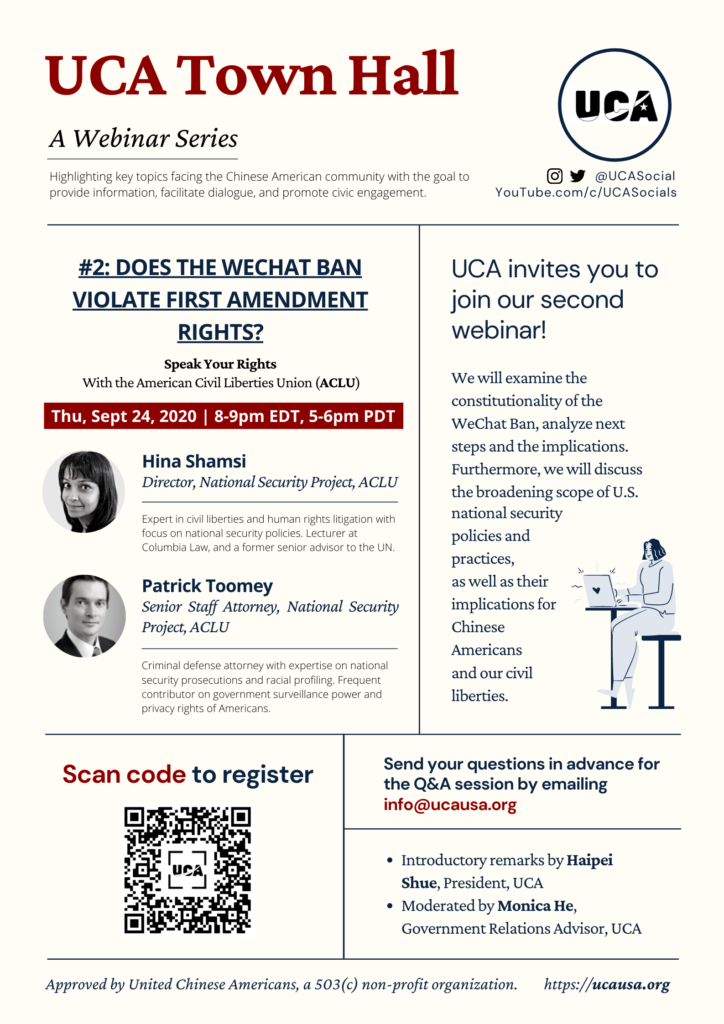
Online Webinar 2 – Does the WeChat Ban Violate First Amendment Rights? SPEAK YOUR RIGHTS – with the American Civil Liberties Union (ACLU)

September 24, 2020, Thursday
8:00pm – 9:00pm EDT | 5:00pm – 6:00pm PDT

Dear Friends,

UCA is pleased to invite you to join us for the second session of our webinar series: “UCA Town Hall.” The webinar, to be held on Thursday, September 24, starting at 8PM EDT, will examine the latest developments regarding the Trump Administration’s actions to restrict access to WeChat in the United States. Our panelists from the ACLU will examine the constitutionality of the Trump Administration’s decision and, furthermore, discuss the broadening scope of U.S. national security policies and practices as well as their implications for Chinese Americans and civil liberties.

For 100 years, the ACLU <https://www.aclu.org/> has defended individual rights and civil liberties as guaranteed by the Constitution of the United States, from protecting immigrant rights to addressing racial injustice, and from securing voting rights to ensuring the freedom of speech. The ACLU currently represents Professor Xi Xiaoxing <https://www.aclu.org/cases/xi-v-haugen-challenge-warrantless-surveillance>, a Chinese American scientist at Temple University, in a civil rights lawsuit challenging the FBI’s baseless prosecution of Professor Xi and its discriminatory targeting of Chinese American scientists like Professor Xi. These concerns have only grown since the Justice Department launched its so-called “China Initiative,” impacting many others.

UCA Town Hall is a webinar series highlighting key topics facing the Chinese American community with the goal to provide information, facilitate dialogue, and promote civic engagement.

This online event will be free via Zoom and will also be broadcast live on Youtube.

REGISTER FOR THE September 24 Event HERE:

https://us02web.zoom.us/meeting/register/tZUkdO-sqjwiEtPWm-XApLs2dImHjXb-zizd

You can submit your questions to the panelists in advance during Registration or by emailing: info@usausa.org

Can’t find your registration link or joining last minute?

Watch the UCA Townhall via the UCA Youtube Channel Live-Broadcast Link HERE:

https://www.youtube.com/c/UCASocials/featured

AGENDA – LISTED IN EDT TIME

8:00pm – 8:10pm  Welcome and Introductory Remarks Monica He, Government Relations Advisor, UCA Haipei Shue, President of UCA  
8:10pm – 8:20pm  Remarks by Hina Shamsi, Director of the ACLU National Security Project   Hina will discuss the Executive Order on WeChat, including the decision by U.S. Department of Commerce prohibiting particular transactions in the U.S. market, and examine whether the actions violate First Amendment rights.  
8:20pm – 8:30pm  Remarks by Patrick Toomey, ACLU National Security Project   Patrick will dive further into national security powers that are frequently invoked by the Trump Administration, and how the abuse of these powers can lead to racial discrimination and potential targeting of Americans of Chinese Heritage.  
8:30pm – 8:45pmPanel Discussion with Speakers Moderated by Monica He, UCA   Questions to be addressed include: How can the community better respond to the broadening scope of emergency powers and national security concerns, particularly when it results in actions that infringe on individual liberties?What is the ACLU’s role, and what should Chinese Americans and other ethnic minorities know about the ACLU, in terms of its mission and the services that it provides?  
8:45pm – 8:55pm  Moderated Q&A Session
8:55pm – 9:00pm  Closing Remarks  

Speakers

Image

Hina Shamsi
Director, National Security Project, ACLU
Twitter: @HinaShamsi

“This order violates the First Amendment rights of people in the United States by restricting their ability to communicate and conduct important transactions on the two social media platforms. The order also harms the privacy and security of millions of existing TikTok and WeChat users in the United States by blocking software updates, which can fix vulnerabilities and make the apps more secure. In implementing President Trump’s abuse of emergency powers, Secretary Ross is undermining our rights and our security. To truly address privacy concerns raised by social media platforms, Congress should enact comprehensive surveillance reform and strong consumer data privacy legislation.” – Hina Shamsi. ACLU Comment on TikTok and WeChat Transaction Prohibition. Sept 18, 2020.

https://www.aclu.org/press-releases/aclu-comment-tiktok-and-wechat-transaction-prohibition

Hina Shamsi is the director of the ACLU National Security Project. She engages in civil liberties and human rights litigation, research, and policy advocacy on issues including the freedoms of speech and association, torture, detention, and discrimination against racial and religious minorities. Her work has included a focus on the intersection of national security and counterterrorism policies and international human rights and humanitarian law. She is the author and coauthor of publications on torture, targeted killing, extraordinary rendition, and privacy and surveillance, and has monitored and reported on the military commissions at Guantánamo Bay. She is a lecturer-in-law at Columbia Law School, where she teaches a course on International Human Rights Advocacy. Hina previously worked as the acting director of Human Rights First’s Law & Security Program and then as a staff attorney in the ACLU’s National Security Project. Before returning to the ACLU in her current position, Hina served as senior advisor to the U.N. Special Rapporteur on Extrajudicial Executions. She is a graduate of Mount Holyoke College and Northwestern University School of Law.

Image

Patrick Toomey
Senior Staff Attorney, National Security Project, ACLU
Twitter: @PatrickCToomey

Patrick Toomey is a staff attorney at the ACLU National Security Project, where he works on issues related to electronic surveillance, national security prosecutions, whistle-blowing, and racial profiling. Patrick is a graduate of Harvard College and Yale Law School. After graduating from law school, he served as a law clerk to the Hon. Nancy Gertner, United States district judge for the District of Massachusetts, and to the Hon. Barrington D. Parker, United States circuit judge for the Second Circuit Court of Appeals. Prior to joining the ACLU, Patrick worked on criminal defense, regulatory defense, and intellectual property matters at a law firm in New York.

Stay tuned for announcements on the exciting line-up of the UCA Townhall Webinar Series.

Happy Birthday, UCA!

Happy Birthday, UCA!

Dear UCA Family and Friends,

Happy Birthday, UCA! 

Four years ago, about 400 Chinese Americans gathered in our nation’s capital, henceforth the birth of a civic movement and a new chapter in Chinese American history. The occasion was the first “Chinese American Convention,” the spiritual start of United Chinese Americans (UCA) movement!

We came from different states with different backgrounds and experiences. But we all share one thing in common: we want to come together to serve, lead and inspire our community! In short, we want to change our life by changing this world around us! And that motto of “serve, lead and inspire!” has since become the banner and guiding spirit of UCA.

I often ask myself the question: What has bound us together at UCA? It is not really politics, or party, or even our skin color. I believe it is our bold pursuit of humanity and social justice, our high watermark idealism, and our determination to make the best out of this impermanent life together—whether it is about meaningful friendship, or a more fulfilled life, or a cultural or spiritual renewal. In short, we want to live our life according to our values and visions. It’s a proud moment for me to declare that we have just done that for four years now!! What a blessing to be part of this amazing journey and in company with all of you, UCA Family, and my amazing fellow Chinese Americans!

Another question I often ask myself is “What is a true community?” We at UCA often fondly talk about “Chinese American community” and “UCA Family,” and these beautiful connections have transformed and uplifted us, and our community, for the better. But we are not quite there yet. More than a common heritage and lineage, a true community or family must be one of mutual care and help, shared values and pursuit of common dreams. On this anniversary day, I want to challenge all of us to think hard on how we can build a true Chinese American community through our sustained efforts.

As we celebrate our UCA’s birthday, I call on you to reflect upon the journey we have taken together and to renew our commitment to the beautiful dream that we started four years ago. Ask yourself some hard questions and challenge each other to do better and more for this troubled world and the suffering planet.

Let me end this anniversary reflection by quoting one of John Lennon’s immortal songs “Imagine”: You may say I’m a dreamerBut I’m not the only oneI hope someday you’ll join usAnd the world will be as one.

Join us! Grow this movement together!!

Happy Birthday, UCA!

Haipei, President UCA 

“Why UCA?”

Xiaoyan Zhang: Our collective insights among both board members and community leaders led to the first draft and review of the Manifesto.

UCA Townhall Webinar on Executive Order

UCA Townhall: A Webinar Series

Inform, Dialogue and Engage: Key Topics Facing the Chinese American Community

Online Webinar I – The Trump Executive Order on WeChat and TikTok: What Does It Mean and What You Should Know

August 27, 2020, Thursday
8:00pm – 9:30pm EDT | 5:00pm – 6:30pm PDT

Dear Friends,

UCA is pleased to invite you to join us for the inaugural session of our webinar series: “UCA Townhall,” highlighting key topics facing the Chinese American community with the goal to provide information, facilitate dialogue, and promote civic engagement. The first webinar, to be held on Thursday, August 27, starting at 8PM EDT, will examine President Trump’s Executive Order to effectively ban WeChat and TikTok. Through focused presentations and an engaging panel discussion, our experts will provide the latest updates and analysis on the Executive Order, dissect potential recourse and ongoing challenges, and shed light on the larger U.S.-China context, as well as what may happen next.

This online event will be free via Zoom and will also be live broadcast on Youtube.

REGISTER FOR THE August 27 Event HERE:

https://us02web.zoom.us/meeting/register/tZIoceGgqjguG9xDJsanVUxg0dnO-NQ8FDVo

You can submit your questions to the panelists in advance during Registration

Can’t find your registration link or joining last minute?

Watch the UCA Townhall via the UCA Youtube Channel Live-Broadcast Link HERE:

https://www.youtube.com/c/UCASocials/channels

Send your questions for the Q&A Session ahead of time to UCA by emailing social@ucausa.org

AGENDA IN EDT TIME ZONE

8:00pm – 8:15pm   Welcome and Introductory Remarks Monica He, Government Relations Advisor, UCA Haipei Shue, President of UCA  
8:15pm – 8:25pm   Remarks by Brian Sun, Partner, Jones Day   Brian will discuss the national security and data privacy claims against Tencent and ByteDance and shed light on the ongoing debate, including civil rights and due process concerns. Through a balanced perspective, Brian will also examine the Presidential Action in the context of what some are already calling a new U.S.-China Cold War.  
8:25pm – 8:45pm   Remarks by Laura Fraedrich and Justin Huff, Jones Day   Lauran and Justin will dive into the U.S. government’s authorities to target WeChat and TikTok and dissect how the Executive Order may be carried out, including next steps and divestment options under CFIUS. As the U.S. government heightens its scrutiny on foreign investment, what are the takeaways for cross-border businesses?  
8:pm – 9:05pm Panel Discussion with Speakers Moderated by Monica He, UCA   Questions to be addressed include: How will this play out in the next 100+ days, and what it could mean to users and businesses relying on the platforms. Furthermore, is the WeChat EO just one of many barriers and divides between U.S. and China that may be coming down the pipeline?   
9:05pm – 9:20pm   Moderated Q&A Session
9:20pm – 9:30pm   Closing Remarks  
Agenda

SPEAKERS

Brian A. Sun, Partner, Jones Day

basun

Brian Sun has earned a national reputation as a distinguished trial lawyer in complex business litigation and white collar criminal defense. He is a former federal prosecutor, a Fellow of the American College of Trial Lawyers, and has been named by Lawdragon Magazine as one of America’s 500 leading lawyers. Brian is recognized as a Band 1 lawyer by Chambers in the area of white collar criminal defense and government investigations. He was also Partner-in-Charge of the Los Angeles Office for several years.

Brian is a former president of the National Asian Pacific American Bar Association (NAPABA) and the Los Angeles Regional Foodbank. He has been honored by NAPABA with its Trailblazer Award and by the Southern California Chinese Lawyers Association with its Lifetime Achievement Award. He also served as a deputy general counsel to the Christopher Commission, which recommended sweeping reforms of the Los Angeles Police Department in the wake of the Rodney King incident.

Brian has been a frequent UCA webinar contributor, past speaking topics include U.S. national security concerns and its implications on the Asian American community, as well as how to navigate the ongoing U.S.-China conflict for scientists of Chinese descent, including in the face of discrimination or wrongful prosecution.  

Laura Fraedrich, Partner, Jones Day

lfraedrich

For more than 20 years, Laura Fraedrich has been helping clients achieve their goals in complex international trade matters, including CFIUS (Committee on Foreign Investment in the United States), economic sanctions, export control, customs, and trade remedy matters. Laura advises and represents clients in foreign direct investment matters, including filing CFIUS notices and negotiating mitigation agreements. She also represents clients in export control matters, including issues related to the International Traffic in Arms Regulations, the Export Administration Regulations, and the various embargoes administered by the Office of Foreign Assets Control (OFAC).

Laura is a frequent speaker on international trade, national security laws, government sanctions, and investment restriction policies and advises businesses on how to comply with the latest regulations. 

Justin T. Huff, Jones Day

Former U.S. Treasury Official with Expertise on U.S. Investment Restrictions

jthuff

Justin Huff has more than a decade of governmental experience and has negotiated multiple complex agreements for the United States government to ensure U.S. national security. Prior to joining Jones Day in 2018, Justin was a deputy director of the Office of Investment Security at the Department of the Treasury, where he assisted in the coordination of the office responsible for the Treasury’s role chairing the Committee on Foreign Investment in the United States (CFIUS), an interagency process that reviews proposed mergers and acquisitions for potential national security concerns.

Justin is a frequent speaker on U.S. investment and export restriction policies and their impact on cross-border businesses, including intellectual property protection, M&A and partnerships.

With Introductory Remarks by Mr. Haipei Shue, President, UCA

Moderated by Monica He, Government Relations Advisor, UCA

Stay tuned for announcements on the exciting line-up of the UCA Townhall Webinar Series. The 2nd Webinar in the Series will examine business reactions and potential commercial impact from the Trump Executive Order on WeChat and TikTok.

UCA Statement Regarding the White House EOs

UCA Releases Statement Regarding the White House Executive Orders

Dear President Trump,

The undersigned organizations would like to express our grave concern about the two Executive Orders you issued on August 6th, 2020, effectively banning the WeChat and TikTok applications.

If fully implemented, these Executive Orders will likely violate constitutional protections for all Americans and erode the American rule of law. In addition, these orders will most certainly harm American business operations and their ability to compete in China. But most importantly, these orders will tarnish America’s moral standing in the world, and certainly have an adverse and disparate impact on the lives of many Americans, including millions of Chinese Americans, by chilling their ability to freely communicate with others throughout the world. As such, we respectfully request that you rescind the two Executive Orders.

WeChat and TikTok are popular applications owned by companies in China that are used by hundreds of millions of people globally, not just in China. In the case of WeChat, a mobile communication and commercial platform, many Chinese Americans rely on the application for daily communication with their families and loved ones in China, for conducting business internationally, for civic participation and free political expression in America, and also for exchanging news and opinions that may not be easily available inside China. Thus, these Executive Orders would severely disrupt and uproot the way of life for millions of Americans, as well as limit the free exchange of ideas and facts both here and abroad.

While we recognize the privacy and cyber security concerns noted in the Executive Orders, to dictate and control the way Americans choose the Internet platforms and access information would fly against the openness and democratic values that are at the core of the American spirit. This unnecessarily restrictive and imperious action is out of sync with our core values and American constitutional principles like freedom of speech, and the right to due process under the rule of law. Furthermore, by banning these popular platforms according to the dictates of US government, we are moving dangerously close to the very censorship we so much loathe and often condemn in autocratic societies.

Mr. President, the United States has long stood for an open and free Internet. These Executive Orders, coupled with the Clean Network initiative your Administration has taken targeting China, would effectively create two separate and decoupled internets, which will only serve to restrict the free flow of information to and from China, and reverse the long-held national policy of an open and free Internet held by all previous administrations.

At a time of global pandemic and economic crises, this world needs more free and open communication and cooperation among the nations, not less. Starting an all-out Cold War on the technology front with China during a pandemic is certainly not in the best interest of the United States and this world.

As such, we respectfully request that you revoke the two Executive Orders.

Sincerely yours,

The Undersigned Organizations:

“Creativity against COVID-19” Young Creative Artists Contest Complete

“Creativity against COVID-19” Young Creative Artists Contest Complete

9-Year-old Justin Koo of California Wins $1,500 Grant Prize

FOR IMMEDIATE RELEASE
Contact: Lily Chen, Email: lily.chen@ucausa.org, Tel: 1-630-863-5579

Washington, DC (August 11, 2020) – The Organizing Committee of “Creativity against COVID-19” Young Creative Artists Contest proudly presents the winners:

$1,500 Grant Prize Winner:

  • Justine Koo, 9, Castlebay Lane Charter School, CA
  • $500 Second Prize Winners:
  • Kevin Lou, 14, Kent Denver School, CO
  • Vanessa Lin, 7, Montemalaga Elementary School, CA
  • Anda Xie, 12, Hawthorne Elementary School, UT
  • Ziyao Zhuo, 16, Mark Keppel High School, CA
  • Rachel Liang, 17, Clayton Highschool, MO
  • Justin Goh, 16, Stargate High School, CO
  • Adam Yeung, 18, Cranbrook Schools, IN
  • Prudence Peng, 8, Prairie Trace Elementary School, IN
  • $250 Third Prize Winners:
  • Peter Yu, 11, Westhoff Elementary, CA
  • Danielle Riss, 15, Kent Denver School, CO
  • Winston Lin, 11, Astra Nova, CA
  • Teamwork of Mandarin Playground, Seattle, WA
  • Sabrinna Yeh, 14, Troy High, CA
  • Yian Shao, 14, Olympia High School, WA
  • Emily Zhao, 16, Naperville North High School, IL
  • ANNA WANG, 17, Louisville High School, CA
  • Richard Geng, 13, Central Middle School, IN
  • Huixi Wang, 16, Saint James School, China
  • Jessica Zhao, 17, North Penn High School, PA
  • Alice Yu, 16, Torrey Pines High School, CA
  • Biyi(Chloe) Shi, 16, Flintridge Sacred Heart Academy, CA
  • Linda Xu, 8, Legacy Christian Academy, CA
  • Kelly Cheng, 11, Solana Pacific Elementary School, CA
  • Alicia Li, 14, Lake Oswego High School, OR,
  • Best Teamwork Prize Winners ($600 each team):
  • Teamwork of Mandarin Playground, Seattle, WA
  • Youth online TV, CT

60 young artists won “My Favorite” Prize. Each of them will receive a $100 Amazon gift card. For a detailed list of the “My Favorite” Prize winners, please visit the official website of the contest:

https://tracysguide.blogspot.com/p/creativity-against-covid-19.html

The “Creativity against COVID-19” Contest is a COVID-19 public health education program co-hosted by UCA, Chinese American Engineers and Scientists Association of Southern Californian (CESASC) and Xing Memorial Fund (XMF).

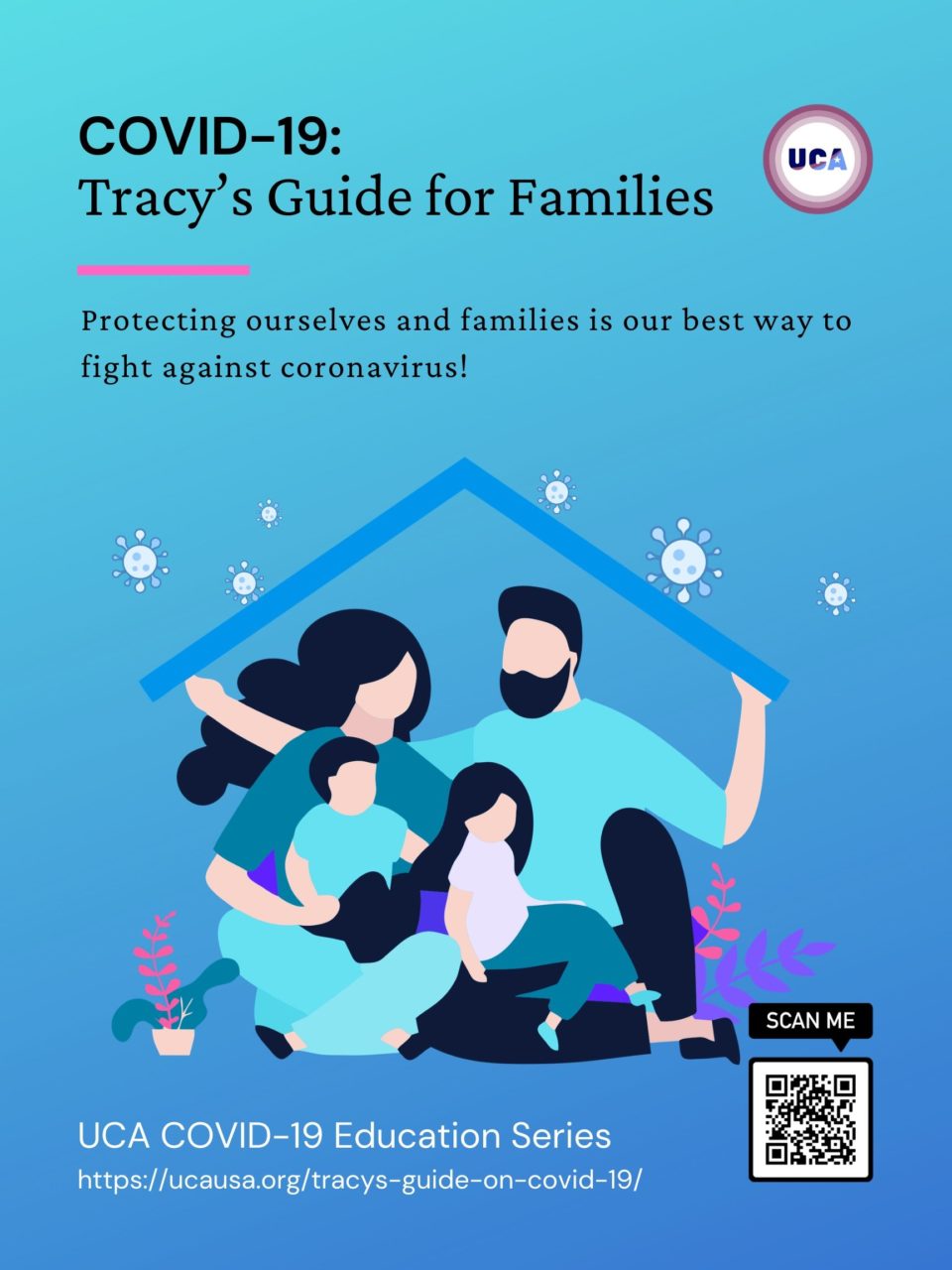
The contest was open to K-12 students age from 6 to 18. Team is encouraged. Artwork was submitted in the forms of picture, video, animation or other multi-media formats with a story based on content from “COVID-19: Tracy’s Guide for Families”. It was posted on social media and is viewable to the public. The artworks submitted were reviewed and graded by a selected committee of youth education experts and community leaders.

The prize winners will receive prize checks and winner certificates by mail. All participants of the contest will receive participation certificates. The top 3 prize winners will have the opportunity to present their artwork during the next United Chinese Americans (UCA) Convention. An online award ceremony is scheduled to be a part of the CESASC 58th Annual Convention at 3pm Pacific Time on Aug. 29, 2020 (Sat).

The purpose of this contest is to encourage K-12 students in America to learn and share essential knowledge about COVID-19, such as how we can protect individuals and their family members from being infected by coronavirus. Young artists who entered the contest were highly creative in producing COVID-19 educational content using digital media and in promoting this content on social media. Congratulations to all contest winners!

All artwork from the young artists who entered the contest can be found on the following page:

https://tracysguide.blogspot.com/p/creativity-against-covid-19-contest.html

“Creativity against COVID-19” Young Creative Artists Contest is a part of UCA’s hallmark public education program on COVID-19, “Tracy’s Guide”, and one of its many projects to help America fighting against COVID-19.

UCA gratefully thanks CESASC and XMF for co-hosting the Contest with UCA, Himalaya Capital, Chinese CEO Organization and C2 Education for their generous sponsorship, Chinese University of Alumni Association Alliance of Southern California, Peking University Alumni Association of Washington State, Asian Culture and Education Society USA and  Mandarin Playground for being our community partners, and Chinesedaily.com, Huarenone.com, UCA-BMXSJ and NewsAgencyAmerica.com for their media support.

United Chinese Americans (UCA) 

UCA is a nationwide nonprofit and nonpartisan federation and a community civic movement; inspired and dedicated to enriching and empowering Chinese American communities through civic engagement, political participation, heritage sharing, youth development and a greater understanding between US and China for the well-being of all Americans and this world. For more information about our organization, please visit our website: https://ucausa.org/. For more information about Tracy’s Guide for Families on COVID-19, please visit its official website: https://tracysguide.blogspot.com.

Organizing Committee of “Creativity against COVID-19” Young Creative Artists Contest

Advisory committee: 

  • Lily Lee Chen, former Mayor of Monterey Park, CA
  • Dr. Cun-Yu Wang, Member, Institute of Medicine of National Academies
  • Haipei Shue, President, UCA
  • Dr. Hui Su, Chairwoman of the Board, CESASC
  • Joy Chen, former Deputy Mayor of Los Angeles, CA
  • Xiaodong Zeng, former Managing Director of Z-Park & World Bank officer.
  • Mingdi Yang, Founder of Xiaoduo & Publisher of Front Vision
  • Hei Feng, Chinese American artist
  • Steve Chiang, Publisher of Chinese Daily Newspaper.
  • Yue Rong, Chairman of the Board, CUAAASC
  • Liam Li, Managing Director of Himalaya Capital
  • Joey Zhou, Chief Editor of UCA-BMXSJ
  • Jing Yang, President of NewsAgencyAmerica

    Winner selection committee: 

    Lily Lee Chen, Dr. Cun-Yu Wang, Haipei Shue, Dr. Hui Su, Joy Chen, Xiaodong Zeng, Mingdi Yang, Hei Feng, Steve Chiang, Yue Rong, Liam Li, Ying Zhan, Jun Sun, Tao Jiang, Sun Liu, Zhang, Dr. Helen Shih, Lily Chen, Jian Ruan, Dr. Jingyi Xi

Organizers:

United Chinese AmericansChinese American Engineers and Scientists Association of Southern California & Xing Memorial Fund

Sponsors:

Himalaya CapitalChinese CEO OrganizationC2 Education

Community Partners:

Chinese University of Alumni Association Alliance of Southern CaliforniaPeking University Alumni Association of Washi

ngton StateAsian Culture and Education Society USA, Mandarin Playground

Media Partners:

Chinesedaily.comHuarenone.comUCA-BMXSJNewsAgencyAmerica.com