United Chinese Americans (UCA), a national federation representing Americans of Chinese descent, wishes to express its grave concern about several aspects of S386, a bill that has just passed the U.S. Senate. We are particularly alarmed by the newly inserted Section 9, which stipulates that the U.S. government “shall not adjust status of any alien affiliated with the military forces of the People’s Republic of China or the Chinese Communist Party.” This new addition is paranoid and xenophobic. We demand its immediate and complete removal from the said bill.
This piece of legislation has sent shock waves through our community. If allowed to become law, because of its broad and vague language, it would essentially bar a large spectrum of Chinese nationals from ever becoming permanent residents or citizens of the United States. As a practical matter, almost all Chinese students or nationals, often out of their own control, have at some point in their lives been “affiliated” with the Chinese Communist Party, be it Young Communist Pioneers in primary school or Communist Youth League in high school or college. Many of them have come to the U.S. to study and some of them have decided to stay to become much-needed scientists or researchers, making huge contributions to the advancement of American society. This kind of “affiliation” certainly does not make them national security threat to the United States. In fact, it is just the opposite: they have become the valued source for our national competitiveness. A legislation aiming at restricting them can only harm the US national interest in competing for top talents from around the world.
This highly offensive legislation, a direct and intentional attack on lawful Chinese nationals, brings back the memory of Chinese Exclusion Act of 1882, an infamous law that barred most Chinese from entering the U.S. or becoming citizens, for more than 60 years. In more recent memory, it is also reminiscent of an equally unfortunate chapter in American history, the anti-communist hysteria of the McCarthy era. If passed, it will surely be a stain on our nation.
Let us be clear: singling out a particular ethnic group for discriminatory treatment under any excuse is just plain wrong and un-American. We urge you to stop this legislation.
United Chinese Americans (UCA) is partnering with Asian American Advance Justice (AAJC) to support the launching of “The Anti-Racial Profiling Project” in October 2020.
“The Anti-Racial Profiling Project offers resources and legal referrals for those impacted by the U.S. government’s increased efforts to target and profile Chinese scientists and researchers. As part of our educational awareness efforts, we work with partners to make sure people know their rights when approached by law enforcement. The Anti-Racial Profiling Project also en-gages in policy analysis, coalition building and public education around these and related pro-filing issues for policymakers, the media, and the general public. Our goal is to be a resource, advocate for non-discriminatory policies, and provide legal expertise and to lift up the voices of those impacted by racial profiling.”
UCA is looking for volunteer translators to support this important project that directly benefit the Chinese American community, especially new immigrants from China.
Two types of volunteers are needed: message reviewers and document translators.
Message reviewer/editor
The project will continue develop community outreach/engagement messages to create awareness of the available resources to the Chinese American community. We need experi-enced bilingual (English/Chinese) translators to review and edit the messages to assure the accuracy and effectiveness of communication. The reviewers will received the message in both the original English and the Chinese translation for prove reading and editing. The turna-round time is usually short (24 – 48 hours).
Document Translator
From time to time, the Project may engage larger volume of legal documents translation. We need translators with relevant experiences (legal, political, cultural, social and economic, busi-ness, etc.) for assistance. This type of work is usually less frequent and has longer time frame but require longer term engagement.
Anyone interested in volunteering for this project, please submit your information via the link below. Xiaoyan Zhang (xiaoyan.zhang@ucausa.org), a board member of UCA, will be the lead contact for this project.
122 Chinese American Organizations Asking White House to Rescind its Executive Order on WeChat Ban
For Immediate Release
Today (September 16, 2020), one day before a Federal district court in San Francisco is going to hold a hearing on Executive Order on Addressing the Threat Posed by WeChat, 122 Chinese American organizations from over 35 states have endorsed UCA’s Open Letter to the White House Regarding WeChat Ban, asking the White House to reverse or rescind this Executive Order.
The Executive Order on WeChat is problematic on many levels. Whether it is the technology difficulty in implementing such a ban or its shaky legal groundwork, this ban just makes no sense, as we have pointed out in our letter (below). It is potentially violating First Amendment rights and disrupting the way of life for millions of Americans.
Banning WeChat isn’t just causing an inconvenience to millions of Chinese Americans, it is part of the far larger effort by this administration to implement the dubious Clean Network, a hawkish initiative to decouple China technically from US and the rest of the world. This goes against the consensus and sustained policy of all previous administrations to maintain a universally open and free Internet.
Furthermore, the President is creating barriers that will hurt Americans and American businesses. Almost all business communication in China is conducted through WeChat, to prevent Americans from having access to this essential business tool puts American businesses and American workers at an extreme disadvantage.
As an organization of Chinese Americans, our members stay connected to family and friends in China through WeChat, as well as family and friends in America. Indeed, much of the political, civic and charitable activities in Chinese American communities is done through WeChat these days. UCA, for example, has just recently organized 2020 Census events, voter registration and education discussions, and the pandemic relief efforts through WeChat.
“Although we very much loath the restriction on freedom of speech imposed on WeChat by the Chinese government, the overwhelming majority of our community is strongly against such an outright ban. But more importantly, we at UCA think this executive order is just wrong. All I can say is Mr. President, it is unAmerican to restrict the freedom of American people. Just rescind your executive order, please,” says UCA President Haipei Shue.
The logo for Tencent Holdings Ltd.’s WeChat app, right, and the logo for ByteDance Ltd.’s TikTok app are arranged for a photograph on smartphones in Hong Kong, China, on Friday, Aug. 7, 2020. President Donald Trump signed a pair of executive orders prohibiting U.S. residents from doing business with the Chinese-owned TikTok and WeChat apps beginning 45 days from now, citing the national security risk of leaving Americans’ personal data exposed. Photographer: Ivan Abreu/Bloomberg via Getty Images
Open Letter to the White House Regarding WeChat Ban
Dear President Trump,
The undersigned organizations would like to express our grave concern about the two Executive Orders you issued on August 6th, 2020, effectively banning the WeChat and TikTok applications.
If fully implemented, these Executive Orders will likely violate constitutional protections for all Americans and erode the American rule of law. In addition, these orders will most certainly harm American business operations and their ability to compete in China. But most importantly, these orders will tarnish America’s moral standing in the world, and certainly have an adverse and disparate impact on the lives of many Americans, including millions of Chinese Americans, by chilling their ability to freely communicate with others throughout the world. As such, we respectfully request that you rescind the two Executive Orders.
WeChat and TikTok are popular applications owned by companies in China that are used by hundreds of millions of people globally, not just in China. In the case of WeChat, a mobile communication and commercial platform, many Chinese Americans rely on the application for daily communication with their families and loved ones in China, for conducting business internationally, for civic participation and free political expression in America, and also for exchanging news and opinions that may not be easily available inside China. Thus, these Executive Orders would severely disrupt and uproot the way of life for millions of Americans, as well as limit the free exchange of ideas and facts both here and abroad.
While we recognize the privacy and cyber security concerns noted in the Executive Orders, and we loathe the restriction of freedom of speech on Wechat by the Chinese Government, to dictate and control the way Americans choose the Internet platforms and access information would fly against the openness and democratic values that are at the core of the American spirit. This unnecessarily restrictive and imperious action is out of sync with our core values and American constitutional principles like freedom of speech, and the right to due process under the rule of law. Furthermore, by banning these popular platforms according to the dictates of US government, we are moving dangerously close to the very censorship we so much loathe and often condemn in autocratic societies.
Mr. President, the United States has long stood for an open and free Internet. These Executive Orders, coupled with the Clean Network initiative your Administration has taken targeting China, would effectively create two separate and decoupled internets, which will only serve to restrict the free flow of information to and from China, and reverse the long-held national policy of an open and free Internet held by all previous administrations.
At a time of global pandemic and economic crises, this world needs more free and open communication and cooperation among the nations, not less. Starting an all-out Cold War on the technology front with China during a pandemic is certainly not in the best interest of the United States and this world.
As such, we respectfully request that you revoke the two Executive Orders. Sincerely yours,
UCA Statement on Trump Administration’s New Visa Rules Regarding International Students
Washington, DC July 9th, 2020
Update on July 14th: Under the huge and growing pressure from and multiple legal complaints by universities, corporations and civic organizations, and one day after UCA joined the lawsuit supporting Harvard and MIT by filing its own amicus brief on July 13 against the government, U.S. Immigration and Customs Enforcement (ICE) withdrew its new regulation regarding foreign students in America. This allows foreign students to continue their study in America uninterrupted. UCA would like to thank those Chinese students and scholars who helped UCA preparing its amicus brief. UCA will continue to monitor the developments of this matter and others impacting Chinese students in America.
United Chinese Americans (UCA), a national organization representing people with Chinese heritage in America, condemns the recent directive by the Trump Administration’s Immigration and Customs Enforcement (ICE) that would strip the international students of their U.S. visa or compel them to leave the United States, if their coursework were entirely online.
The ill-conceived directive would adversely impact more than one million international students in the United States. Having the largest share of the international student body, with 369,548 students or about one third of the total foreign students in America in 2019, Chinese students would undoubtedly bear the brunt of such a decision. Many Chinese students have reached out to UCA, expressing their concerns, such as experiencing anxiety, fear of possible deportation, lack of safe or easy international travel options, and potential interruption to complete their education in America.
“It is shameful the Trump Administration continues to use foreign students to politicize the pandemic and score political points. These students, thousands of miles away from their families and loved ones, deserve our outmost sympathy and support during this pandemic. They should have the option to remain in this country to complete their education in the safest and most undisrupted manner possible,” says Haipei Shue, President of UCA.
UCA calls on Chinese student and scholar associations as well as individual students throughout the United States to contact UCA immediately to share their concerns and consider joining UCA for probable legal actions against the Trump Administration. UCA would like to offer more support to Chinese students and their associations during this most difficult time of the pandemic. Please call us at (202) 642-5060 or e-mail us at info@ucausa.org
A Public Statement On the Death of George Floyd and Ahmaud Arbery
May 28, 2020, Washington, DC. For immediate press release.
United Chinese Americans (UCA), a leading Chinese American coalition and civic movement in the U.S., condemns in the strongest possible terms recent acts by Minneapolis policemen that resulted in the death of George Floyd, and by Georgia civilians that ended the life of Ahmaud Arbery. We deplore these grave injustices and stand with the victims’ families as they mourn their losses.
The families and the public deserve thorough, fair and independent investigations of both cases, and the perpetrators must be brought to justice. If convicted, they should be punished to the fullest extent of the law.
In recent years, our society has become increasingly numbed to the repeated killing and maltreatment of African Americans at the hands of police or vigilantes. This cannot stand anymore and it has to change! As Asian Americans, we are well aware that neither we nor anyone else can enjoy true security and peace in our lives as long as African Americans cannot enjoy them in theirs. Far too often, we feel this killing or maltreatment could not happen in our own life or in our own community. But today, we are already victims of a spike of hateful and racist acts directed at Asian Americans during the current coronavirus pandemic.
As Dr. Martin Luther King famously asserted in his Letter from Birmingham Jail, “injustice anywhere is a threat to justice everywhere.” Despite significant progress made in recent decades, discrimination, glaring disparities and social injustice still haunt our society. United Chinese Americans (UCA) calls for all Americans, regardless of their race, ethnicity or political affiliations, to join us in condemning the brutality we have witnessed in these disturbing cases that has senselessly cut two lives short. We pledge to continue to work in solidarity with African Americans and, indeed, all Americans to bring positive and real social change and justice to all.
UCA is calling for Chinese Americans to participate in the election
2020 Primary Election has drawn national attention as it sets the beginning of the historical 2020 General Election in November. The purpose of the Primaries is to elect winning candidates from each political party, Democratic and Republican, who will be then heading to the November General Election. Iowa and New Hampshire have finished the Primaries. This will be followed by Nevada and South Carolina on Feb 22 and Feb 29.
Two large states, California and Texas are among 14 other states in the Super Tuesday Primaries on March 3rd. Traditionally, who will be the winners of the US Presidential nominees of both parties will become more apparent after the Super Tuesday Election. Other state primaries follow the schedule which has been set by the two political parties and published by all major media channels.
Early voting for the Super Tuesday Primaries is starting this week in different states. Though much of the community attention has been pulled to the coronavirus outbreak recently, UCA is asking Chinese Americans across the country to watch what’s happening in the Primaries and who are on the ballots in their states, especially considering Asian Americans don’t normally come out to vote in the Primaries. However, this year, given the unfavorable political climate against immigrants and turmoils in American politics, more Asian Americans are emerging as candidates and stand up for our voices. Some of the races are also crowded with candidates, including the presidential position.
Though many people are disappointed with the leave of Andrew Yang, the democratic presidential candidate as a Chinese American, he has inspired other Asian Americans to run for public offices and more people to care about politics. It is paramount that we, as Chinese Americans, continue to be civically engaged, and support these candidates who can be future leaders for our communities.
Down-ballot candidates, who run at the local levels, such as county positions, district judiciary positions, are even more relevant to our daily life, as their policies affect tax, funding, public safety, and other important aspects of the local communities. Therefore, UCA is calling Chinese Americans to do the necessary homework in researching and choosing the candidates and the party to vote for (in Primaries, voters can only choose one party, either Democratic or Republican, but not both).
Election information is available from the county election office and from the official state websites such as the Secretary of State. Status of voter registration, polling locations and hours, sample ballot and election results are published by these websites. Another good resource to look for is established and respected newspaper and media channels, which have coverage of the election, interview of the candidates and endorsements. Large civic organizations, including the League of Women’s Voters or LWV, routinely provide voter guide (https://www.vote411.org/) that covers many different states, some even with Chinese translation in large cities.
Local UCA chapters and groups are organizing events and activities to help the Chinese American communities participate in the Primary Election and meet the candidates. Please help support these efforts and fulfill our responsibilities as conscientious citizens of the country. Its progress depends on everyone’s participation, and 2020 elections will be extremely important for Asian Americans.
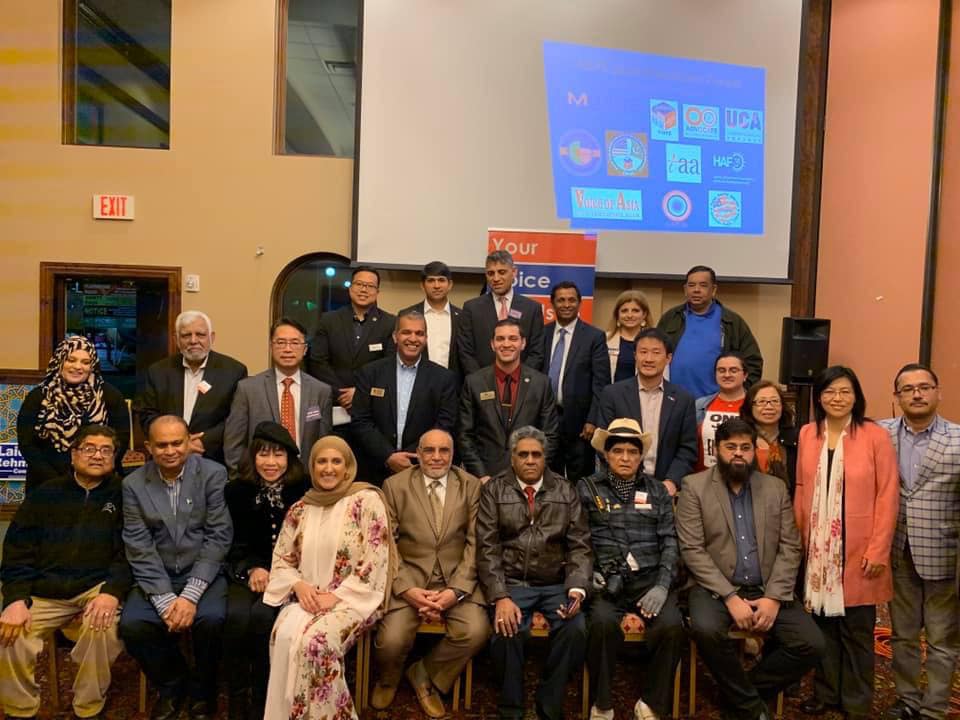
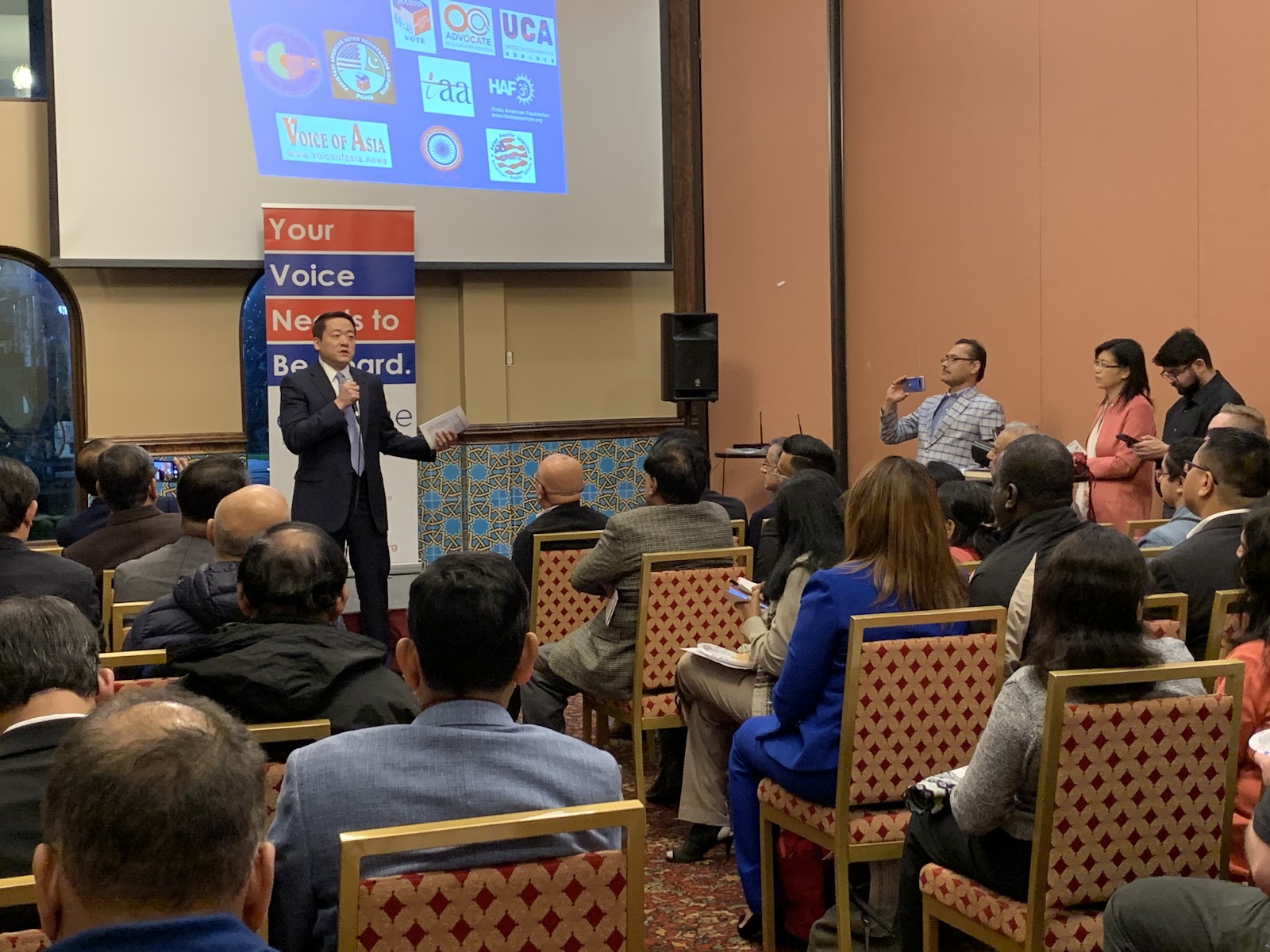
2020 Primary Asian American Candidate Forum hosted by UCA Houston, in collaborating with 10 other Asian American organizations in the area.Rep. Gene Wu, a Texas House Representative in Houston, is the Chinese American elected official, spoke during the candidate forum, to encourage voting participation.
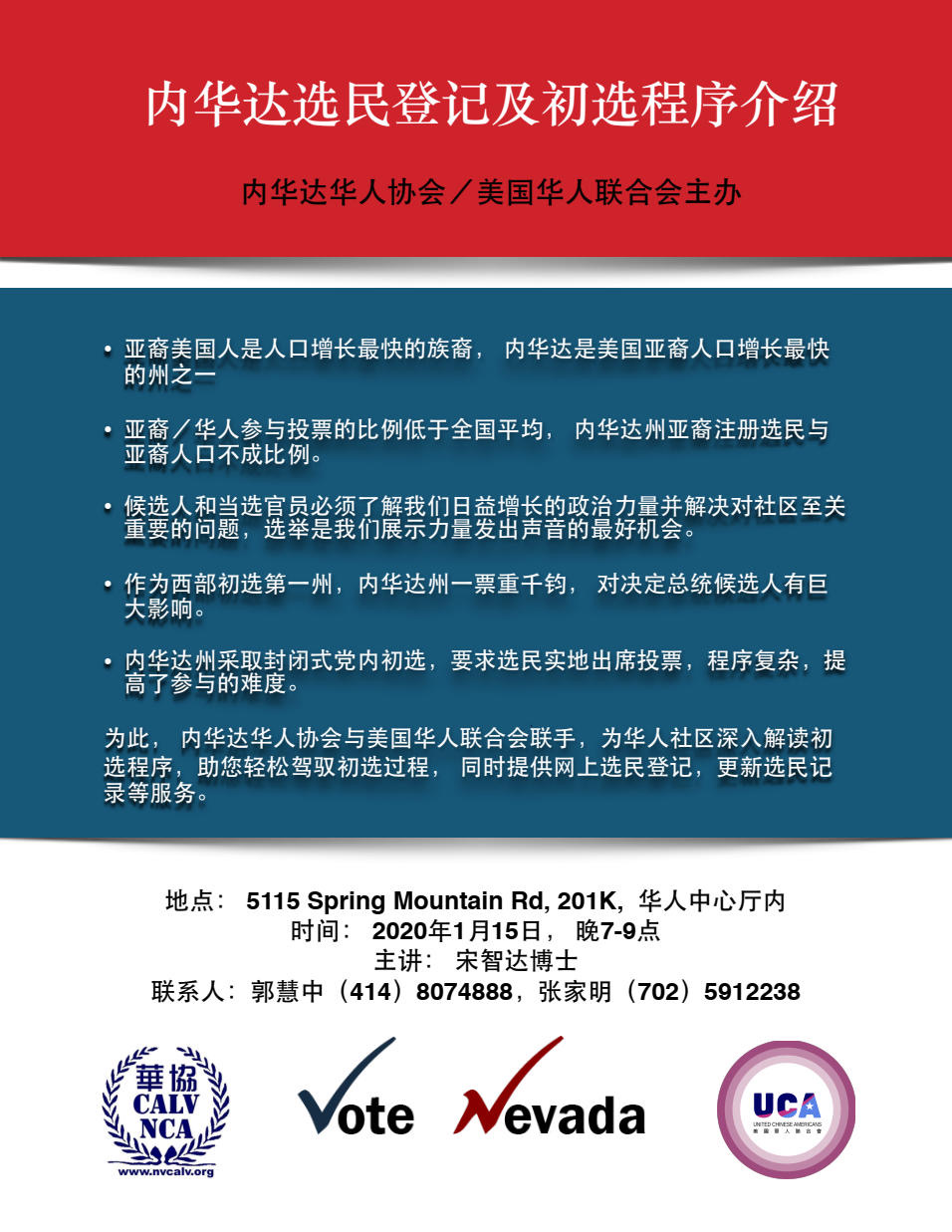
Asian Americans are the fastest growing
ethnic group. Between 2000 and 2010,Asian-Americans population grew by 46
percent, far more than the national population growth rate of 10 percent. Since
2008, there have been more immigrants from Asia than anywhere else in the
world.
Nevada is one of the fastest growing states
with Asian-American populations. Since
2000, Nevada’s AAPI population has grown by 140 percent, and eligible
Asian-American voters in Nevada have accounted for more than 5 percent of all
voters. Candidates and elected officials must understand our growing political
power and address issues that are vital to our communities.
Elections are our best chance to show our
strength. The proportion of Asians/Chinese participating in elections is lower
than the national average, and as a result, our voices and needs have been
ignored for a long time. There have been many times in history that an election
outcome was determined by a single ballot, each vote counts!
As the first state in the West to hold a
presidential primary, Nevadans play a crucial role. Nevada caucuses will have huge impacts on the
final decision of who would be the presidential candidate. However the closed-party caucus is a complex
process that has made first-time participation more difficult.
Nevada Chinese Association and the United
Chinese Americans will hold a seminar to provide in-depth explanation to the
caucus process for the Las Vegas Chinese community. It will help Chinese voters navigate the
caucus process with confidence. In
addition the organizations will provide online voter registration, voter
information update and other services on site.
UCA among Organizations Endorsing Senator Durbin’s Bill S.2603 on Green Card Reforming
UCA president Haipei Shue visited Senator Durbin and Senator Duckworth’s offices and discussed issues of immigration, S.386 and Chinese American scientists. At the request of Senator Durbin’s office, UCA has endorsed his new legislation “Resolving Extended Limbo for Immigrant Employees and Families (RELIEF) Act” (S.2603), along with a list of other organizations.
Sen. Durbin tweeted that “One of the most serious problems in our broken immigration system is the lack of green cards, leaving immigrants in a crippling backlog. The solution is clear: increase the number of green cards. Proud to introduce the RELIEF Act with @SenatorLeahyto eliminate the backlog.”
During his introduction speech, Durbin criticized the Senate leadership for ignoring the immigration issue, pointing out that, last year, there was only one hearing in the Senate and no vote on the floor.
Reminding his colleagues that they are there to solve the problems the country is facing, he said: “Here is a problem we are not solving: How to deal with the backlog of people highly skilled and important people, like [a] doctor from my hometown of Springfield from India, who wants to have a Green Card, giving him an opportunity to become an American citizen. You know what? I want that doctor to become an American citizen. I want him to get a Green Card. We need him in my hometown, many more like him. I want his family with him.”
However, S.2603 was blocked by Sen. John Kennedy (R-LA) from seeking an Unanimous Consent (UC). The content of the bill can be found at the official press release. Here’s a short summary provided by the office.
Appendix: Resolving Extended Limbo for Immigrant Employees and Families (RELIEF) Act
One of the most serious problems in our broken immigration system is that there are not nearly enough immigrant visas – also known as green cards – available each year. As a result, immigrants are stuck in crippling backlogs for many years.
Close to four million future Americans are on the State Department’s immigrant visa waiting list, which doesn’t include hundreds of thousands of immigrants in the U.S. who are also waiting for green cards. However, under current law only 226,000 family green cards and 140,000 employment green cards are available annually. Children and spouses of lawful permanent residents (LPRs) count against these caps, further restricting the number of available green cards.
The backlogs are a particular hardship on families who are caught in immigration limbo. For example, children of LPRs often “age out” because they are no longer “children,” as defined under immigration law, by the time green cards are available for them.
The solution to the green-card backlog is clear: increase the number of green cards. Immigration law also should treat children and spouses of LPRs as immediate relatives, just as they are considered when their family members become citizens. The Senate did exactly this in S. 744, the comprehensive immigration reform bill which passed the Senate in 2013 on a strong bipartisan vote.
Congress should also lift green-card country caps, which were designed to preserve immigration diversity but have contributed to backlogs because of the insufficient number of green cards and the large number of immigrants in the United States stuck on temporary work visas. However, lifting country caps alone without increasing the number of green cards will not eliminate backlogs for Indian immigrants (the nationality with the most people in the employment backlog), and will dramatically increase backlogs for the rest of the world.
The RELIEF Act will:
• Eliminate the family and employment green card backlog over five years in the order in which applications were filed (based on S. 744, the Senate CIR bill).
• Keep American families together by classifying spouses and children of LPRs as immediate relatives and exempting derivative beneficiaries of employment-based petitions from annual green card limits (based on S. 744, the Senate CIR bill).
• Protect “aging out” children who qualify for LPR status based on a parent’s immigration petition.
• Lift country caps (House-passed H.R. 1044).
• Extend the “hold harmless” clause from H.R. 1044 that exempts immigrant visa petitions approved prior to enactment from the lifting of country caps to petitions approved for five years after enactment.
Latest update: On October 17, 2019, Senator Durbin blocked another attempt to pass S.386 via Unanimous Consent (UC).
The following contents first published on September 26, 2019.
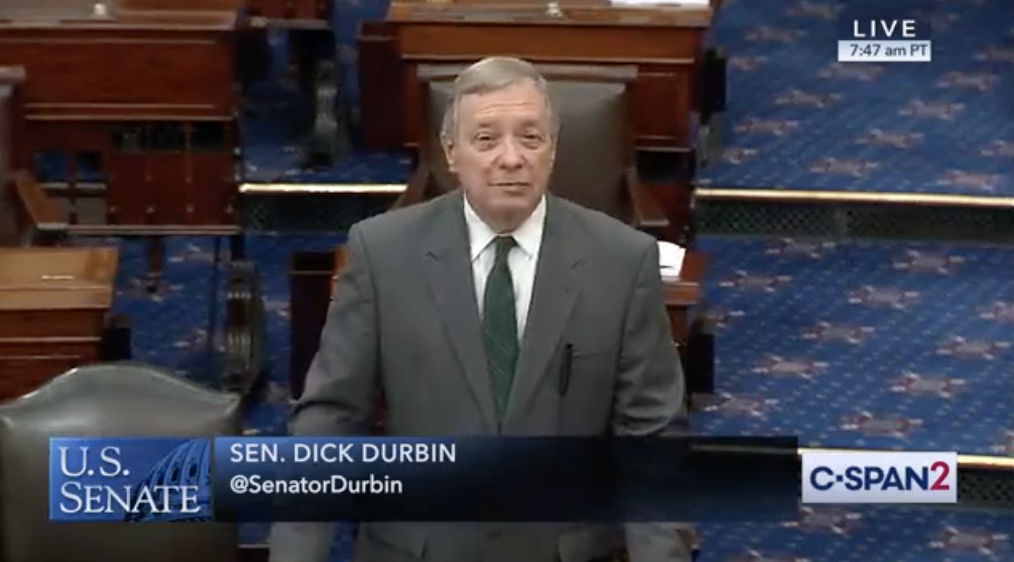
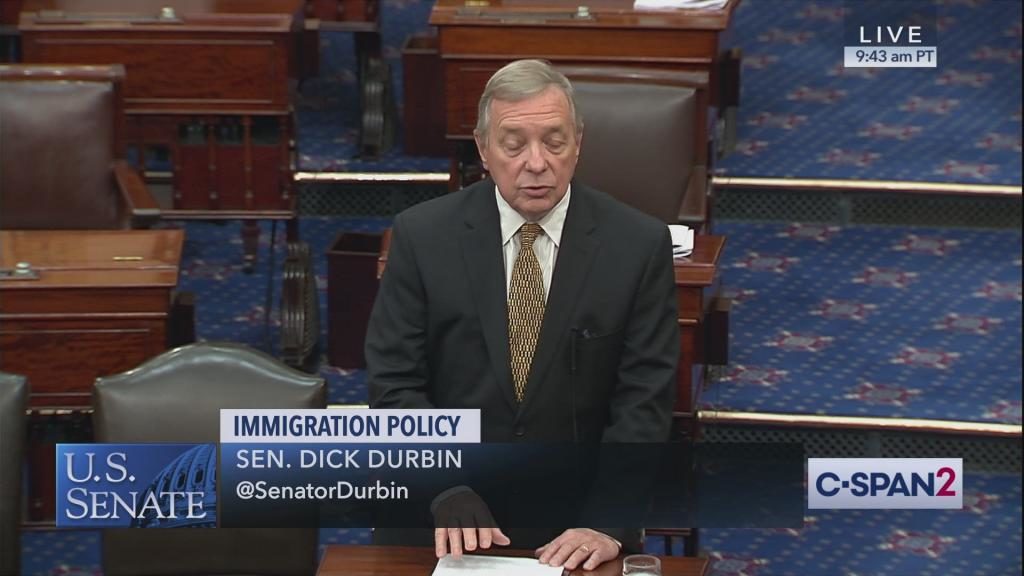
Sen. Durbin (archive photo)
Hours ago, Senator Dick Durbin (D-IL) blocked S.386 and the unanimous consent vote has once again been delayed. After Senator David Perdue (R-GA) dropped his objection after reaching agreement with the bill’s sponsor, Sen. Mike Lee (R-UT). Sen. Durbin blocked this “green-card giveaway bill to Indian graduates” because “it doesn’t give away ample green cards to international graduates from many international locations”.
We attribute this win to the collective actions of the communities including fellow citizens from various ethic background: Chinese, Korean, Arabic, Iranian, etc. We celebrate the good news with everyone who worked hard in contacting the offices of multiple Senators. This is a superb example of political engagement, with combined efforts from grass-root movement and organizational actions. Let’s continue to push for a public hearing and a true reform of the employment-based green card system.
We suggest the community keep reaching out to the Senators via phone and email or in person. In addition, a letter co-signed by multiple local organizations, preferably from diverse ethic background, may be helpful. The letter of opposition show above can be an example; the following can be another for your reference.
September
24, 2019
Honorable Sen. David Perdue 3280 Peachtree Rd, Suite 2640 Atlanta, GA 30305
RE: S.386
Dear Senator
Perdue:
On Behalf of Chinese
American community in Atlanta area, we urge you to oppose Senate legislative
Bill S.386.
Legislative Bill
“Fairness for High-Skilled Immigrants Act of 2019” is misnamed and cannot be
considered “fair” under any circumstances. By lifting the 7% country caps and
allocating almost 100% of all available employment green cards to nationals
from one country alone – India; S.386 will shut out nearly all nationals from
190+ other countries for many years to come. If passed, S.386 will absolutely
reduce the required skill, industry and ethnic diversity that American needs to
continue healthy growth into the future.
As you know, the
State of Georgia relies on skilled immigration workers in certain fields, such
as rural area hospitals (nurses and physicians) and biomedical industry. Losing
the ability to recruit these workers will have significant negative impact on
our state.
The root cause of
the employment-based green card backlog stems from many years of H1B visa abuse
where IT outsourcing companies flooded the H1-B lottery program with applicants
on behalf of Indian nationals and dominated visa distribution. Passing
legislation S.386 would simply reward this H1B visa abuse. We ask that you
resist the temptation to implement convenient, but entirely ineffective,
legislation “solutions” that solve nothing, regarding the very real problem of
the employment-based green card visa backlog.
The best solution
to this issue it not to scrap the per country cap, but to expand the number of
green cards available and to enact
a merit-based system for awarding employment green cards that rewards the most
qualified, talented, and likely to succeed.
While we do
understand that there is a problem to be solved with the backlogged green card
applicants, clearly S.386 is not designed with America’s best interest in mind.
We respectfully request that you oppose this bill moving forward by unanimous
consent and, at the very least, ensure that the bill proceeds through regular
order so that it is properly debated, and its implications fully assessed.
So far, 18 national organizations, including UCA, have joint their forces to oppose S.386. We expect more national organizations to join this coalition in the coming days. Please share the letter with staffers of senators when you contact those offices.
To: Members of the U.S. Senate
Dear Honorable Senators,
As organizations representing immigrant
communities who would be harmed byH.R.
1044/S. 386, the so-called Fairness for High Skilled Immigrants Act, we write
to express our opposition to this legislation. Given that this proposal would
remove a pillar of our immigration system and have significant repercussions,
we urge Senators to block the bill from moving forward for unanimous consent.
We do so for the following reasons:
The bill would not fix the green card backlog faced by visa applicants. Instead, it would merely shift the backlog onto other nationals, reducing the diversity of the green card process.
The bill offers a zero-sum approach that pits one group of immigrants against others to fight over a broken immigration system.
A true solution would protect diversity by expanding the number of green cards available.
We agree that the substantial backlog of
visa applicants is unfortunate and needs to be addressed. But H.R. 1044/S. 386
is not a fair solution and risks further problems, such as creating what the
State Department has referred to as a “monopoly” of the green card process for
one group of nationals and eliminate any diversity from the process. We urge
Senators to object to the bill moving forward by unanimous consent and reject
what would be a counterproductive attempt at fixing a long-standing, complex
problem.
Sincerely,
80-20 United
Arab American Institute
Asian Pacific Islander American Public Affairs (APAPA)
Asian Pacific American Labor Alliance, AFL-CIO
Council on American-Islamic Relations
Emgage Action
Federal Asian Pacific American Council (FAPAC)
Italian American Democratic Leadership Council
Korean American Service & Education Consortium (NAKASEC)
National Iranian American Council Action
National Korean American Service and Education Consortium (NAKASEC)
OCA – Asian Pacific American Advocates
Pakistani American Political Action Committee (PAKPAC Membership)
Project South
South Asian Americans Leading Together (SAALT)
United Chinese Americans (UCA)
United Community Oriented Development Association (UCODA)
Upon UCA’s Call for Action, over a dozen of professions in University of Delaware (UD), lead by Named Professor Xiaohan Yan, expressed their concerns over increasingly deteriorated atmosphere. The university released the following official statement in a positive and articulated response, emphasizing on the support of legit scientific communication and collaboration, and highlighting on recognition an protection of the legal rights of Chinese researchers in UD.
This makes UD the fifth institution doing the same, following UC Berkeley, Stanford, U of Michigan, and UC Davis, and the first on the east coast. We appreciate the timely and proactive action by these Chinese professors in UD that empowers the community by example. UCA hopes more universities and institutions would follow the suit. Please contact us at info@ucausa.org or call (202)642-5060 regarding similar actions.
Our Commitment to International Scholarship
Dear UD Community,
The University of Delaware has long been a leader in
international scholarship, exemplified by our role as the originator of
study-abroad programs and continuing with today’s robust global partnerships
that extend our impact around the world. Students and scholars from dozens of
nations have made tremendous and indispensable contributions to UD’s
excellence, and we are a more vibrant and diverse institution because of their
engagement.
Unfortunately, members of our nation’s international community
sometimes may feel vulnerable or unwelcome, caught in the political crossfire
among nations. Recently, concerns have been voiced at UD and other institutions
regarding rhetoric and actions targeting certain international community
members, such as Chinese or Chinese-American scholars. What’s more, faculty and
students here and elsewhere have been subject to prejudicial comments,
unwarranted scrutiny or professional strictures based on their race, ethnicity
or national origin. Therefore, it is essential that we at the University of
Delaware reaffirm our unwavering support for our international students,
faculty, staff and visitors, as well as the vital partnerships and initiatives
that enable their work.
The University of Delaware is committed to enabling the success
of our students, building inclusive excellence, strengthening global
initiatives and investing in our intellectual capital, as well as other
priorities. International scholarship is absolutely integral to these
commitments. Diversity of knowledge, skill and perspective undoubtedly
strengthens our academic programs and research teams by bringing multiple
viewpoints to bear on the complex challenges of our society. Collaboration with
our global partners attracts talented people to our campus and sends UD’s best
and brightest as ambassadors around the world. Top scholars in every field and
from every continent enrich our intellectual climate and help ensure the
academic rigor of our student experience.
To realize these benefits, we will continue to facilitate
international collaborations through UD’s Research Office,
the Office of International Students and Scholars, and
the Institute for Global Studies, as
well as other campus units. Our policies and practices, along with federal reviews,
help protect our intellectual property, our digital infrastructure and our
research disclosures. It is equally important that our vigilance is never
mistaken for suspicion based on ethnic or national heritage.
The work of the University of Delaware — along with the entire
American higher education system — is an essential element in the global
knowledge economy and serves as a beacon of intellectual freedom around the
world. We remain committed to the promise of international scholarship to benefit
our institution, our community, our partners and, most importantly, our
society.
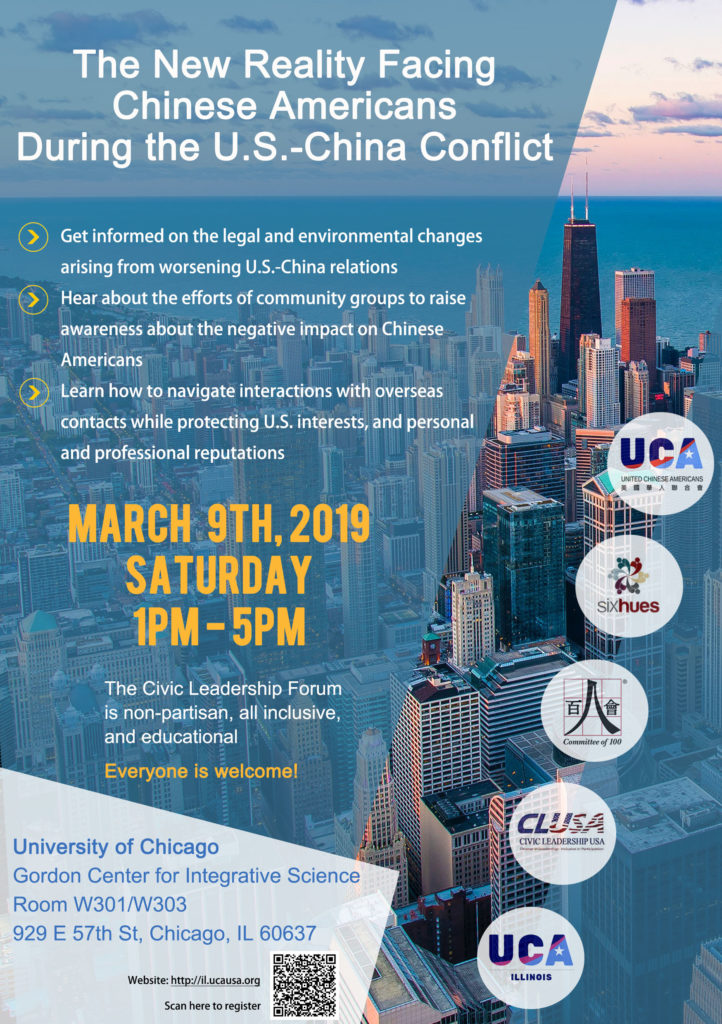
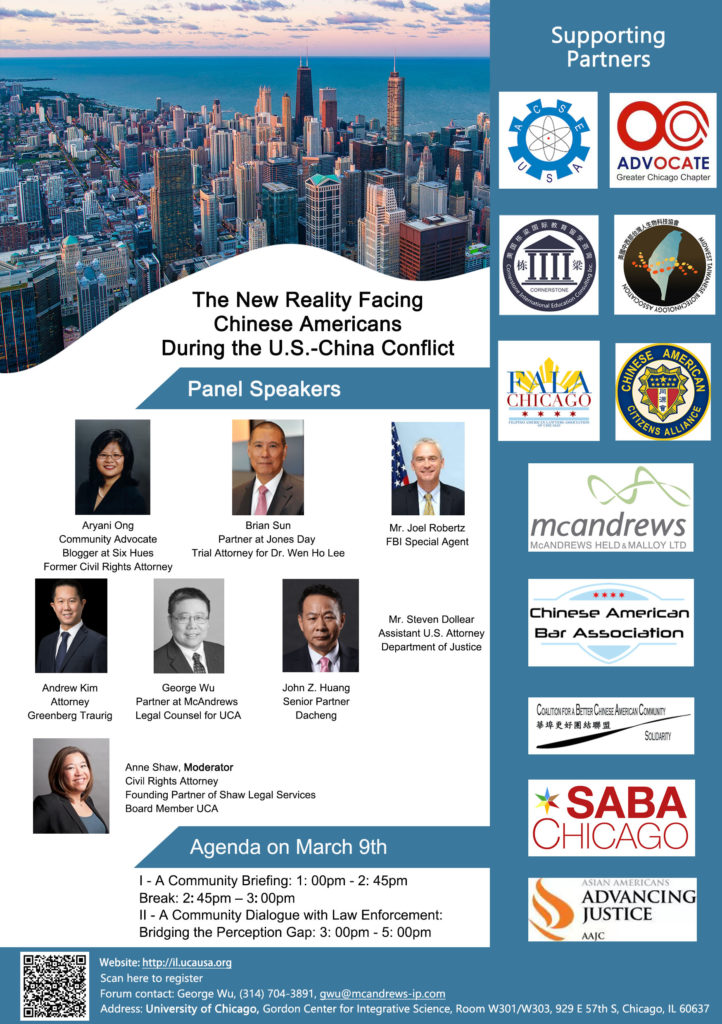
Community Dialogue with Law Enforcement: Bridging the Perception Gap
University of Chicago, 929 E 57th St, Gordon Center for Integrative Science, Chicago, IL 60637
The cases of Chinese American scientists such as Dr. Xiaoxing Xi and Sherry Chen have aroused concern in the Chinese American community that innocent parties are collateral damage in worsening U.S.-China relations. Yet, the cases represent broader trends. As the U.S. reacts to the rise of China as a military and economic competitor, the Chinese Americans, particularly immigrants, are facing a new reality. They face potential heightened scrutiny from both countries if they work in a broad range of science and technology areas. Now, the act of downloading information at the workplace has national security implications. Hear a panel of speakers explain the legal and environmental changes that have led to this situation. Learn about the backdrop of Asian American history that makes Chinese Americans more wary about government actions in a handful of cases that look like profiling. Find out about the work of community groups around the country to engage elected officials and law enforcement around the issue of bias, press for more transparency and accountability, and community dialogue.
Thank you to our event organizers : United Chinese Americans National and Illinois Chapter, Six Hues, Community of 100, Civic Leadership USA. Thanks also go to our forum co-sponsors : Association of Chinese Scientists and Engineers, Shaw Legal Services, Ltd., Cornerstone International Education Consulting, Inc., OCA Chicago, Midwest Biotechnology Association, Chinese American Citizen Alliance, Filipino American Lawyers Association, Asian American Bar Association Law Foundation, Chinese American Bar Association, South Asian Bar Association, Asian Americans Advancing Justice Chicago, McAndrews Held and Malloy, and Coalition for a Better Chinese American Community.