UCA WeChat Use Survey Report

Survey Gauges Impact of WeChat Ban on Chinese American Community

October 22, 2020 

United Chinese Americans (UCA) has just concluded a nationwide survey (click to see the form) among the Chinese American community regarding the impact of a potential WeChat ban by the Trump administration.

WeChat Survey Introduction 

About UCA 

Founded in September 2016 at the inaugural Chinese American Convention, UCA was formally incorporated and received IRS 501(c)(3) nonprofit status in 2017. UCA has since grown into a national federation with 12 chapters and over 30 community partners. 

Survey Purpose 

After the Trump Administration issued the Executive Order to ban WeChat on August 6, 2020, UCA conducted an online survey (see attached WeChat survey email) to measure the potential impact to the Chinese American community among its followers between October 14 to October 21. 

Sampling Method 

An on-line survey questionnaire was sent via email to 7447 UCA followers and promoted through UCA social media channels. Everyone is invited to respond to the survey within a 7-day window. Survey response is voluntary with anonymity. The invitation message also assures respondent privacy. (Link to survey invitation message) 

Questionnaire Design 

I receive daily updates of my mother’s health status from her doctors in China when she underwent surgery.

User Y.

The questionnaire consists of questions. Most questions are close-end (Yes/No or Multiple choices) except two open-ended items related to personal reasons and specific example of using WeChat. (Link to survey questionnaire) Every effort was made to assure neutrality and avoid leading respondent one way or the other. 

Results 

Between October 14 and October 21, 2020, 45% of the 7447 UCA email recipients opened the email, 17% attempted the survey, 8.5% (625 people) completed survey. Of 625 respondents, 70% are U.S. Citizen, 23% are permanent resident, the remaining are international students, H1B/H4 holders or visitors. Of all respondents, 97% are identified as ethnic Chinese. 

For more details, please see the attachments: 

  • Attachments 1. Survey Summary 
  • Attachments 2. Why WeChat 
  • Attachments 3. Personal Stories 

Among the more than 600 individuals who participated in the survey, 97% are ethnic Chinese who are either citizens or permanent residents of the United States; 83% have lived in the United State for more than 10 years.

As an “all-in-one” social media platform combining messaging, video, phone, payment, and other features, WeChat has attracted a large following among the Chinese speaking population since its inception just 10 years ago. Among the survey participants, 90% have used it for at least 5 years. Among all the users, 92% use Chinese as the primary language, and 95% use WeChat on a daily basis. The most popular reasons to use WeChat are its ease of use for users of all ages, its Chinese language features, and the extensive communications between friends and family members already on the network in China and US.

The survey has revealed an interesting finding that 1 in 3 users learned about the COVID-19 through WeChat as early as December 2019 as it was emerging in Wuhan, China. 58% of them continue to reply on WeChat for infection prevention and treatment information on an ongoing basis.

The survey also included questions on sensitive issues such as censorship, propaganda, and national security. 8% of the users have experienced censorship enforced by the platform owner Tencent in China; 6% have received or consumed some Chinese government contents; but 93% don’t think their use threatens US national security.

I am an adoptive parent who is using WeChat to not only try and find my daughter’s Chinese birth parents, but also to help other Chinese adoptees spread their search information. We keep in touch with friends and volunteers via WeChat, and without it, we wouldn’t have been able to help reunite all of the families we have thus far.

User G.

If the WeChat ban is implemented, 82% of the users think they cannot find a reasonable alternative or replacement.

The survey also encouraged users to share their personal stories. Some of these stories are highlighted in this article.

For details of the survey and its results, please click on the following links.


All my family members (close to 100 people ) use WeChat Group feature to share our life.

User L.

Top reasons why people use WeChat:

· Availability and smooth usage in both US and China.

· Keep in touch with relatives and friends.

· Connection with business partners.

· Group chat capability.

· Convenient and important for everyday life.


Featurette: User Stories

“Before I had WeChat, it was so inconvenient to call my family and get information on timely manner. In December 2008 just several days before Christmas, my father was in a car accident and admitted into the hospital. My family attempted to call me but could not get through. They sent me email, but I was busy working and doing Christmas stuff, didn’t check emails for several days. By the time when I checked email and found out what had happened, my father already passed away. I didn’t have chance to go home to be at his side when he died. That was the one thing I could never make up for.

“Two weeks ago, my sister called me and told me that my mom felt and broke her hip. Initially I was trying to go home, but found out I couldn’t due to COVID and the tension between the two countries. Thanks to WeChat! I was able to consult the doctors in China, contacted my friends in China (they are all healthcare professionals), arranged her hospitalization and her surgery. Now she had her hip replaced and went back home walking again. I would not be able to do all these things without WeChat! With WeChat, I feel no distance with my family and friends in China. I video chat with my mom everyday when she was in the hospital, talked with the doctors via WeChat. I am so thankful we have WeChat! My mom is 86 this year. I don’t want to lose her without being at her side! WeChat means so much to me and my family!” — User-submitted personal experience.

There are countless stories like this, some are warm and sweet, some are heart-wrenching, while some others are inspiring. Please see the PDF link above.

Everyday I use WeChat to connect my parents in China, my father had kidney failure and do hemodialysis every other day, it is very hard for him, so I call to courage him and help to release his lots of pain.

Video chatting with my patents and grand mother during quarantine.

I call my parents, relatives and friends almost every day. All these calls are free. I love it so much.

[I use WeChat to] help a family in china to look for their missing son who studied in our area.

I did video-calls with elders in my family in China who are in their 70s and 80s . It is remarkable because they are not technology-savy by any stretch.

I found many of my old friends and classmates who I grew up with, attended elementary and high school together, through WeChat.

I introduced WeChat to my boss who went to China for a business trip he could keep close contact with his family while he was there, after that he introduced WeChat to our department head when he needed travel to China.

I organized Kenya trip using WeChat group with my friends in China and Kenya.

I use WeChat with my parents in China. They are old and WeChat is the only app they know how to use.

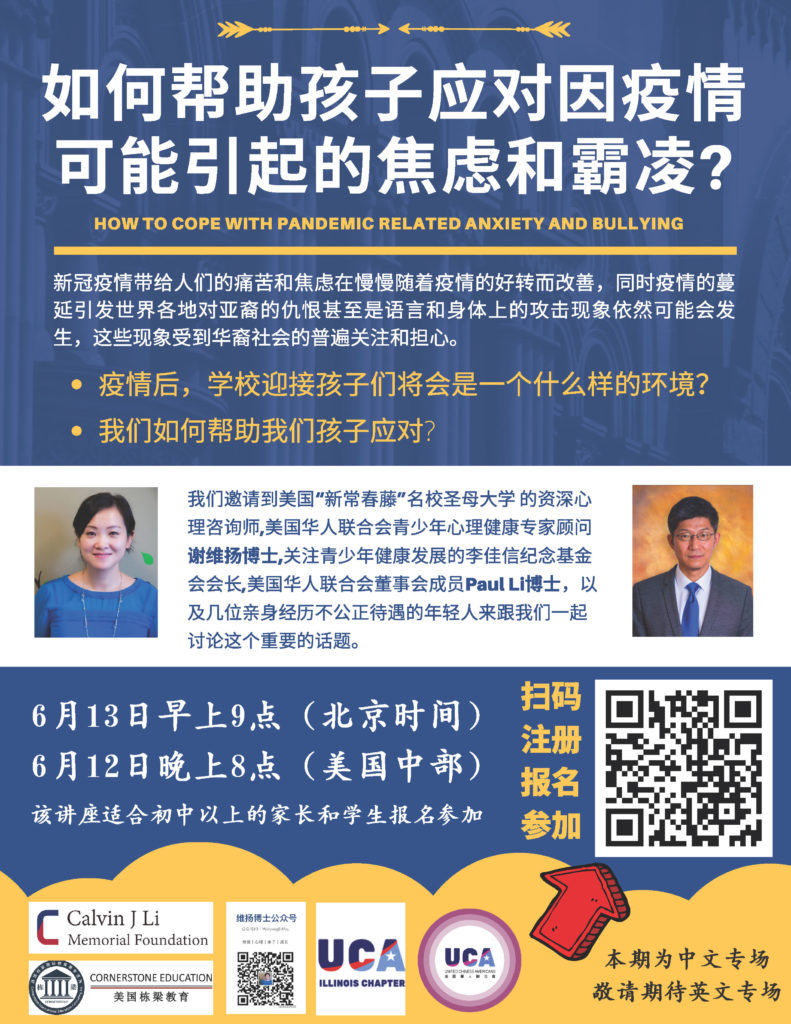
Cope with Pandemic-related Anxiety and Bullying

An Educational Seminar: How to Cope with Pandemic-related Anxiety and Bullying

Many of us have been impacted by COVID-19 in more ways than we’ve ever anticipated, including the toll on our mental health. The social pressure facing Chinese and other Asian American youths, in particular, has been challenging to many families. To help our youth and families cope with mental stresses during the pandemic, United Chinese Americans (UCA), UCA Illinois Chapter, Cornerstone Education, and the Calvin J Li Foundation are organizing an educational webinar titled: “How to Cope with Anxiety and Bullying During Covid-19,” to be held on Friday, June 12, 2020 @9 p.m. EST. The webinar will be conducted in Chinese, and an English version will be available at a later date. Please register here: http://june0713.mikecrm.com/1ouzmt0

The first part of the webinar features Dr. Weiyang Xie, a licensed clinical psychologist and a consultant for UCA’s youth mental health initiative. Dr. Xie will discuss coping strategies related to anxiety and bullying. The second part of the panel will feature a group of young students and professionals who will share their experience, including Jeff He, Tim He, Connor Hu, Frank Li, Zachary Wu, Andy Yu, and Sophie Zheng. The discussion will be hosted and moderated by Dr. Paul Li. Dr. Li is the founder of the Calvin J Li Foundation, and is also a UCA board member and UCA youth mental health co-coordinator. 

疫情给全人类带来困惑、焦虑和不安。 对孩子们来说,更是如此: 他(她)们迷茫,不知所措;有的甚至选择极端的方式。如何引导孩子的健康发展,如何及时排查孩子们的变化,如何疏导他们的焦虑,如何面对可能出现的霸凌,都成了刻不容缓的话题。请大家注册参加 6/12 周五美中时间晚间八点的讲座。 健康生活和学习,人人关注:http://june0713.mikecrm.com/1ouzmt0 

The short video below offers a glimpse of the youth mental health issue our community is facing: https://tinyurl.com/ycc3oomv

We hope you can join us in this timely educational webinar. See you soon!

Sincerely, 

Youth Mental Health Webinar Organizing Committee

Creativity Against COVID-19

“Creativity against COVID-19” Young Creative Artists Contest

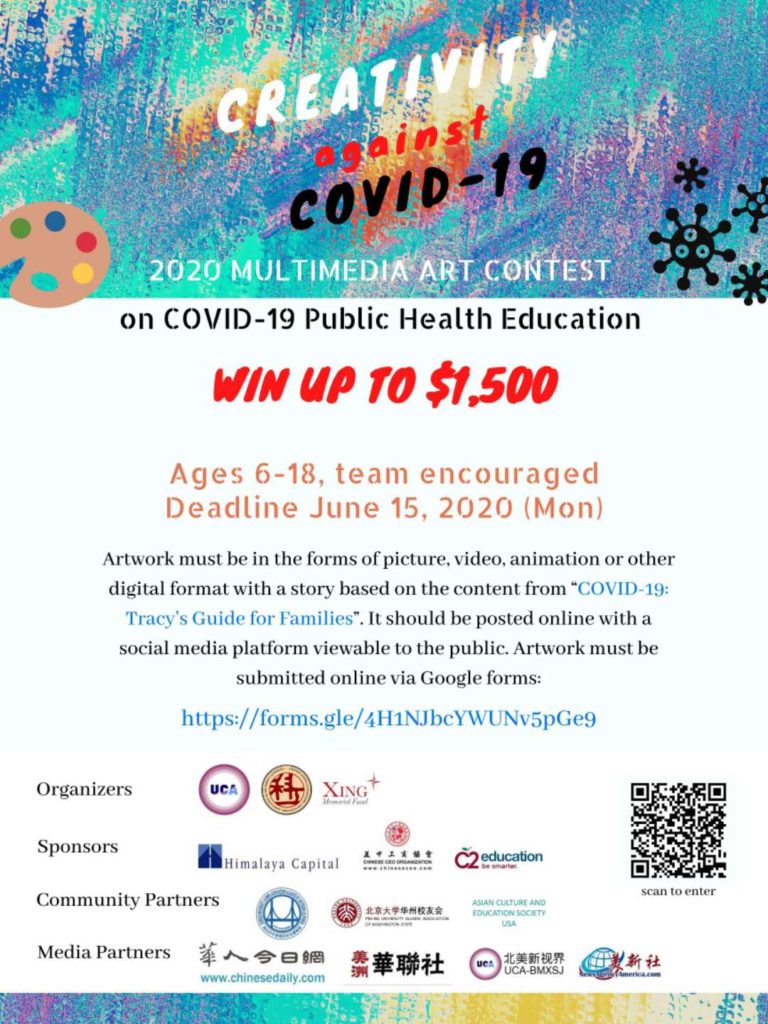
In conjunction with multiple partners, UCA is co-organizing an art contest to help illustrate and promote our beloved Tracy’s Guide COVID-19 educational series for families.

Prizes

  • Grand Prize: $1500 cash + award certificate, 1 winner
  • Second Prize: $500 cash + award certificate, 8 winners
  • Third Prize: $250 cash + award certificate, 16 winners
  • Best Teamwork Prize: $600 cash  + award certificates, 5 winner
  • “My Favorite” Prize: $100 Amazon gift cards + award certificate, 60 winners

Ages 6-18, team encouraged! Artwork must be in the forms of picture, video, animation or other digital format with story based on the content from “COVID-19: Tracy’s Guide for Families“.

Artwork should be posted online with a social media platform viewable to the public. Artwork must be submitted online via Google forms: https://forms.gle/4H1NJbcYWUNv5pGe9

Rules

  • The contest opens to K-12 students age from 6 to 18. Teamwork is encouraged. Appropriate proof of age may be asked by the organizers. Parent/guardian permission is needed for students under age 13 to enter the contest. 
  • The purpose of the contest is to encourage K-12 students in America to learn and share the essential knowledge about COVID-19 and how to protect individuals and their family members from infection of coronavirus.  Use of social media is an important requirement of the contest. Participants are expected to post their work on social media to generate viewership. Viewership of the artwork on social media (a measurement of how popular it is) will be considered in winner selection. 
  • Artwork must be in the forms of picture, video, animation or other multi-media format with a story based on the content from “COVID-19: Tracy’s Guide for Families”. It should be posted online and is viewable to the public. Participants should submit the URL to us by the end of June 15, 2020 (Monday). 
  • The entry artwork must be original and may not violate U.S. copyright laws. Any entry that has been copied from an existing photo, image (including a painting, graphic, or advertisement) or video that was created by someone other than the student is a violation of the competition rules and will not be accepted. 
  • Entries to the competition of participants under age 13 should be supervised by parents/guardians.

Artwork should be submitted online at: https://forms.gle/4H1NJbcYWUNv5pGe9. The entry form asks for the following information:
Participant’s name, age, school, contact information, URL of the artwork, and a short essay on what you want to achieve through your artwork (no more than 500 words). 

For any participant under 13 years old, artwork must be submitted by a parent/guardian of the participant. 

Submitted artworks will be reviewed by a selection committee. Committee members are appointed by United Chinese Americans and Xing Memorial Fund. The committee members will evaluate the artworks by the following categories:

  1. Content (story must be based on content from “COVID-19: Tracy’s Guide for Families”)
  2. Quality (rating based on age group)
  3. Creativity/Imagination (rating based on age group)
  4. Popularity (based on viewership on social media)

The names of the prize winners will be announced before the end of June 2020 and the winners’ prizes and certificates will be mailed out to the winners at the same time. All participants of the contest will receive participation certificates. Top 3 prize winners will have the opportunity to present their artworks in the next United Chinese Americans (UCA) Convention.

Please write to tracyuca@gmail.com if you have any questions.

For co-hosting or sponsorship opportunities, please click here.

Advisory committee: 
Lily Lee Chen陈李婉若、Dr. Cun-Yu Wang王存玉院士、Haipei Shue薛海培、Dr. Hui Su苏慧、Joy Chen陈愉、Xiaodong Zeng曾晓东、Mingdi Yang杨鸣镝、Hei Feng黑峰、Steve Chiang江启光、Yue Rong容跃、Liam Li李黎、Joey Zhou周宇
Winner selection committee: 
Lily Lee Chen陈李婉若、Dr. Cun-Yu Wang王存玉院士、Haipei Shue薛海培、Joy Chen陈愉、Xiaodong Zeng曾晓东、Mingdi Yang杨鸣镝、Hei Feng黑峰、Steve Chiang江启光、Yue Rong容跃、Liam Li李黎、Ying Zhan战颖、Jun Sun孙军、Tao Jiang姜涛、Sun Liu刘隼、Xi Zhang张西、Dr. Helen Shih施慧伦、Lily Chen陈健、Jian Ruan阮健、Dr. Jingyi Xi席静怡
Organizers: United Chinese AmericansChinese American Engineers and Scientists Association of Southern California & Xing Memorial Fund Sponsors:

Himalaya CapitalChinese CEO OrganizationC2 Education
Community Partners:

Chinese University of Alumni Association Alliance of Southern CaliforniaPeking University Alumni Association of Washington StateAsian Culture and Education Society USA
Media Partners:

Chinesedaily.comHuarenone.comUCA-BMXSJNewsAgencyAmerica.com

Disclaimer and Copyright © 2020 United Chinese Americans

UCA #FoodOfLove Donation Drive

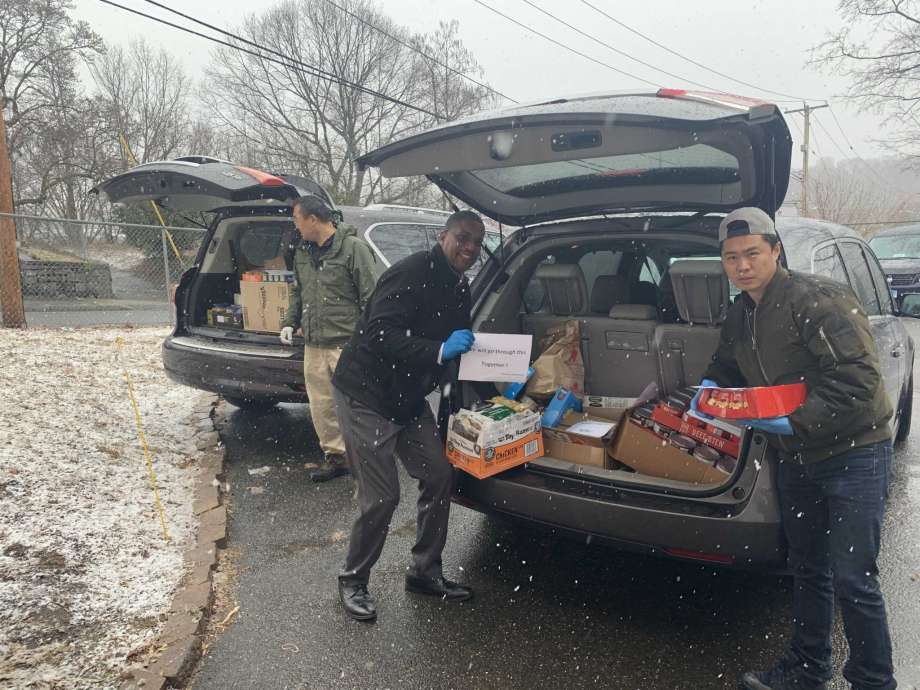
UCA “Chinese American Food of Love Day” Donation Drive

全美华人联合会“华人爱心中餐日”捐款

50 States, 100 Cities,

One People United!

五十个州,一百座城市,万众一心!

That is what our community is doing on May 10 to donate food to the needy people all across the country. Never have we done that together before!

5月10日这一天,我们华人社区将向全国各地需要的人们捐赠食物。 这是前所未有的集体行动!

United Chinese Americans, partnering with many organizations and the Salvation Army, is kicking off “Chinese American Food of Love Day,” to show that Chinese Americans care (for more, visit: https://ucausa.org/food-of-love/).

全美华人联合会和许多地方组织以及Salvation  Army共同发起“华人爱心中餐日”活动,以表明华裔美国人的关切心情(更多信息请访问:https://ucausa.org/food-of-love /)。

Your donation of $100 or more will also double as your membership fee to UCA. Every dollar you donate will be used exclusively for the food program and the pandemic relief. (See different levels of UCA membership and benefits: https://ucausa.org/membership/)

您若捐赠100美元或以上的金额,也将成为你UCA会员费用的两倍。 您捐赠的每一美元,都将专门用于食品服务和抗疫活动灾。 (请参见UCA成员资格和权益的不同级别:https://ucausa.org/membership

Together, we shall defeat this pandemic!

我们将一起努力战胜疫情!

P.S. UCA (United Chinese Americans) is a 501(c)3 non profit, UCA’s Federal TAX ID is 82-1111498. Your donation is tax deductible.

For Check Donation: Payable to UCA
Mailing Address: 1050 Connecticut Ave. NW. Suite 500. Washington. DC. 20036

附注: UCA(全美华人联合会)是501(c)3非营利组织,联邦税号是82-1111498。 您的捐款可以获得免税。支票捐赠请支付给“UCA”。

Email: info@ucausa.org
Website: ucausa.org

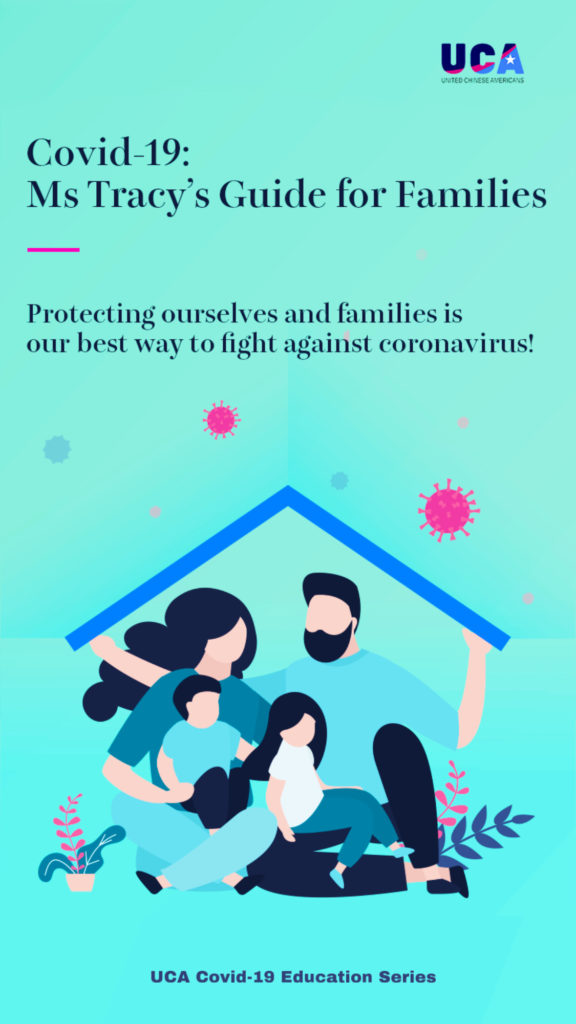
UCA Launches Tracy’s Guide for Families to Help Combat COVID-19

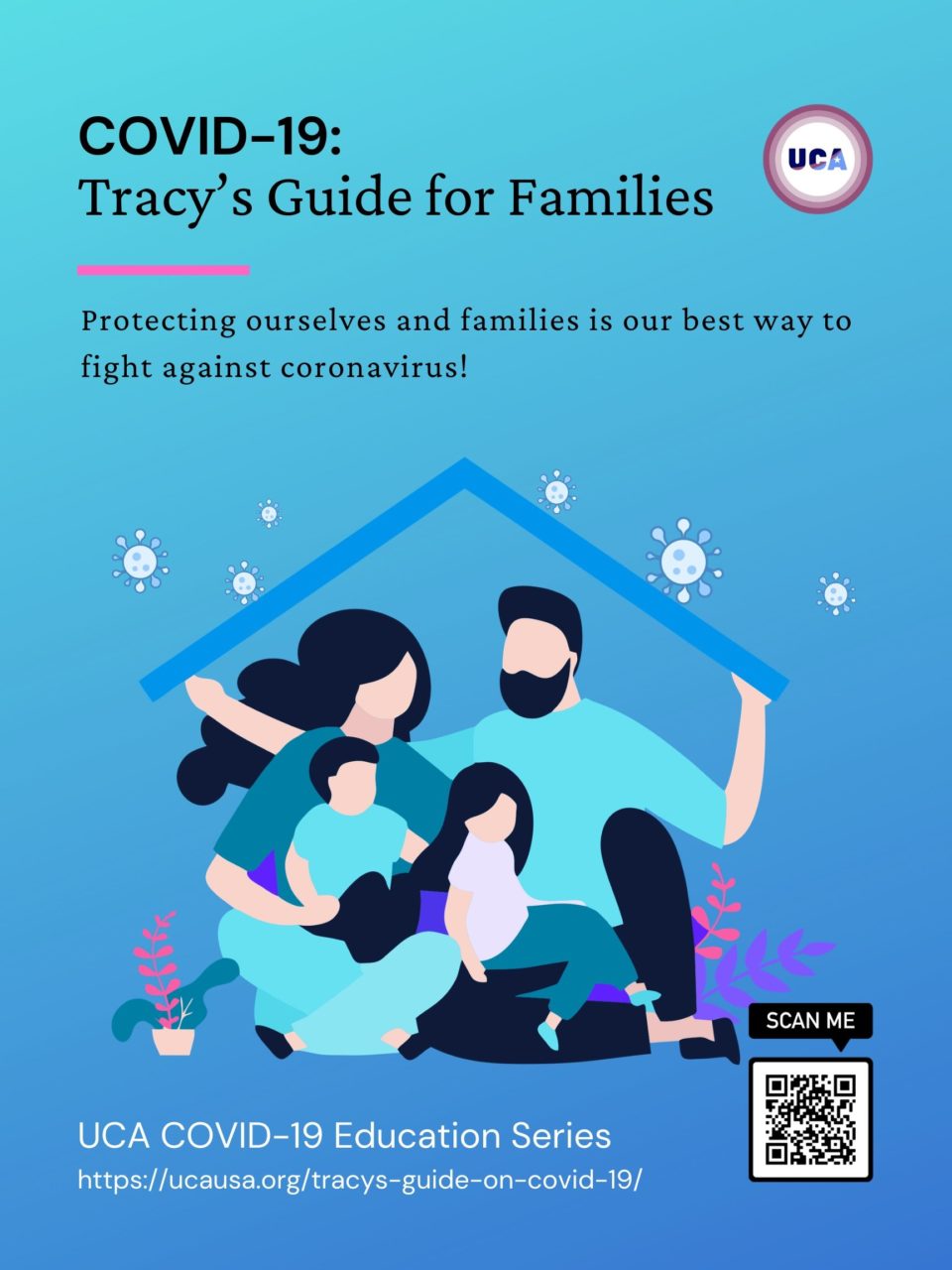
UCA announces the launch of the “COVID-19: Tracy’s Guide for Families”

Help Combat the Coronavirus in and Around our Homes

Washington, DC (April 10, 2020) – United Chinese Americans (UCA) proudly announces the publication of an educational series for families: “COVID-19: Tracy’s Guide for Families” (the “Guide”) on its website https://ucausa.org/tracys-guide-on-covid-19/ (official blog: tracysguide.blogspot.com). The Guide is a running online series aimed to provide useful knowledge and tips for protecting our loved ones and our home as we work together to “flatten the curve”.  As more than 80 percent of Americans are now under stay-at-home orders, learning how to take care of our homes and protect family members is a critical part of the national effort to control the pandemic.  In this Guide, UCA is gathering valuable experiences from Chinese-speaking regions that are recovering from the COVID-19 epidemic, including China, Hong Kong, Taiwan and Singapore, so their hard lessons-learned can be shared with the rest of the world.

Materials in the guide are collated and distilled from the official medical guidelines, prevention books, and published materials, from China and other regions, then adopted into English literature based on American custom by freelance writers, translators and artists. They are also cross-checked and referenced, and combined with those from CDC and various state public health departments, with an aim to bring out these contents to American families and communities in a timely fashion. The guide is the product of teamwork and collaborative effort by more than 40 volunteers and UCA members, both in the US and China. Many of them are healthcare professionals, biomedical scientists, and medical doctors involved in fighting the COVID-19 pandemics since the beginning.

Through a factitious character named “Ms. Tracy”, the key steps in COVID-19 prevention, how to disinfect common household items and areas such as kitchen and bathroom, and how to take care of the sick, are addressed by a lively question-and-answer dialog fashion. The materials are specially organized and illustrated to make it easy to understand, attractive to children, and relatable to the general public. More than 40 articles will be forthcoming, addressing questions and providing know-how in the most commonly encountered situations at home and in community settings.

UCA and its members have been actively engaged in the relief effort and public health education since the beginning of the pandemics in China.  “Projects like “Tracy’s Guide for Families” to contribute to the fight, initiated and organized by UCA volunteers, are happening in every city and township in America.” commented by UCA President, Haipei Shue. “This is the time for us to work together, to put aside our biases on race, politics, religions, or anything that could divide us. The war against COVID-19 pandemic is a global one. People all over the world must work together side by side to win it at the end!”

For more information on the Guide, as well as other efforts by UCA members and the Chinese-American community to combat Covid-19 in America, contact Helen Shih/ helenshih1111@gmail.com.

Contributions by Asian Americans in fighting COVID-19 Pandemic

Contributions by Asian Americans in fighting COVID-19 Pandemic

Since the beginning of the outbreak in January, Asian Americans have been on the frontline combating the pandemic and protecting America. Not only we supported families and doctors in Asia, but also, we actively engaged in the local communities here to slow down spread of the virus to America in saving lives. Apart from Asian American doctors, nurses, scientists, and many others who have been an integral part of front-line defenders and medical community, some of community-wide efforts done by Asian Americans, in the order of time sequence, include:

  • Educating local communities on prevention tips and scientific facts, dispelling myths and fear associated with the virus.
  • Organizing self-help and self-monitoring groups to alarm people who have traveled abroad and assisted them in proactive self-quarantine and home-isolation.
  • Organizing meetings and town halls with local public health departments and elected officials, in addressing the anxiety of the communities and economic impact to local small business.
  • Various donation drives and fundraising through different organizations and self-help groups, purchasing, collecting, and sending personal protection equipment (PPE) to front-line medical staff, first responders, senior centers, and healthcare facilities.
  • Connecting local business communities and global logistics network through chambers of commerce and Asian American business, identifying manufacturers of PPEs and medical equipment in Asia, and shipping them to hospitals and healthcare facilities here in the US.
  • Connecting medical doctors and public health experts in Asia, bringing their valuable expertise and experiences to the US in building medical exchange and online resources centers.
  • Connecting doctors, scientists and healthcare professionals, bringing their knowledge and prevention tips to American general public and healthcare workers in disease prevention and public health, for example, by hosting webinars and writing online articles.

As an example, here is a partial list of the medical units and first responders in the Greater Houston area that have already received donations and PPEs from various Asian American organizations:

  • City of Bellaire Police / Fire department City of Houston
  • Fire Station #78
  • Harris County Sheriff’s Office Precinct 5 Constable Office
  • Beeler-Manske Clinic Center for Women’s Health
  • Colony Internal Medicine Associates Colonial Oaks at Pearland
  • Dr. Mei Zhang Family Medicare Greater Houston Psychiatric Associates Energi Care
  • Harris Health System
  • HCA Healthcare Clear Lake Hillcroft Medical Clinic Houston Health Foundation
  • Kelsey-Seybold Clinic with 24 Locations Kindred Hospital Sugar Land
  • Memorial Hermann Southwest Hospital Memorial Hermann Katy Hospital
  • Memorial TMC/UT Health McGovern Medical School
  • Methodist Hospital
  • Michael E. DeBakey VA Medical Center Nexus Children’s Hospital Woodland Sacred Heart Emergency Center
  • Signature Care Emergency Rooms – 9 locations Sound Medical Clinic
  • St. Luke’s Hospital
  • St. Luke’s Hospital Anesthesiology Division St. Luke’s Hospital, Pearland
  • Sugar Land Donation Event to Mayor Texas Children Hospital
  • Texas Children’s Pediatric Clinic, Katy West Houston Division of U.S. Anesthesia Partners (USAP)
  • Welcome Family Medicine

A resource center built by United Chinese Americans for disease prevention and public education with compiled resources from China: https://ucausa.org/covid19/

Example webinars hosted by United Chinese Americans for community education:

https://ucausa.org/facts-not-fear/

Video link: https://youtu.be/HZ_1PAb9YZw

Example articles documenting efforts by Houston Asian American Community:

https://www.houstonchronicle.com/news/houston-texas/houston/article/False-Coronavirus-rumors- crush-business-as-they-15021425.php?cmpid=gsa-chron-result

https://www.houstonchronicle.com/news/columnists/grieder/article/Grieder-Let-s-focus-on-coronavirus- solutions-15146001.php

https://www.chron.com/business/real-estate/article/The-Branch-to-close-Mondays-to-support- Chinatown-15117984.php

A partial compiled list of published media on Chinese American community in COVID-19 relief effort:

http://www.ucausa.org/go/media-reports/