Action for Covid-19

UCA Calls for Chinese Americans to be involved in the relief effort towards the New Coronavirus outbreak and disease prevention in the U.S.

Click to download PDF

Given the urgent situation of the Novel Coronavirus outbreak in China, United Chinese Americans (UCA) is watching it closely and working with Chinese organizations across the country in coordinating our relief and prevention efforts.

At UCA, we understand this is a particularly difficult time for Chinese families here and back in China, many of them are severely impacted by this outbreak, and many are deeply concerned of what has and would happen next. At this critical moment, our hearts are with millions of families in China, especially those who are fighting the virus on the frontline day in and day out.

Many Chinese communities and organizations are involved in the relief effort here in the U.S., sending medical supplies back home or raising fund for it. These efforts bring a sense of solidarity and hope from the Chinese diaspora to the Chinese people in affected regions.

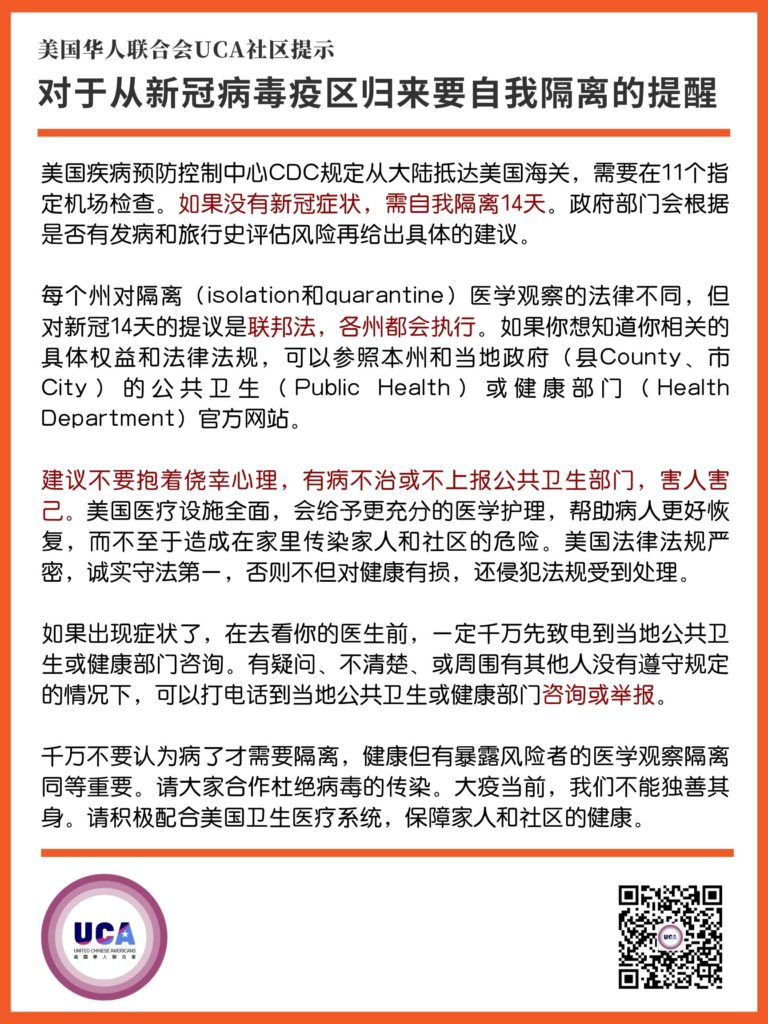
We ask members of the Chinese communities in the U.S. to exert every precaution you can in stopping the spread of the virus, and follow the guidelines from the CDC, local and state public health departments. Effective and responsible communication and working together with other members of the American authorities concerned will be instrumental in approaching this virus and ultimately defeating it.

At the same time, we also have to be vigilant to fight any old racial stereotype, media bias, and mis- and disinformation that could spread faster than the virus itself. Please do due diligence in keeping social media clean, remain calm and objective, in dealing with information. 

Panic and other overreactions will not alleviate the problem but instead create more difficulties, for example, many Chinese American small businesses and companies are already suffering from the aftermath of the outbreak. Not only do we have to be responsively involved in the relief effort in China, we also have to be mindful of the social impact of what we do or not do toward our own communities here in this difficult time.

With rising fear, ignorance, and discrimination against Chinese and Chinese Americans, we have to stand up together, for ourselves. UCA is ready to help Chinese American communities, as we have always done in the past, to stand up for our rights and dignity.   

We need to be active and vigilant citizens in local communities and civically engaged in communicating with governmental agencies and elected officials. It is a humanity crisis and opportunity of global effort and scientific collaboration. If you can contribute, either in the relief effort, or any areas of your talent and interest, please contact us immediately and join the UCA community of dedicated volunteers and team members.

In the end, at this special time of the passing of the Lunar New Year, we trust that our persistence, patience, and hard work will take us to the end and lead us to a victory over the virus. UCA wishes everyone and every family a safe and healthy year ahead, and let’s try our best to win this battle together.

Science and Technology Caught between the United States and China Conference

By: Steven Pei

Science and Technology Caught between the United States and China Conference

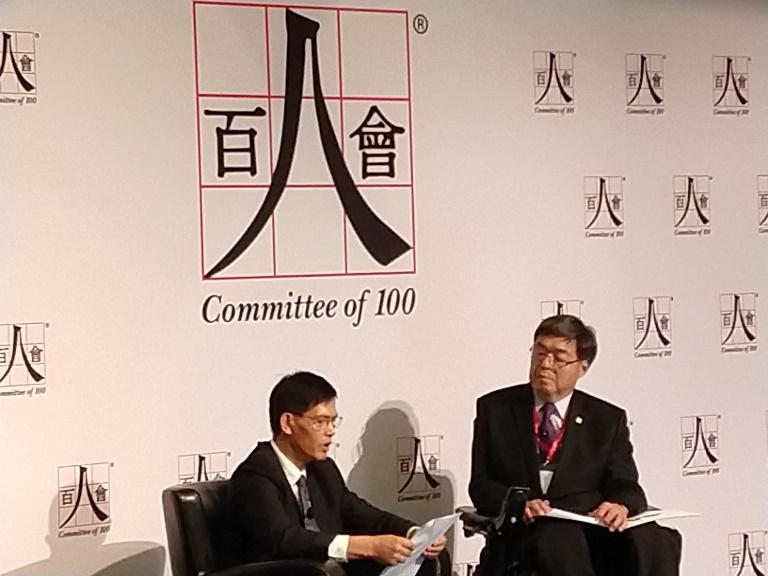
The Committee of 100 (C100) convened nearly 300 leading policy makers, legal experts, educators, business leaders, scientists, and community leaders in Palo Alto, Ca. on September 28, 2019 to address the human impacts of geopolitics. In addition to sixteen community partners, including Civic Leadership USA (CLUSA) and United Chinese Americans (UCA), the conference was also co-sponsored by thirteen professional organizations, including the Society of Chinese Bioscientists in America (SCBA), the Chinese American Hematologist and Oncologist Network (CAHON), and the Chinese Biological Investigators Society (CBIS), who issued the first open letter in the Science Magazine and drew a response from the leadership of National Institute of Health (NIH) on March 22, 2019.

After the opening welcome by Roger Wang, Chair of C100, Ambassador Gary Locke set the tone of the conference: “The U.S. – China relationship is the world’s most consequential bi-lateral relationship. We must be concerned about security concerns and condemn illegal activity, but in recent years there have been many cases of wrongful prosecution. Our pride in our heritage does not mean we are any less loyal or patriotic to America.” He was followed by Professor Susan Shirk, Chair, 21st Century China Center at the School of Global Policy & Strategy, University of California, San Diego, and former U.S. Deputy Assistant Secretary of State. She gave the opening keynote: “China and the U.S. wove together a dense fabric of trade, technology, and education – forming a nexus of what became globalization.” “To preserve America’s open society and vibrant research environment, we should double down on American openness, not put limitations on scientific collaboration.” 

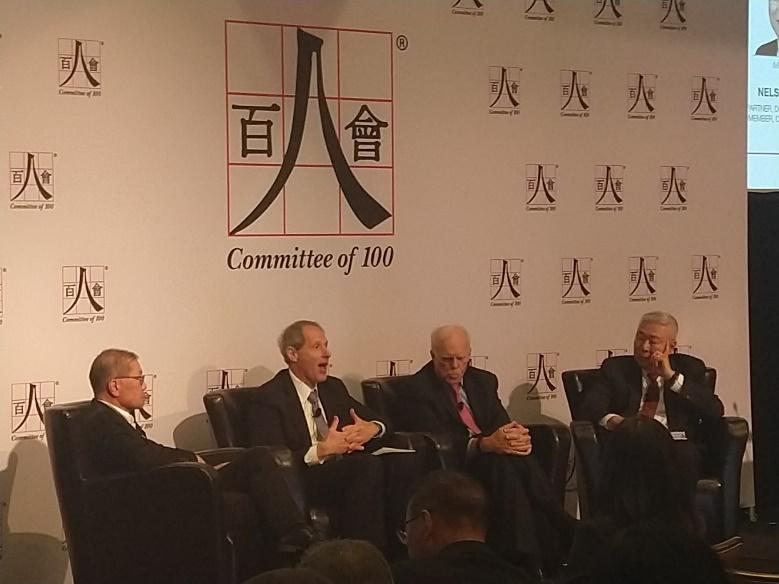
Dr. David Ho, Scientific Director of Aaron Diamond AIDS Research Center, Dr. Thomas Rosenbaum, President of California Institute of Technology, Dr. John Hennessy, Chairman of Alphabet Inc. and moderator Nelson Dong of C100 at the keynote panel.

Dong pointed out that “76% of 1,466 patents issued in 2011 to top 10 U.S. research universities had at least one foreign born inventor.” He also presented data showing the high percentages of American Nobel laureates and prize winners, science and engineering workers and student who were foreign-born. 

Dr. Ho argued, worried that NIH’s crackdown had already gone too far. Ho argued that the known cases are “largely due to sloppiness and a degree of greed” by a few scientists. “A small number of ‘bad apples’ does not connote a systemic problem that requires federal intervention when it could be addressed at the institutional level with policies already in place.”

President Rosenbaum, “The strength of the United States as a scientific, technological and economic power has depended crucially on immigration. Recent demonstrated examples of violations of scientific ethics, coupled with fears for U.S. economic competitiveness and national security, may well lead to governmental restrictions that broadly and severely restrict the flow of people and ideas.”

Chairman Hennessy pointed out that “Immigrants come to this country to make America a better country. There are a number of important American companies with foreign born founders. If you cut that off, you cut off an important part of our nation’s economic vitality.”

Dr. Steven Chu, Nobel Laureate and Former Secretary of Energy, and Congresswoman Judy Chu gave the plenary speeches at lunch. Robert Gee of C100 and Former Assistant Secretary of Energy gave a policy briefing in the afternoon. 

David Stilwell, U.S. Assistant Secretary of State for the Bureau of East Asian and Pacific Affairs joined by live video conference from the United Nation. 

Congressman Adam Schiff, chair of House Intelligence Committee, also delivered a pre-recorded speech.

It was followed by the “Business and Technology Panel” on the impact on business and the technology industry with Ambassador Craig Allen, President of U.S.-China Business Council and Carl Guardino, President and CEO of Silicon Valley Leadership Board.  The panel was moderated Jerry Yang of C100 and co-founder of Yahoo! Inc.

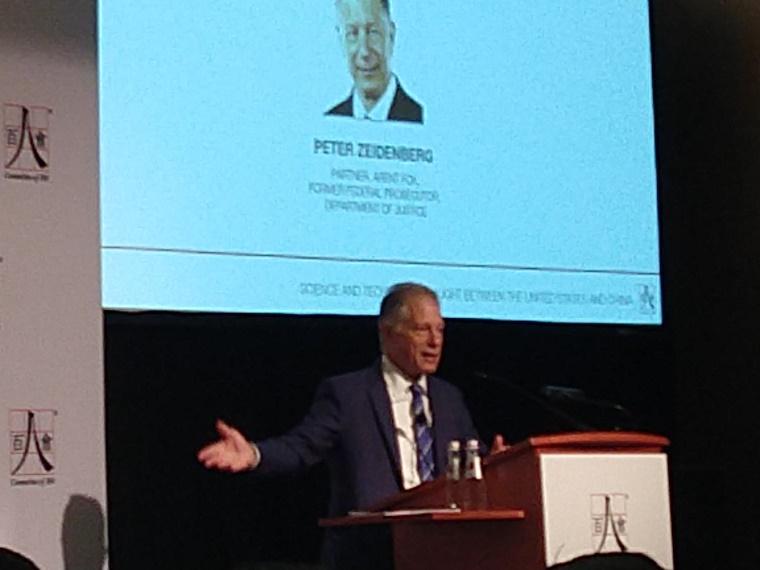
John Hemann, Chief of the Special Prosecutions Section of the U.S. Attorney’s Office for the Northern District of California and Peter Zeidenberg, former Federal Prosecutor, Department of Justice at the “Law and Justice Panel” on legal perspectives and impact moderated by Brian Sun of C100.

Brian Sun opened the panel with a discussion of Chinese Americans contributions and several U.S. Government initiatives and investigations of espionage cases and false accusations. As a lawyer with Jones Day in Los Angeles, California, he warned the audience that participating in the Thousand Talents Program “puts a target on your back. So don’t be stupid.”  

Zeidenberg talked about the cases of Xiaoxing Xi and Sherry Chen that he represented. It set the stage for “A Personal Perspective” by Professor Xiaoxing Xi. Even though he has shared what he and his family went through many times already, it brought Xi to tears again. Then Conference Chair Charlie Woo of C100 annnounced the good news that the American Physics Society just named Xi the 2020 recipient of Andrei Sakharov Prize “for his steadfast advocacy in support of the U.S. scientific community and open scientific exchange.” 

Woo also gave the closing remarks, “It is our hope to come together and find balanced solutions that protect national security, uphold the civil liberties of all Americans, and continue to foster the welcoming environment for the development of science, technology and research that America has always been known for.”

Columbia University Joins UCA’s Call to Speak Up

Lee C. Bollinger, president of Columbia University, published an opinion piece on Washington Post, titled “No, I won’t start spying on my foreign-born students“, in response to heightened pressure on academic research, joining a growing list of other institutions making similar statements. The content is reposted here.

The FBI has stepped up its scrutiny of research practices at college and university campuses — including mine.

Law enforcement and intelligence agencies determined to thwart the illegal transfer of intellectual property to foreign rivals are encouraging U.S. academics and administrators to develop more robust protocols for monitoring foreign-born students and visiting scholars — particularly if they are ethnically Chinese.

With students returning to campus, these policing attempts thrust economic and political concerns into fierce conflict with First Amendment freedoms.

To be sure, government-funded academic research in such national security realms as cybersecurity and bioterrorism is justifiably sensitive. Likewise, academic research conducted in collaboration with U.S. companies — a principal target of most unlawful technology transfers — leads to commercial innovations that warrant protections. Universities have an obligation to comply with existing security protocols, identify sensible ways to bolster them, and cooperate fully with law enforcement authorities and corporate research partners if clear acts of espionage are suspected. To the extent we are falling short in any of these areas — and yes, there have been isolated incidents of academics sharing sensitive intellectual property with foreign governments — we can and must do better.

At the same time, however, only a fraction of the research conducted on campus is “secret.” Indeed, the reality is just the opposite. Academic research is intended to be shared — released into the public domain to advance human progress. Groundbreaking medical discoveries, agricultural innovations credited with saving billions of people worldwide from starvation, the Internet, artificial intelligence: All are the result of publicly available, university-based research.

Consequently, a foreign national need not fly halfway around the world to “infiltrate” our great universities and learn about our latest insights and findings: With some notable exceptions,she can type words into a search engine and peruse peer-reviewed academic journals from the comfort of an office or dorm room overseas. Or, similarly, she can visit the U.S. Patent and Trademark Office’s website, where applications for patent protection provide detailed descriptions of recent innovations.

And so, most worrisome to me, as someone who has spent five decades advocating freedom of expression and assembly, is the notion that university personnel — and perhaps students themselves — should be asked to monitor the movements of foreign-born students and colleagues. This is antithetical to who we are.

The mission of a university is to foster an open atmosphere conducive to speculation, experimentation and creation. American higher education is the envy of the world not in spite of, but because of, its unrivaled commitment to openness and diversity. Attracting — and welcoming — the brightest minds in the world, regardless of nationality or country of origin, is what we’re all about.

To put it another way, the U.S. university model is a strategic advantage, not a hindrance to American competitiveness. Our administrators, professors and research scholars are not, and should not become, an arm of U.S. law enforcement. Ironically, what the FBI apparently considers our great vulnerability is, in my view, our greatest strength.

At Columbia University, where I am president, thousands of students and faculty represent more than 150 countries. We stewards of major research universities couldn’t contain intellectual freedom even if we wanted to. The incompatibility of university culture with systematic scrutiny may explain why even law enforcement officials who have visited our campus have offered little prescriptive guidance, instead offering that we should be vigilant.

The unauthorized use of intellectual property by overseas competitors is a serious problem. But the surveillance of foreign-born scholars in this country is the wrong solution. If law enforcement agencies have legitimate concerns, it seems to me that they should identify and monitor those they designate as “suspicious people” based on real threats, not broad worries about entire nationalities.

A more effective approach — advocated by many of my colleagues in higher education as well as the bipartisan Commission on the Theft of American Intellectual Property — is to expand the number of green cards awarded to foreign-born graduates of our great colleges and universities. Many of these international scholars, especially in the fields of science, technology, engineering and mathematics, would, if permitted, prefer to remain in the United States and work for U.S.-based companies after graduation, where they could also contribute to the United States’ economic growth and prosperity. But under the present rules, when their academic studies are completed, we make it difficult for them to stay. They return to their countries with the extraordinary knowledge they acquired here, which can inform future commercial strategies deployed against U.S. competitors.

The mandate of our colleges and universities is to pursue open, robust inquiry across a wide range of topics. Our institutions of higher learning should do more — not less — of what made the United States the most innovative nation in the history of the world.


Related Posts:

UW-Madison is the Latest to Join UCA’s Call to Speak Up,Amid Worsening US-China Relations

Repost from UW-Madison OFFICE OF THE CHANCELLOR website: UW’S RELATIONSHIP WITH CHINA.

The U.S. and China need each other. We need each other as trading partners; we need each other as major world leaders. And our universities need each other.

As we count down the final days of summer and get ready for another academic year, let me tell you about my most interesting trip of the summer.

In late May, I had the honor of leading a delegation to China. While not my first trip to that country, it was my first trip as UW chancellor.

Why visit at a time when the geopolitical relationship between the countries is strained? Quite simply, UW and China need each other more than ever and can learn much from one another.

On the May trip, multiple groups from campus, including the International Division, the Wisconsin Foundation and Alumni Association, International Student Services and several of our schools and colleges, participated in various aspects of the trip to help make it a success.

It was a busy itinerary, including meeting with our alumni, welcoming incoming Chinese students and their families to UW, attending conferences organized by UW faculty at Chinese universities, meeting with higher education leaders, and conducting industry-partnership conversations.

By way of background, you might know that UW’s history with China goes back more than 100 years. A century ago, we were the top public university (and 4th largest overall) recipient of Chinese students enrolling in American universities through the “Boxer Indemnity” scholarship fund, the main route at that time for Chinese students to attend college in the U.S.

Forty years ago, then-Chancellor Irving Shain was the among first American university presidents to visit China after it re-opened to the outside.

Today, we have 3,200 students from mainland China studying at UW. They comprise the largest group of international students at UW. Between 2000 and 2018, their share increased from 25% of all international students to 55%.

We welcome these students and scholars to Madison and do everything we can to support them and help them to be successful. Their presence on campus enriches the residential experience of all of our students.

Big, public research institutions like UW that educate thousands of students and conduct groundbreaking research have to have a global reach if we’re going to carry out our mission. Unlike in past decades, this relationship has become increasingly bilateral. Our scientists are collaborating with Chinese scientists. While there are still far more Chinese students coming to UW, increasing numbers of our U.S. students are interested in going to China. Our faculty are organizing international conferences in China with colleagues from that country – and vice versa. During my recent visit, a conference on higher education organized by a UW faculty member in collaboration with Peking University allowed me to address colleagues in China. All of these connections create new opportunities for all involved.

We need to be smart and respectful in all of our international collaborations. Full transparency and disclosure will benefit all partners and everyone involved in collaborative research projects.

The strategic partnership agreement that we signed with Nanjing University is particularly significant. We have a long-shared history of cooperation with Nanjing – this is the campus that made the most significant impression on Chancellor Shain in 1979.

In signing our most recent agreement, UW-Madison and Nanjing are seeking linkages across disciplines that can have a lasting and positive global impact. This lays the foundation for an expanded relationship featuring many more years of research collaboration and student exchange.

We also are collaborators in nine active research partnerships with Chinese universities, including a project that brings our wildlife biologists together with ones at Peking University to understand the impact of development on the Asiatic Black Bear population.

Our faculty talk about the two-way nature of their work with Chinese counterparts. As Chinese universities expand in size and quality, and as top scholars work in China, we now meet as full partners and potential collaborators with much to gain on both sides.

Collaborations can create the potential for economic development, with six current industry projects located in China, including a $2.5 million project with Nestle to develop and run a dairy farming institute.

There is growing concern about security issues with China, particularly around intellectual property. We need to be smart and respectful in all of our international collaborations. Full transparency and disclosure will benefit all partners and everyone involved in collaborative research projects.

But I am proud of the number of scholars at UW – both US citizens and citizens of other countries – who have ties to China, and I support the work that they do.

The U.S. and China need each other. We need each other as trading partners; we need each other as major world leaders. And our universities need each other. We can learn more working together than working in silos.

As long as we both share a commitment to open inquiry, outstanding education, and sharing knowledge and discoveries in a way that improves people’s lives, we can work together.