Graduation Ceremony – UCA-IL/CLUSA Civic Engagement Summer Internship

UCA is excited to share some updates on the new youth program from UCA Illinois: Civic Engagement Summer Internship. The program’s mission is: Train, Connect, Collaborate, Empower and United civic leaders and local organizations in USA.

The program provides students internship opportunities in elected officials’ offices or government agencies, whether at the local, city, county, state, or federal levels, and selected nonprofits to inspire students’ interest in government and public policy, to build a pipeline of Asian Americans in public office, and to build strong coalitions with participating agencies, offices, and organizations. The program is made possible with a grant from Civic Leadership USA (CLUSA) .

We want to express our heartfelt thanks to the following offices participated in the program and hosted our interns:

  • Illinois State Representative Theresa Mah’ office
  • Chicago 12th Ward Alderman George Cardenas’s Office
  • Illinois Department of Human Services
  • Illinois Department of Corrections
  • Illinois Department of Children and Family Services
  • Illinois Human Rights Commission
  • Illinois Business Immigration Coalition
  • City of Aurora

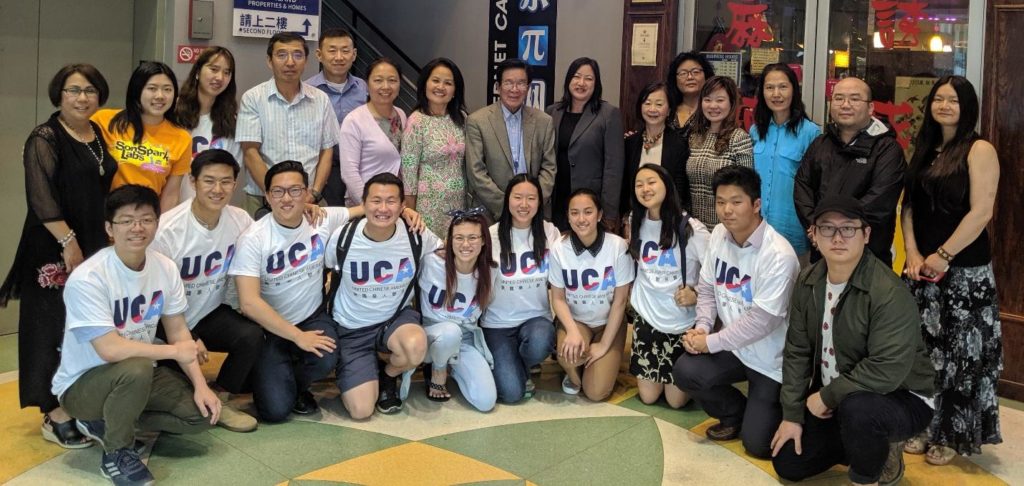
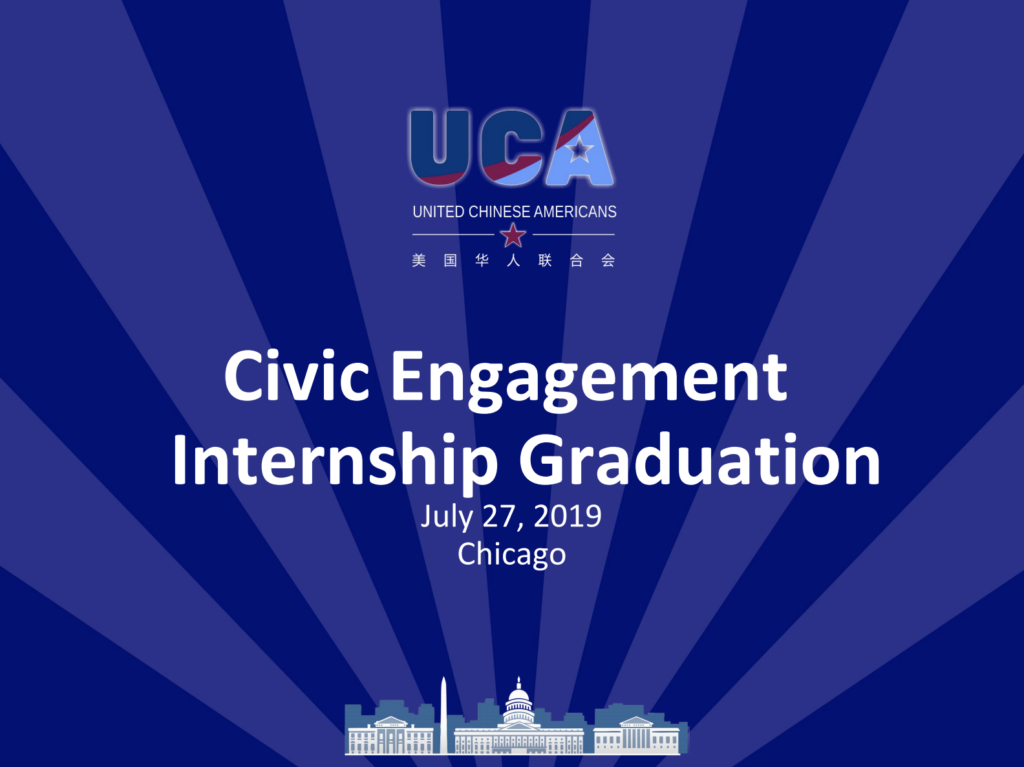
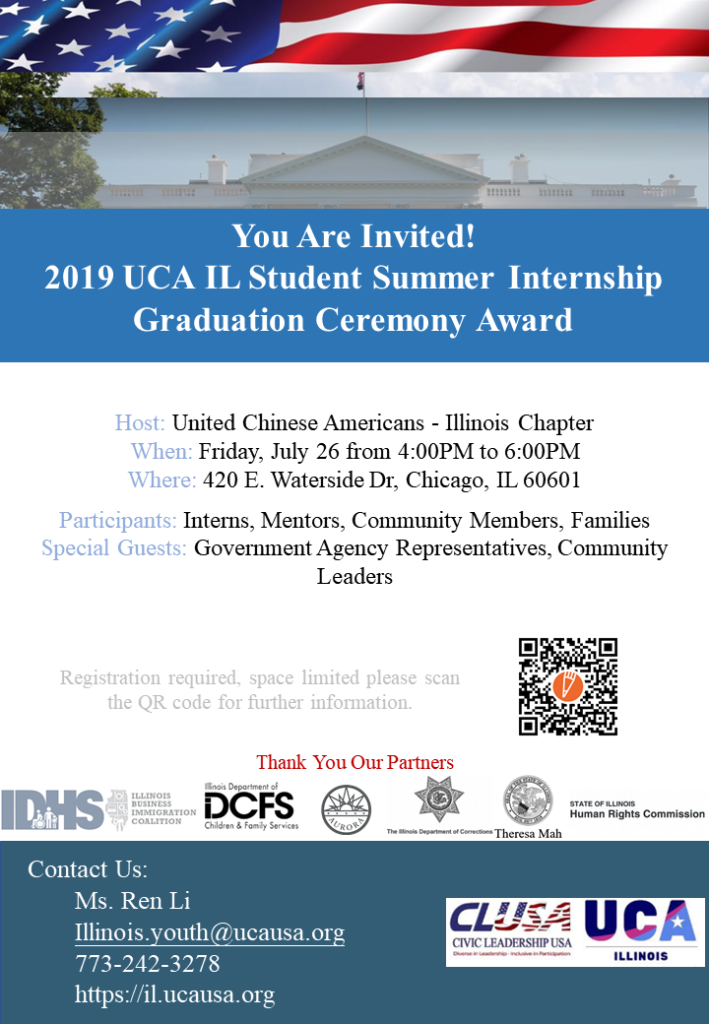
Now we’d like to invite you to join the graduation ceremony with representatives of these government offices, our interns/students, their mentors and families, future interns and community members on Friday July 26, at 4-6 pm in Chicago.

Please see details about the event on the flyer below. You will hear our honoured officials and speakers from these offices and our interns sharing their inspiring stories and experiences.
Civic engagement has been a key mission for UCA as an organization. Over the last three years, we have done a lot to increase the engagement of Chinese Americans in their communities and civic processes. To more effectively carry out that mission, we also need to get the next generation involved. We would like to help the youth to become more aware of the social and political environments. Having the chance to participate in the processes and understand how governments work is a great way to achieve that. Our interns in Representative Mah and Alderman’s Cardenas offices shared that each citizen’s voice does count and these offices’ daily work is related to every citizen’s daily lives.

Some of our interns also find governments can be a great place to apply the academic knowledge and professional skills that they have acquired at colleges, learn about social justice, and simply grow and network as young adults. For example, the intern at City of Aurora was assigned to work on regulations of commercial signs. It’s a good fit for his Urban Planning major in college. Another student in Biology found relevant work during his internship at Department of Human Services in fighting abuse of controlled substances. Our high school interns learned a great deal at Human Rights Commission about social justice. The parent of one of the two students interning at Department of Corrections shared with me that the internship is the best time he has this summer, and proudly included the experiences on his LinkedIn profile.
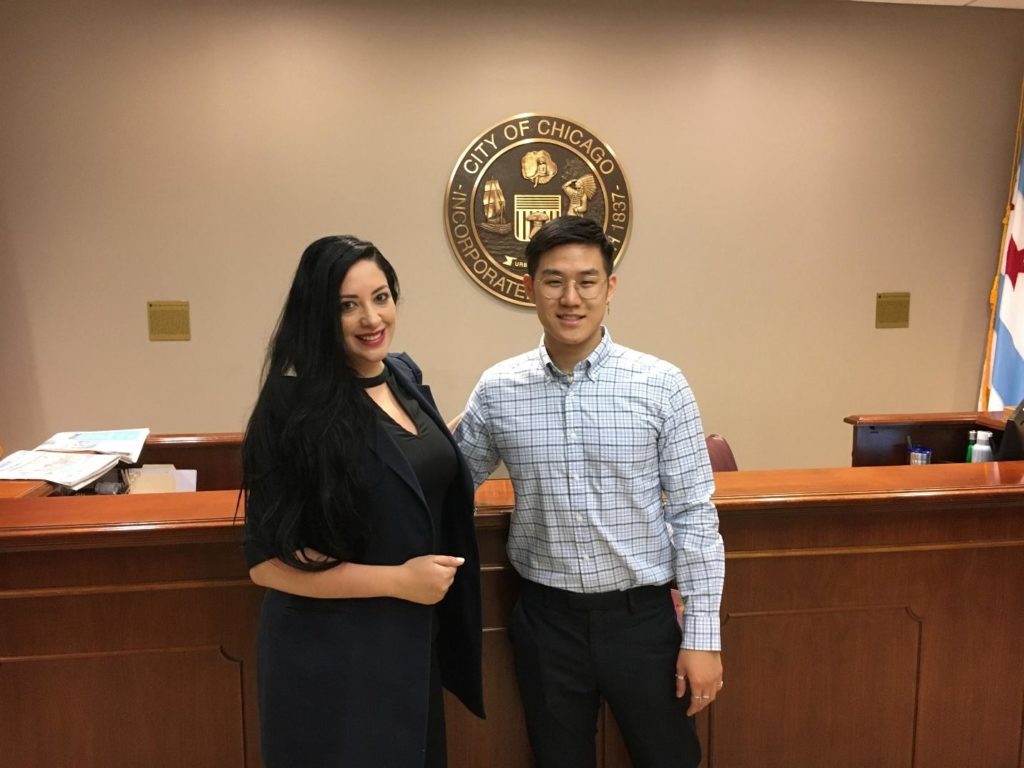
The internship was coordinated by Ren Li, VP of UCA IL who works with Jean Ma, Coordinator for Civic Engagement. They also participated in National CLUSA internship training with four of our interns late June. They got the great opportunity to gain insights into how we get more involved in the civic processes around the country, and developed their networks of Chinese American youth communities.

To help interns adapt to the work environment and develop themselves, we had two group trainings and each was assigned with a mentor. The mentors are mostly community leaders with deep experience in government, civic services, or their respective professions. These mentors are Ms. Marjorie Moore of DCFS, Representative Theresa Mah, Ms. Nancy Chen, Ms. Winnie Chan, Ms. Hongbo Wang, Ms. Jing Kong, Mr. Haibo Guo, Ms. Jan Zheng, and Mr. Yaoming Pei.

If you have any questions about the program, you may contact Ms. Ren Li, the program’s coordinator, at illinois.youth@ucausa.org or by phone: 773-242-3278. We are looking forward to seeing many of you at the July 26 event! We will start to take names for the application for 2020 summer internship at the event.
Carnegie-Mellon is the latest to answer to UCA’s Call to Speak Up, joining U-Pitt, John Hopkins, UC San Diego, U-Chicago and more…

Carnegie-Mellon is the latest to answer to UCA’s Call to Speak Up, joining U-Pitt, John Hopkins, and more...

Further development since last update. (Click for details). Carnegie-Mellon University, joining U-Pitt, John Hopkins, UChicago, UC San Diego, and Caltech, issued statement to CMU community supporting Chinese and other international scholars and students. More institutions previously issued similar statements since February, 2019. Read the original call-tospeak-up (click here).

08/15/2019

Dear Members of the Carnegie Mellon University Community,

I write to you today about the vital importance of America’s research universities to our economic prosperity and national security, and the need to recommit to what has made us so successful. As public concerns and political debates emerge about global engagement in higher education, we must ensure that our research ecosystem remains strong. This requires steadfast commitment to both the free flow of ideas and the safeguarding of our work as required by the national interest.

In this time of intense rhetoric and in the wake of recent incomprehensible tragedies, it is important to remember that the United States is a nation of immigrants. People the world over flowed into this land, continually tempering and galvanizing us with new ideas and spurring the relentless renewal that has defined our global leadership. Here in Pittsburgh, generations of immigrants forged futures for themselves and their families — and the nation — in the factories lining the three rivers. Andrew Carnegie, an immigrant from Scotland, founded the Carnegie Technical Schools to educate the sons and daughters of those factory workers.

With this in our DNA, Carnegie Mellon has been an international university since our inception more than a century ago. And as our institution has grown and transformed, we have always been at the cutting edge of countless fields, such as artificial intelligence, performing arts, engineering, computational finance and behavioral economics, precisely because we have kept our doors open to the best and brightest from around the country and around the world. This is who we are and who we always will be. As an immigrant myself, I value this fundamental principle on a very personal level.

In the context of this great, open, immigrant nation, we also must recognize that foreign influence in the form of intellectual property theft, cyber attacks, espionage and other broad-scale, state-sponsored efforts are direct threats to our nation’s security and economic prosperity. Carnegie Mellon takes these threats seriously. At the same time, the negative tone of the public discourse on international issues and unjust scapegoating of segments of our community are causing mounting anxiety and unease on campuses across the country. Our campus, especially our international community, is not immune from this anxiety and we must take this just as seriously.

To break through the heat of this debate — one that is tinged with controversy and concern involving both immigration policies and U.S.-China relations — we must ask a fundamental question: how can we preserve and enhance the diverse research, education and innovation ecosystem that has fueled our nation’s broad prosperity since World War II? In other words, can we be both open and secure? I believe we can.

First, we must be — and are — ever-vigilant to protect our work and safeguard the national interest by following best practices, applicable laws and policies that shield us from foreign interference and exploits. We will continue to work directly with national policymakers and our colleagues at the Association of American Universities (AAU) to preserve the integrity of university-based research. Mary Sue Coleman, president of the AAU, and Peter McPherson, president of the Association of Public Land-grant Universities, recently penned a joint op-ed about academic institutions preserving open collaboration while maintaining vigilance with respect to national security. Carnegie Mellon is proud to be part of a network of universities committed to both.

Second, we must double down on what we do best: leading the world in innovation, creativity and finding solutions to society’s most pressing challenges. America’s research and innovation ecosystem is the envy of the world, and it is powered by higher education, serving as an extraordinary engine of social mobility and catalyzing our nation’s economic prosperity. Our research enterprise has been successful because we have always competed globally not in the hope that others will lose, but in the belief that when we win, the world wins. That’s why we must not retreat from global engagement. We must not change how we do research. We must not cripple the engine that has delivered amazing benefits for society. In this most disruptive age, our nation must invest and out-innovate.

Finally, as a nation we must prioritize immigration policies that are central to continuing our global work and deepening our commitment to national security. This ranges from the need for swift and accurate resolution of visa and other immigration determinations for those seeking to join our university communities, to a final action by Congress on the Deferred Action for Childhood Arrivals (DACA) program. As we have before, we encourage our nation’s leaders to finally provide a solution for DACA students who came to the United States as children, were raised here and have always called America their home.

Today, CMU’s researchers and scholars are undertaking bold projects to solve real-world problems. Our discoveries in areas like robotics and cybersecurity enhance our nation’s economic prosperity and safety. We have been successful on those fronts only because of the dedication and contributions of all of our scholars and students, many of whom come from all over the world.

So, to the members of our international campus community, without hesitation and with heartfelt affirmation, let me say: We value you. We support you. We will always welcome you. This is a campus that is unafraid of inclusivity. We are compelled and defined by it. And that will never change.

Earlier this year, I charged CMU’s Committee on International Engagements with developing principles and processes to guide our efforts in the way we engage international partners. This work is happening in earnest — work that will result in our sustained ability to advance knowledge and develop talent through our research and educational missions. The committee will share its recommendations with the university community this fall.

As we embark upon a new academic year full of promise and opportunity, let us reaffirm our belief in the power of education to transcend social and economic divides. Let us take pride in knowing how much our work matters. And let us continue embracing the diversity that has always made, and continues to make, it all possible.

Warm regards,
Farnam Jahanian
President
Henry L. Hillman President’s Chair
Carnegie Mellon University

07/22/2019

Dear Fellow Pitt Community Members:

Our very mission—to leverage knowledge for society’s gain—demands a global perspective. We seek to tackle the world’s greatest challenges. We welcome the most talented faculty, students, staff and visitors from near and far. And we collaborate with the most distinguished scholars, universities and research institutions from around the world.

These international pursuits and collaborations are the oxygen for the University of Pittsburgh’s vibrant and rich academic environment. Some of our most celebrated members—scholars and discoverers like Yuan Chang, Adolf Grünbaum, Cho-yun Hsu, Maud Menten, Carmelo Mesa-Lago, Wangari Maathai and Vladimir Zworykin—chose to join our University community and have written significant chapters in Pitt’s remarkable history of accomplishments and achievements. Today, as our celebrations for the Year of Pitt Global conclude, I am confident that some of the brightest storylines in Pitt’s future will be authored by faculty, students and staff who have also joined our University from afar.

Yet, this long-standing tradition of global academic engagement is increasingly under attack. Rising geopolitical tensions over economic competitiveness, trade and national security have begun to erode support for the robust global academic engagement that we have long enjoyed—and which is crucial for Pitt’s continued success.

National and economic security are based, to a large extent, on access to the latest knowledge and technology. This linkage places research-intensive universities like Pitt at the front lines of these issues. As a result—and for the first time since the end of the Cold War—university-based research and scholarship are facing calls to restrict global engagement. A rising tide of fear is fueling uncertainty, confusion and rapidly changing responses by our federal agencies, and the effects of government policies on research universities have been especially striking.

Collaborations between scientists across national boundaries have been subject to unprecedented scrutiny. Established practices have been prohibited on technicalities. And researchers, particularly immigrants and visitors from China, have been the target of aggressive investigations and public sanctions.

At Pitt, our mission demands better—and so does our University community.

As a public institution, we will continue to uphold all laws governing research, innovation and international partnerships while fostering a vibrant and globally engaged university. As a world leader in research and learning, we must both excel at our mission and protect public interests—despite the difficult climate and challenges involved.

This work requires us to remain engaged with Congress, federal agencies and national university associations to advocate for sensible and clear government actions that address real threats without causing irreparable harm to our nation’s research universities, which are still admired around the world.

It also requires us to issue new guidance as needed. As a result, I urge everyone to pay close attention to new information, since this is one of the best tools we have for helping our community members navigate the current, rapidly shifting legal and regulatory environment.

And, when new guidance does arrive, we promise to assist any affected University community member and to do so without fear, prejudice or invidious distinctions based on an individual’s nationality, ethnicity, race or country of origin.

For the international members of our academic community, I will state the obvious: You belong here. We welcomed you to our campus in good faith and in compliance with all applicable laws and regulations, and we want you to have a productive and positive Pitt experience. We will continue to do our part to help you feel at home here—no matter where else you have called home.

I invite our extended University community to join me in this effort, and—as always—I look forward to seeing what we can accomplish together.

Sincerely,

Patrick Gallagher

07/11/2019

To: The Caltech Community
From: Thomas F. Rosenbaum, President and David A. Tirrell, Provost
Date: July 11, 2019
Re: Our International Community of Scholars

The strength of the United States as a scientific, technological, and economic power has depended crucially on the contributions of scholars and entrepreneurs from all over the world. Our universities, in particular, have long opened their doors to foreign talent, seeking to become destinations for the most creative, original minds, irrespective of heritage or national origin. At Caltech, 45% of our faculty were born outside the United States, and roughly the same percentage of our graduate student body is international. Approximately 35% of American Nobel Prizes in the sciences have been awarded to individuals born outside the United States.

Recent news stories and communications from government agencies have raised concerns about threats to U.S. national security and economic competitiveness, concurrent with rising tensions in international trade and the growing technical capability of international corporations. In such a climate, it can be tempting to try to protect our national interests by putting boxes around our researchers and our laboratories, to attempt to constrain the transfer of scientific discoveries and technological innovation. But the academic enterprise is utterly ineffective in that mode; it depends on talent and interaction and the challenge of ideas, all of which may arise anywhere in the world. Our universities thrive by bringing together people of diverse perspectives, of different backgrounds, of distinct sensibilities, and letting them hone their conceptions of the world by confronting and shaping each other’s ideas.

It is essential that we maintain the open, vibrant sense of community that is so central to successful scholarship and innovation. In particular, we must ensure that our international colleagues – students, postdoctoral scholars, staff, and visitors – continue to feel welcome here, and continue to enjoy the personal and professional support that they need to pursue their most ambitious goals. We have heard from some of these colleagues that they are feeling heightened stress, not because of actions taken by our community, but because of the broader public conversation and policies that are understandably unsettling. Under such circumstances, we must all make special efforts to reaffirm our embrace of scholars from all over the world, our commitment to open exchange, and our celebration of the richness of international collaboration.

07/09/2019

Dear Johns Hopkins Community:

Over the past several months, we have watched with growing concern the change in tenor of the national dialogue regarding the role of universities in supporting the open international exchange of ideas and people, while also preserving U.S. national security interests. Amid increased scrutiny by Congress and government agencies of research endeavors involving foreign-born faculty and students, recent media attention to potential national security threats posed by foreign governments’ access to intellectual property, and foreign nations warning students about studying in the United States, our international community of students and scholars at Johns Hopkins have expressed mounting anxiety and concern.

We write today to reaffirm our enduring commitment to our international students, researchers, and patients. The success of a research university like ours is predicated on the open, robust exchange of ideas; enhanced by our ability to welcome people with different academic and practical training, experiences, cultural backgrounds, and viewpoints; and improved by our capacity to nurture talent from around the world.

Johns Hopkins has a long and storied history of international collaboration in research, education, and patient care, from Dr. William Welch’s partnerships in medical education in China in the early 20th century to our academic and clinical commitment to fight AIDS in sub-Saharan Africa. Today, our faculty are working in more than 110 countries, and we are expecting an entering class of undergraduates that boasts the highest percentage of international students in our history. They will be welcomed into an academic community that includes more than 7,000 international students, faculty, and researchers, who hail from more than 120 nations and share our commitment to discovery that makes a measurable impact on the quality of human life.

We are also an institution with a proven commitment to protecting our nation’s security and advancing its economic success. Consistent attention to best practices in disclosing, managing, and securing federally funded information and intellectual property protects the integrity of our research and its use beyond the borders of our institution.

We believe that that these twin commitments can and must be maintained, and that we must remain vigilant about the long-term consequences of sacrificing one to the other. When any members of our community unfairly bear the burden of government mistrust simply by virtue of their place of birth, country of residence, or ethnicity, we risk undermining the core tenets of our success as an institution and as a nation. The potential for such scrutiny to have a deadening effect on the free and unfettered pursuit of ideas and the important contributions of international scholars and researchers is distressing in the extreme. Our great societal challenges are not constrained by geographic boundaries, and our pursuit of solutions must therefore also transcend those borders.

As Johns Hopkins pursues innovation and discovery to benefit our nation and our world, we will advocate for sound policies that allow us to continue to be a place of open academic exchange. We remain steadfast in supporting our colleagues and students from abroad who have committed themselves to our shared pursuit of truth and service to humanity.

Sincerely,

Ronald J. Daniels
President
Johns Hopkins University

Sunil Kumar
Provost and Senior Vice President for Academic Affairs
Johns Hopkins University

Paul B. Rothman
Dean of the Medical Faculty
CEO, Johns Hopkins Medicine

06/13/2019

ALL ACADEMICS, STAFF AND STUDENTS AT UC SAN DIEGO


SUBJECT:   Reaffirming Our Support for UC San Diego’s International Community

In recent months, increased media attention focusing on the diplomatic and economic tensions between the United States and foreign countries have led to greater scrutiny of academic exchanges. In turn, a feeling of unease has developed among many international students and scholars here at UC San Diego and at other universities across the country.

As one of the premier research institutions in the U.S., UC San Diego engages in cutting-edge, impactful research and pedagogy with our global partners. We are mindful of the reality of economic and technological espionage and the importance of confidential and proprietary information. UC San Diego takes great care in protecting our intellectual assets while encouraging global engagement.

At a time when national security issues lead news reports, it is critical that we remain welcoming to students, staff, faculty, visiting scholars, and other members of our community who come from other countries, or for whom those countries are an ancestral home.

UC San Diego is unequivocally committed to its international students and scholars. We value every member of our community and actively cultivate a diverse and inclusive campus that encourages respectful open dialogue per our longstanding Principles of Community.

More than 8,700 undergraduate, graduate and non-degree students from outside the United States, representing 111 countries, study at UC San Diego, and more than 1,500 international scholars conduct research and provide instruction. Within our faculty are more than 400 educators from around the world who create knowledge, teach and mentor students, and add immeasurable value to our collaborative intellectual community. The university also employs a number of individuals from around the world who serve in a wide variety of roles that sustain UC San Diego’s world-class reputation of local, national and global impact in service to others.

Together, these individuals make significant contributions to UC San Diego’s research and educational endeavors. By bringing the most talented and promising students and scholars to our university, and working closely with knowledge partners across the globe, we are better able to collaborate and find solutions to the world’s most pressing issues.

If you have concerns about aspects of research partnerships taking place at UC San Diego, we encourage you to contact the Office of the Vice Chancellor for Research at vcresearch@ucsd.edu. For more information on UC San Diego’s international student population, contact the Office of the Vice Chancellor for Student Affairs at vcsa@ucsd.edu. For questions concerning faculty, contact the Office of the Executive Vice Chancellor for Academic Affairs at evc@ucsd.edu.

UC San Diego is a student-centered, research-focused, service-oriented public research university, open to people from all over the world. We are proud to support research and educational collaborations with both domestic and international scholars and partners. International exchanges are instrumental in opening and sustaining important dialogues that ultimately make our world a safer, more equitable place to live.

Pradeep K. Khosla
Chancellor

06/10/2019

MIT and other institutions respond to UCA’s call for action​

Because of the amazing efforts by many MIT Chinese American faculty members and some prominent alumni, including some contacted by UCA, MIT president met with the Chinese American faculty members on June 20th and now followed it up with this amazing statement. Our hats off to those at MIT who together have made it possible. Now more than 10 leading American universities have issued such statement, a great moral encouragement to Chinese American faculty and to the spirit of a free and borderless science!

MIT and other institutions respond to UCA's call for action

06/25/2019

To the members of the MIT community,

MIT has flourished, like the United States itself, because it has been a magnet for the world’s finest talent, a global laboratory where people from every culture and background inspire each other and invent the future, together.

Today, I feel compelled to share my dismay about some circumstances painfully relevant to our fellow MIT community members of Chinese descent. And I believe that because we treasure them as friends and colleagues, their situation and its larger national context should concern us all.

The situation
As the US and China have struggled with rising tensions, the US government has raised serious concerns about incidents of alleged academic espionage conducted by individuals through what is widely understood as a systematic effort of the Chinese government to acquire high-tech IP.

As head of an institute that includes MIT Lincoln Laboratory, I could not take national security more seriously. I am well aware of the risks of academic espionage, and MIT has established prudent policies to protect against such breaches.

But in managing these risks, we must take great care not to create a toxic atmosphere of unfounded suspicion and fear. Looking at cases across the nation, small numbers of researchers of Chinese background may indeed have acted in bad faith, but they are the exception and very far from the rule. Yet faculty members, post-docs, research staff and students tell me that, in their dealings with government agencies, they now feel unfairly scrutinized, stigmatized and on edge – because of their Chinese ethnicity alone.

Nothing could be further from – or more corrosive to – our community’s collaborative strength and open-hearted ideals. To hear such reports from Chinese and Chinese-American colleagues is heartbreaking. As scholars, teachers, mentors, inventors and entrepreneurs, they have been not only exemplary members of our community but exceptional contributors to American society. I am deeply troubled that they feel themselves repaid with generalized mistrust and disrespect.

The signal to the world
For those of us who know firsthand the immense value of MIT’s global community and of the free flow of scientific ideas, it is important to understand the distress of these colleagues as part of an increasingly loud signal the US is sending to the world.

Protracted visa delays. Harsh rhetoric against most immigrants and a range of other groups, because of religion, race, ethnicity or national origin. Together, such actions and policies have turned the volume all the way up on the message that the US is closing the door – that we no longer seek to be a magnet for the world’s most driven and creative individuals. I believe this message is not consistent with how America has succeeded. I am certain it is not how the Institute has succeeded. And we should expect it to have serious long-term costs for the nation and for MIT.

For the record, let me say with warmth and enthusiasm to every member of MIT’s intensely global community: We are glad, proud and fortunate to have you with us! To our alumni around the world: We remain one community, united by our shared values and ideals! And to all the rising talent out there: If you are passionate about making a better world, and if you dream of joining our community, we welcome your creativity, we welcome your unstoppable energy and aspiration – and we hope you can find a way to join us.


* * *


In May, the world lost a brilliant creative force: architect I.M. Pei, MIT Class of 1940. Raised in Shanghai and Hong Kong, he came to the United States at 17 to seek an education. He left a legacy of iconic buildings from Boston to Paris and China to Washington, DC, as well as on our own campus. By his own account, he consciously stayed alive to his Chinese roots all his life. Yet, when he died at the age of 102, the Boston Globe described him as “the most prominent American architect of his generation.”

Thanks to the inspired American system that also made room for me as an immigrant, all of those facts can be true at the same time.

As I have discovered through 40 years in academia, the hidden strength of a university is that every fall, it is refreshed by a new tide of students. I am equally convinced that part of the genius of America is that it is continually refreshed by immigration – by the passionate energy, audacity, ingenuity and drive of people hungry for a better life.

There is certainly room for a wide range of serious positions on the actions necessary to ensure our national security and to manage and improve our nation’s immigration system. But above the noise of the current moment, the signal I believe we should be sending, loud and clear, is that the story of American immigration is essential to understanding how the US became, and remains, optimistic, open-minded, innovative and prosperous – a story of never-ending renewal.

In a nation like ours, immigration is a kind of oxygen, each fresh wave reenergizing the body as a whole. As a society, when we offer immigrants the gift of opportunity, we receive in return vital fuel for our shared future. I trust that this wisdom will always guide us in the life and work of MIT. And I hope it can continue to guide our nation.

Sincerely,
L. Rafael Reif
President
MASSACHUSETTS INSTITUTE OF TECHNOLOGY
77 MASSACHUSETTS AVE, W98-300 | CAMBRIDGE, MA 02139

06/14/2019

Dean of Engineering Mary C. Boyce’s Letter to Columbia Engineering Community

Dean Boyce’s letter states that “It is important for each of us in Columbia Engineering to reflect on the importance of our commitment to maintaining an open and welcoming community for all students, faculty, researchers, and administrative staff. As a School of Engineering and Applied Science, we are fortunate to attract students and faculty from diverse backgrounds, from across the country, and from around the world.” (Chinese Translation)

06/11/2019

Case Western Reserve University President and Provost’s Message to Faculty, Staff and Students 

President Barbara R. Snyder and Provost Ben Vinson III issued an email stating that “[d]iversity is a core value at Case Western Reserve. It is essential to advancing our educational and research missions….  Integrity and transparency are also core values of our university. We all must follow government regulations and university policies…. National security is a paramount concern for all of us, but it must not be used as an excuse for isolation, discrimination or xenophobia.” 

05/30/2019

 President Wallace Loh on commitment to international collaborations and the international community 


President Wallace Loh wrote “to reaffirm the University of Maryland’s commitment to international collaborations and support for all faculty, students, visiting scholars, and staff on our campus from all countries, including China. American research universities, a landmark of American civilization, have thrived because of our core values of openness, academic freedom, and inclusiveness. Our universities draw talent from all over the world. In the U.S., the majority of PhDs in STEM fields are awarded to international students, many of whom eventually become U.S. residents and citizens.”  Read his entire statement here.

05/23/2019

Yale’s steadfast commitment to our international students and scholars

University President Peter Salovey issued a statement about “tensions in United States–China relations and increased scrutiny of academic exchanges have added to a sense of unease among many international students and scholars here at Yale and at universities across the country.”  

The statement concludes that “I will continue to advocate for government policies that support the ability of international students and scholars to study and work in the United States. Openness—a key to the extraordinary success of America’s great research universities—must remain a hallmark of Yale.”

05/17/2019

Message from President David Leebron to the Rice Community

The message states that “Blanket generalizations regarding any group are dangerous, and risk leading to racial

profiling and other forms of discrimination. Indeed, such discrimination has been felt more broadly by those of Asian descent, whether immigrants or not. On our campus, discrimination on the basis of citizenship, national origin or race is a clear violation of our policies. When members of our community with international backgrounds face obstacles to their freedom of movement or work, we will seek to support them. And while recognizing there are important issues that must be addressed in international relations, we will advocate forcefully for the openness of our country and institutions of higher education for both learning and research.”

05/10/2019

University President and Provost Share Commitment to International Scholarship

University of Delaware President Dennis Assanis and Provost Robin shared this message to “reaffirm our unwavering support for our international students, faculty, staff and visitors, as well as the vital partnerships and initiatives that enable their work” after concerns were voiced regarding rhetoric and actions targeting certain international community members, such as Chinese or Chinese-American scholars.

04/22/2019

UC Davis Reaffirms Commitment to Our International Community

The statement by four top university administrators led by Chancellor Gary S. May reiterates, “Let there be no doubt: At UC Davis, we highly value our international researchers, scholars and students. Indeed, our international relationships and collaborations form an essential part of our commitment to diversity and inclusion.”

03/28/2019

President Schlissel discussed U-M’s support of U.S.-China research collaborations.  The President’s statement reiterates that the University of Michigan is proud to support research and educational collaborations with international scholars, including those from China. He believes that “one of the underappreciated aspects of having international exchanges is that they make our world a safer place.”

03/07/2019

Stanford Issues Statement “In Support of Our Community”

The joint blog by the president and provost states that “[a]s our country works to both advance innovation and protect national security, let us also make sure to reject prejudice and discrimination in all their forms.”

02/21/2019

UC Berkeley Reaffirms Support for International Community

The statement was issued in response to reports of negative comments directed at Chinese-American faculty, as well as at researchers engaged in collaborations with Chinese companies and institutions.

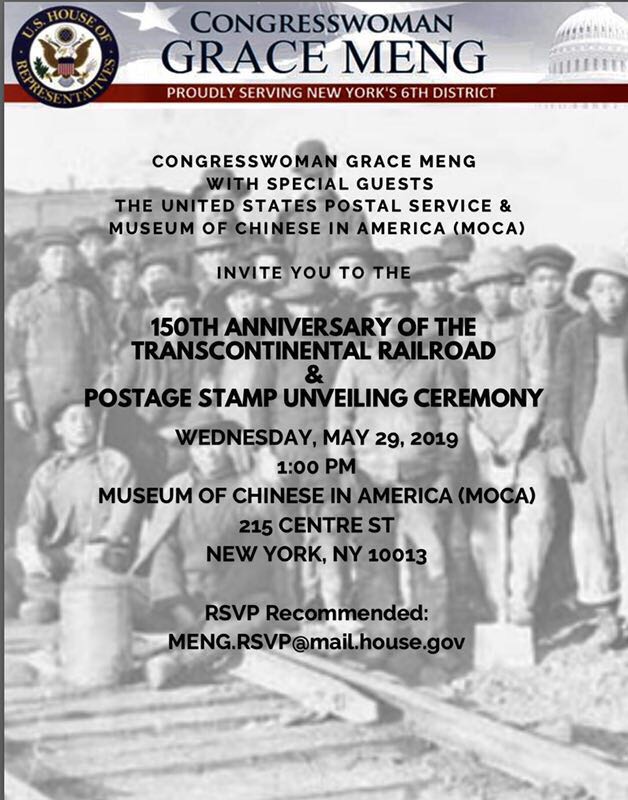
UCA Invited by Rep. Meng to Present House Resolution 165 at Unveiling Ceremony for Post Stamps Commemorating The 150th Anniversary of The Transcontinental Railroad’s Completion

UCA Invited by Rep. Meng to Present House Resolution 165 at

Unveiling Ceremony for Post Stamps Commemorating

The 150th Anniversary of The Transcontinental Railroad’s Completion

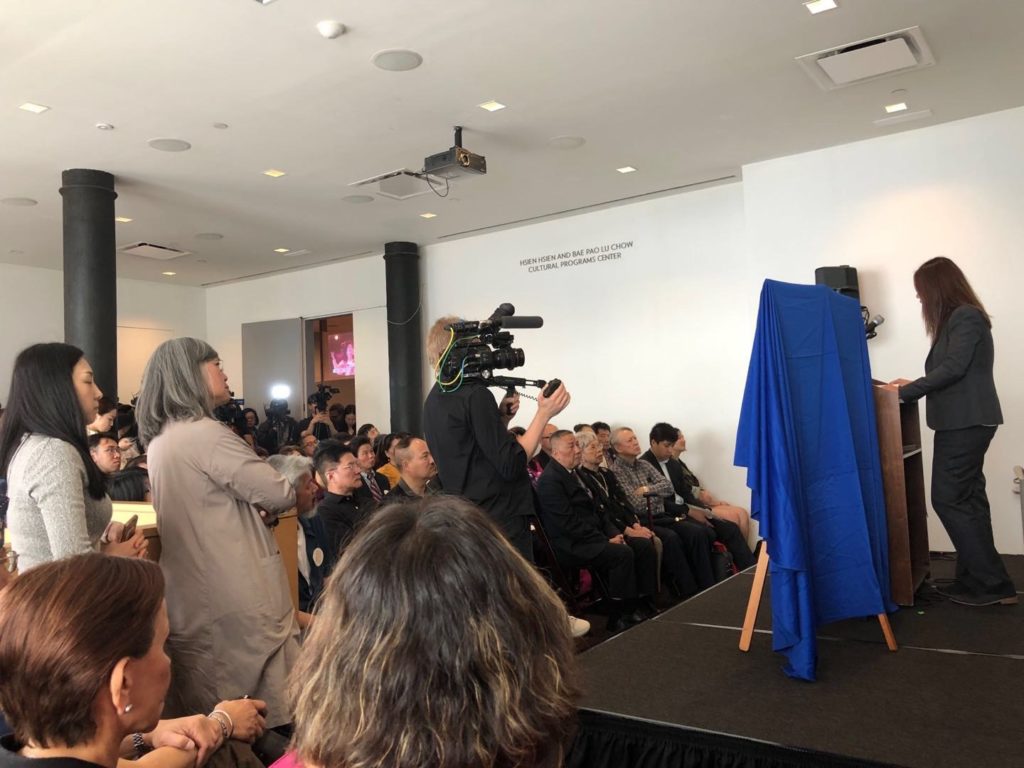
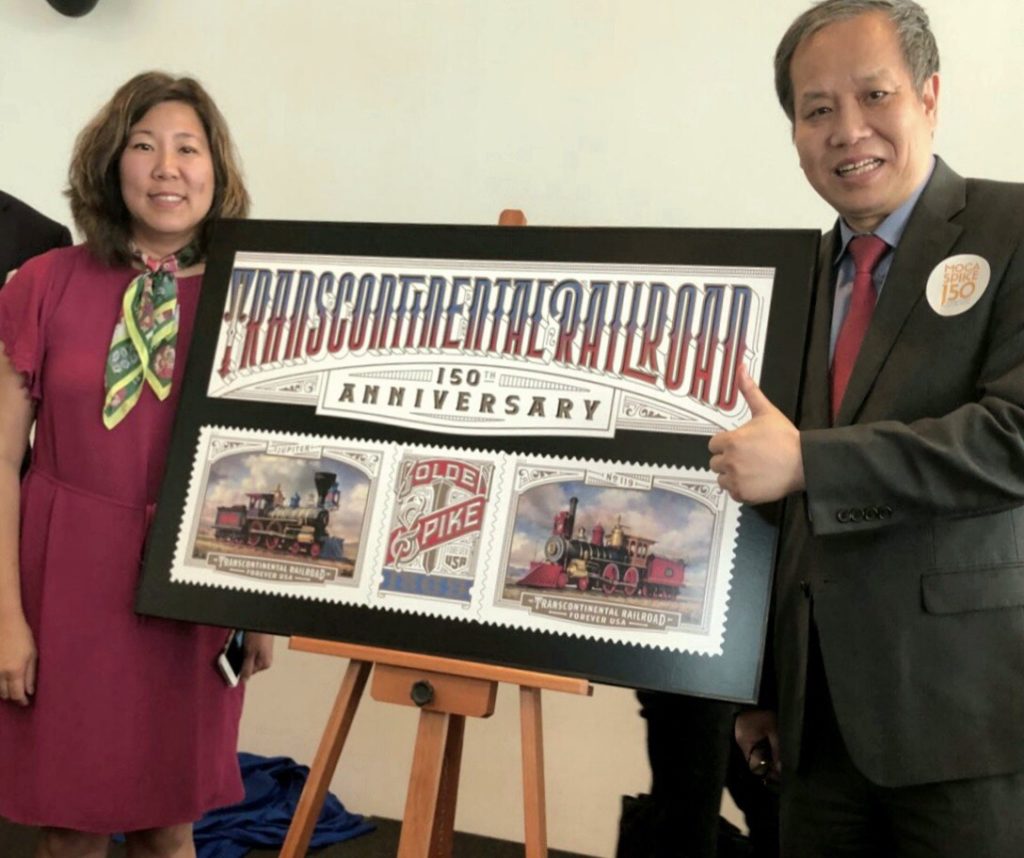
Today, U.S. Rep. Grace Meng, joined by officials from the U.S. Postal Service and the Museum of Chinese in America (MOCA), held an unveiling ceremony at MOCA, Chinatown, New York City, for new postage stamps commemorating the 150th anniversary of the Transcontinental Railroad, and for the contributions that Chinese laborers made in building it. A set of three Transcontinental Railroad Forever Stamps were unveiled during the ceremony.

Between 1865 and 1869, approximately 12,000 Chinese laborers worked under extremely dangerous conditions to help construct the railroad. The Transcontinental Railroad has long been considered one of the most remarkable engineering feats of the 19th century.

Recognizing the work and contribution by United Chinese Americans (UCA) in campaigning for the Congressional resolutions for the anniversary, Congresswoman Meng, who has been a driving force over the years for USPS to issue such stamps, invited Haipei Shue, president of UCA, to the event to read out the commemorative House Resolution 165 (https://www.congress.gov/bill/116th-congress/house-resolution/165) that she introduced recently in US Congress.

http://video.sinovision.net/?id=50366&cid=1&from=singlemessage&isappinstalled=0#10006-weixin-1-52626-6b3bffd01fdde4900130bc5a2751b6d1&sts=1559191454832

One More Major University Speaks Up For Science Community

One More Major University Speaks Up For Science Community

At the urging of UMD Association of Chinese American Professors and Scholars and UCA members in Maryland, President Wallace Loh of University of Maryland at College Park has just issued a strong statement on American universities’ historic mission and the need to keep research and science, including international scholars and students associated with it, as a free, open and inclusive enterprise. The university further expressed its concern for the greater suspicion and scrutiny over Chinese American faculty members, while demanding greater compliance efforts by all stake holders on the campus.

May 30, 2019

Dear University of Maryland community,

Our campus and peer institutions are feeling the effects of growing tensions between the U.S. and China. Chinese, and Chinese-American faculty, students, visitors, and staff are feeling rising unease about their status and sense of belonging in America.

Open and free inquiry, and academic collaborations with universities from around the world are central to our institutional mission. This includes collaborations with institutions in China. The University of Maryland has established many academic exchanges and developed historical bonds of friendship with them. One of the symbols of the normalization of U.S.-China relations some forty years ago took place on our campus in Cole Fieldhouse, the so-called “ping-pong diplomacy” matches between the U.S. and China’s national teams. 

Since then, China has transformed itself into the second largest economy in the world. Amid rising geo-political, economic, and cultural tensions between our countries, there is U.S. concern about China’s multi-faceted efforts at influence-seeking. About a year ago, a senior Federal law enforcement official testified before Congress that persons of Chinese descent represent a “whole of society” threat to America. In academic, scientific, and governmental organizations, they are increasingly subject to generalized suspicion and greater scrutiny.

I write to reaffirm the University of Maryland’s commitment to international collaborations and support for all faculty, students, visiting scholars, and staff on our campus from all countries, including China. American research universities, a landmark of American civilization, have thrived because of our core values of openness, academic freedom, and inclusiveness. Our universities draw talent from all over the world. In the U.S., the majority of PhDs in STEM fields are awarded to international students, many of whom eventually become U.S. residents and citizens.

We must remain true to these core academic values. At the same time, as American institutions, we also need greater awareness and vigilance to confront undue foreign influence, which rises to the level of foreign interference. 

The Association of American Universities and the American Public and Land Grant Universities have identified practices of universities that can help ensure the security of research, protect against intellectual property theft and academic espionage, and prevent foreign infringement on values of free speech and scientific integrity. The American Council of Education has also compiled best practices. 

I have asked our Vice President for Research, Laurie Locascio, to form and lead a campus group to consider implementing these practices on our campus, as appropriate. They may include, for example, expanding campus awareness of foreign interference; enhancing the training of faculty, researchers, and graduate students on foreign export controls and reporting requirements; reviewing foreign gifts and grants; reviewing foreign conflicts of interest; strengthening data security, cybersecurity, and research security; and safeguarding information in foreign travels. 

I urge our campus to stay in touch with Laurie about any individual issues as they arise so that she and her staff can work with you to resolve them.

The U.S.-China bilateral relationship is of global and strategic importance. Today, it is increasingly fraught and competitive. The challenge of U.S. research universities, including the University of Maryland, is to safeguard our academic values and our nation’s legitimate interests. At stake are American leadership in education, research, and innovation in the 21st century and the resilience of our democracy. 

Sincerely,

Wallace D. Loh

President, University of Maryland

At this point, altogether 8 leading American universities have issued such public statement: University of California at Berkeley, Stanford University, Michigan University at Ann Arbor, University of California at Davis, Rice University, University of Delaware, Yale University and University of Maryland at College Park. At UCA, we hope you will help keep this momentum going by contacting leaders of your university asking them to issue similar statements.

UCA Raises Concerns For Chinese American Scientists as Collateral Damage

United Chinese Americans (UCA) Raises Concerns For Chinese American Scientists as Collateral Damage in the Crossfire Between the United States and China Due to Deteriorating Relations

WASHINGTON, D.C. – April 25, 2019.  The United Chinese Americans (UCA), www.ucausa.org, expresses grave concern for Chinese American scientists, who have been made to feel increased scrutiny and increasing suspicion of their loyalties based on their ethnic background.

Last week’s news reports on what is likely the first wave of a crack down targeting primarily Chinese American scientists at MD Anderson Cancer Center in Houston are unsettling, because of the manner in which the investigations were carried out, and the fear they have generated. No scientist has been charged with a federal crime. Yet, reportedly, at least 10 scientists have retired, resigned, been fired or placed on administrative leave, with more parties affected. Fifty-five other NIH-funded institutions are currently carrying out similar investigations in response to U.S. government concerns. UCA is closely monitoring these developments.

More broadly, the sharp deterioration in U.S.-China relations of recent years has endangered academic freedom in American universities and research institutions as well as scientific exchanges between the two countries. At the same time, tighter scrutiny and growing distrust of Chinese Americans have had a profoundly adverse effect on this community, who historically has suffered profoundly from the notorious Chinese Exclusion Act and Red Scare. Once again, Chinese American scientists are caught in the crossfires between the two global powers, becoming collateral damage as a result of the charged atmosphere.

Chinese American scientists, who have made tremendous contribution to America’s scientific progress and technical prowess, are increasingly being questioned, investigated, suspended and even prosecuted. To avoid suspicion or to be able to continue their work, some scholars with Chinese background or ties have been forced to change the direction of their research or the nature of their grant application, or to reduce or end reciprocal scientific collaboration with China.

But the vast majority of Chinese American scientists are law-abiding. Some who have been prosecuted with espionage related charges have turned out to be totally innocent. But to this day, their reputations, careers and lives remain in tatters. In many other cases, people have had multiple felony charges leveled against them but at the end, have been convicted of much lessor offenses, e.g., mishandling of data. Ever since 1996, altogether fewer than 200 defendants—about 31% of them or 58 individuals being Chinese nationals or Chinese Americans—have been charged, not all convicted, under the Economic Espionage Act. Of those, most were motivated by personal financial gains, not economic espionage carried out in collaboration with a foreign power or with the intent to benefit a foreign government.

Let’s be clear: American interests and national security, unquestionably, must be protected. Where a few wrongdoers have acted with intentional malice toward our nation, UCA condemns such behavior in the strongest terms and supports vigorous prosecution of them according to the law.

To address the current situation, UCA makes the following five appeals:

  • We call on the U.S. higher education and scientific communities to continue to uphold and strengthen scientific collaborations around the world so they may continue to benefit all mankind. We salute the University of California at Berkeley, Stanford University, the University of Michigan and the University of California at Davis for their efforts to uphold these principles and ideals as well as for their civil rights concerns for their faculty members and students, and call on more institutions to follow their example.
  • We call on Chinese American scientists to continue to carry on the indispensable role they have played in maintaining America’s lead position in scientific research and global competitiveness. To this end, we fully endorse the strengthening of compliance efforts and ethical standards guiding scientific research and collaboration. We call on Chinese American scientists—indeed all scientists—to adhere strictly to all applicable laws, regulations and practices, and to cooperate in reporting any breaches to appropriate authorities.
  • We call on Chinese American scientists – indeed, all Chinese Americans – to continue to strengthen U.S.-China people-to-people relations through scientific exchanges and educational efforts rather than retreating. An adversarial U.S.-China relationship is harmful to Chinese Americans, to the United States and China, and to the future of the world. Chinese Americans have a unique role to play as communicators, bridge builders and messengers of peace between the two peoples.
  • We call on the Chinese government to earnestly protect U.S. intellectual property rights, as American scientists participate in its talent programs and other exchanges, and vigorously strengthen the standardization and transparency of those programs. The Chinese government should also improve its supervision and management of such programs, including sub-national ones, toughen two-way compliance requirements and enhance training to reduce or eliminate doubts and concerns other countries may have about such programs.
  • Finally, we call on U.S. law enforcement agencies to strengthen internal training and safeguards to reduce implicit bias and discrimination, to enhance communication with Chinese American communities and to ensure that the freedom and civil rights of all Chinese Americans are rigorously protected.

The United Chinese Americans (UCA) stands at the forefront of safeguarding the rights and interests of Chinese Americans. We will continue to conduct legal awareness education in the Chinese American community, to promote dialogue and communication between the Chinese American community and the FBI, the Justice Department and other government agencies so that Chinese American scientists may lead normal, peaceful and productive lives.

UCA is a nonpartisan, nonprofit organization whose members across the nation comprise Chinese American immigrants dedicated to contributing to and participating in the full civic life of American society.

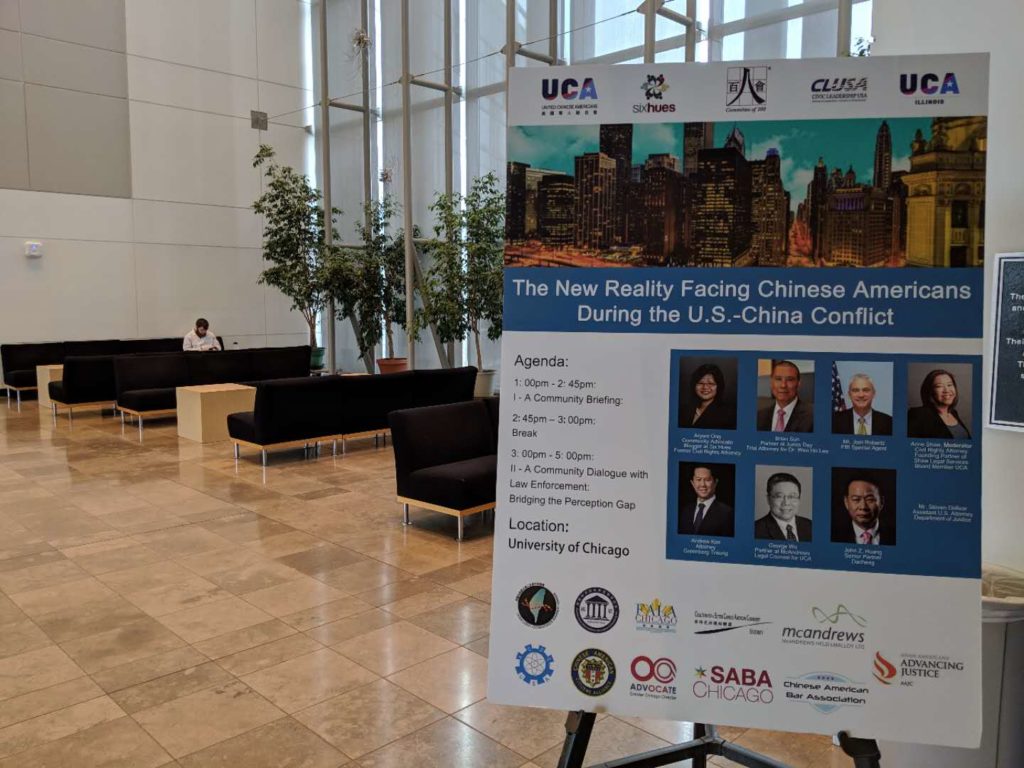
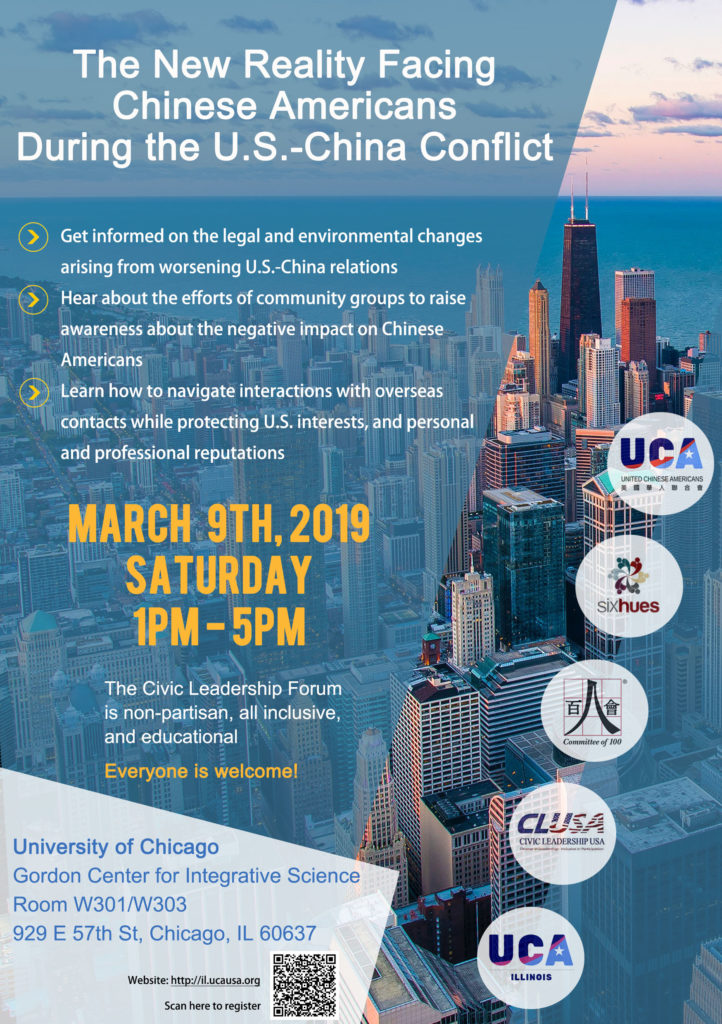
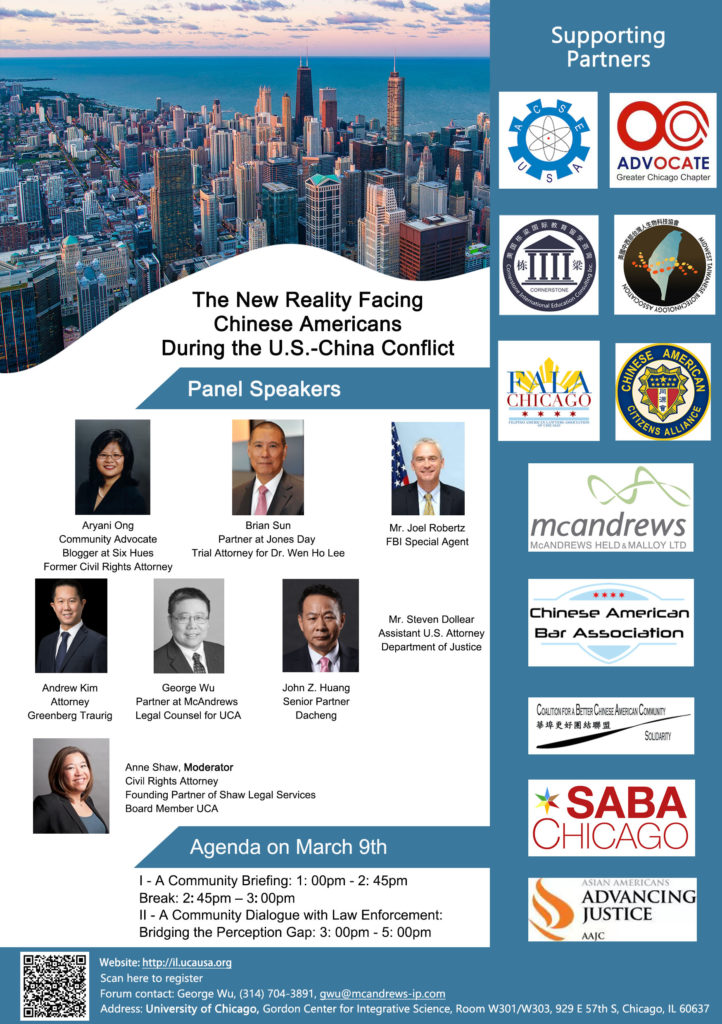
UCA Forum: A New Reality Facing Chinese Americans

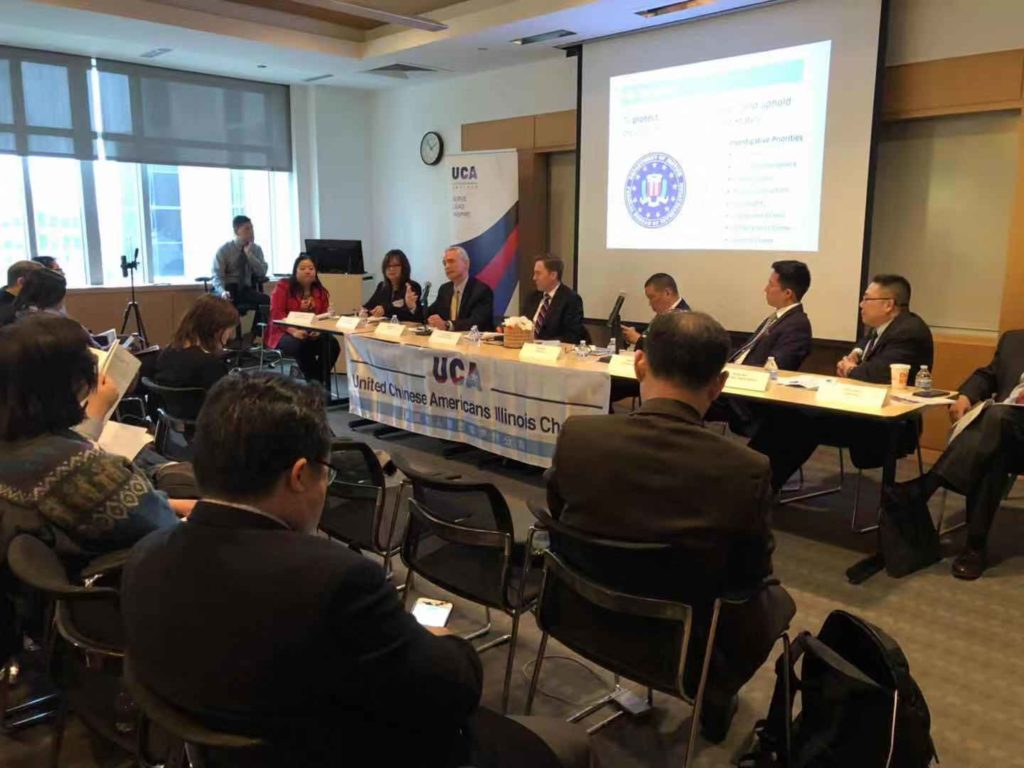
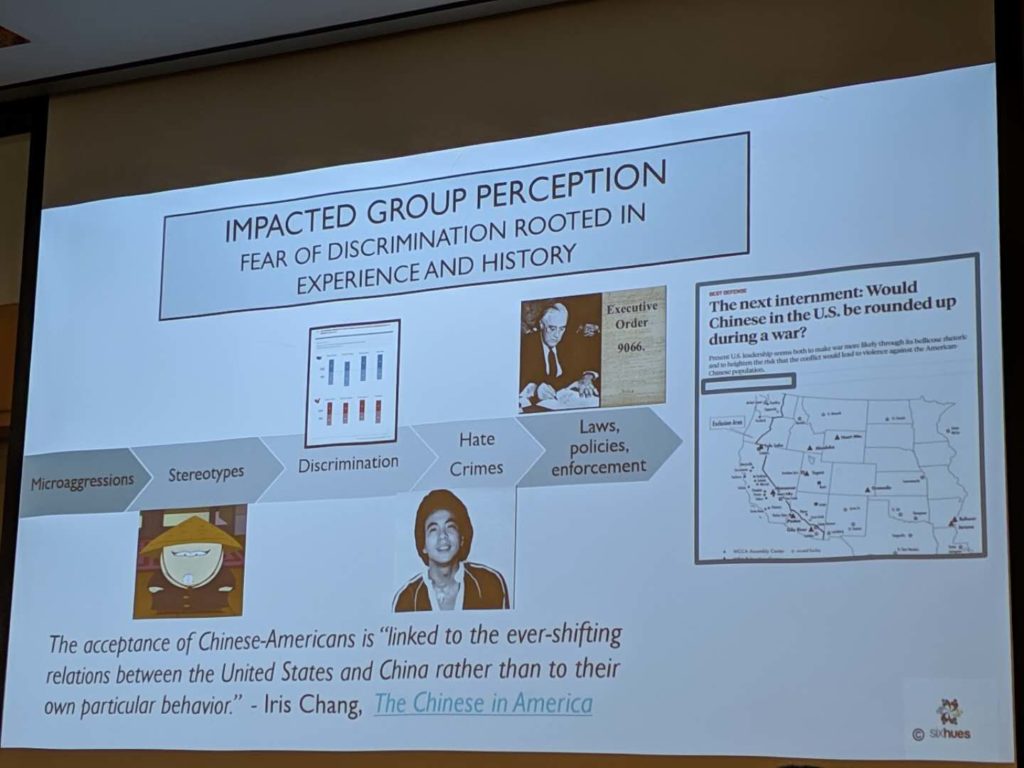
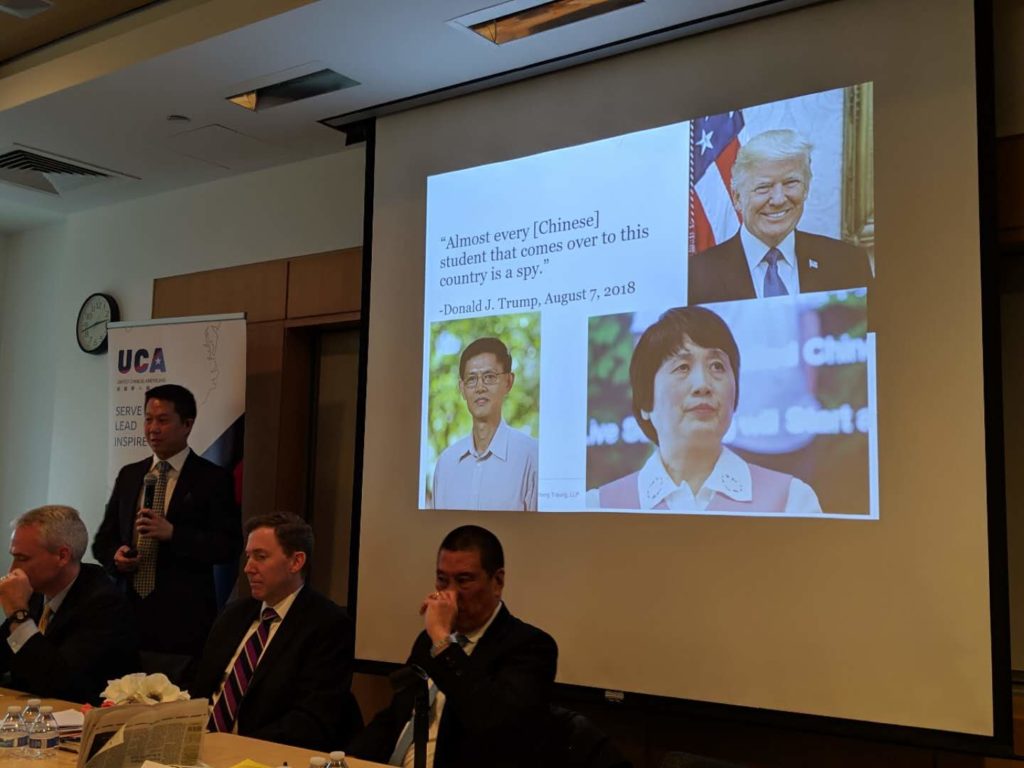
The much-anticipated forum on the new reality facing Chinese Americans during China-US conflicts has successfully wrapped up. UCA/UCA-IL, along with CLUSA, Committee of 100, and SixHues, invited a panel consisting of renowned lawyers, FBI investigator, and activists to bring some crucial messages to the Chinese American community.

Data have shown that Chinese Americans are being a more scrutinized ethnic group under the current administration’s policies. Some policies in China such as the “1000-person Plan”, does not help, especially when there are existing stereotypes against Chinese. And the lack of experience in sensitive business activities as well as dealing with law enforcement has been an issue as well.

Brian Sun, a distinguished trial lawyer in complex business litigation and white collar criminal defense, emphasized on the importance of being transparent and law-abiding. It is a fact that 22% or suspects of espionage cases are Chinese Americans, who count for only 1.8% of population. It is also a fact that many Chinese Americans unintentionally acted inappropriately or even illegally.

Another lawyer, George Wu, specialized in Intellectual Properties, also called for transparency and full compliance with policies. It is critical to take some time to study the company policies. For example, downloading data to USB, or visiting the company intranet from within China via VPN, could raise some serious eyebrows.

However, the good news is that law protects everyone’s rights, including Chinese Americans. John Huang, lawyer in Chicago, assured the audience that there are only about 100 Chinese Americans currently under investigation of espionage. According to the speaker, Chinese students have not been accused of economic espionage. As to immigration, 90% of EB5 applications still come from Chinese ethnic group. It may be noted, however, that Chinese students and scholars faced generalization as a “counterintelligence risk” by FBI director Chris Ray.

One of the highlights in the Q&A session is the theft of business secrets. Any of the following could count as theft and make it hard to defense: make copy of business secret without approval; obtain and transfer non-public confidential information; disclosure of such secret for the purpose of personal, financial gain, etc.

When it comes to investigation, it is important to clarify why FBI wants to talk with you, and understand that you are not obligated to talk with FBI without a lawyer. Wenho Lee and Sherry Chen, two victims of the espionage accusals, both talked with FBI for a long time without the presence of a lawyer. It is reminded that you have the right to be silent.

A detailed report in Chinese has been published via our WeChat public account. Click to read.

Seasons Greetings

festive_christmas_banner.jpg
Dear UCA Family,
As we are approaching the end of memorable 2018 and beginning of an exciting 2019, we want to express our gratitude to our UCA family members and supporters nationwide, who have nurtured and sustained this UCA civic movement in our community.
At this special moment, we vow to renew our commitment and redouble our efforts to serve, lead and inspire our beloved community, making sure that we will continue the community wide civic and spiritual renewal started here at UCA Family!
Christmas is traditionally a season of giving and giving back, a beautiful ritual and virtue that we cherish. We hope you will continue to have UCA in your heart when you plan year-end charitable giving or corporate matching gift. We can dream and achieve so much more together, with your support and care.
This world is and will be a better place because of you! Thank you, the beloved UCA family!
Merry Christmas and Happy New Year!
Warmly,
The UCA Team

UCA San Francisco Event: “How to Talk to Teens so Teens Will Listen”

UCA San Francisco Event: “How to Talk to Teens so Teens Will Listen”


November 4th, 2018.  San Francisco

A successful community workshop, “How to Talk to Teens so Teens Will Listen”, was hosted by UCA Friends in San Francisco on November 3rd in Palo Alto Gunn School, CA. Our invited speakers and moderators, Carl Shan and Brandon Lee are founders of Orenda Academy, a California Bay Area based non-profit organization that provides training to help teens master valuable life skills and achieve a meaningful and successful life. Youth development is one of the important initiatives UCA commits to strengthen in our community.

Here is the link to the video recording of the event.